

2
2
5
6
7
1
1
5
8
7
1
1
–
6
–
7
7
2
1
7
6
6
1
1
5
6
5
(a)
(b)
76
Biomedical Signal and Image Processing
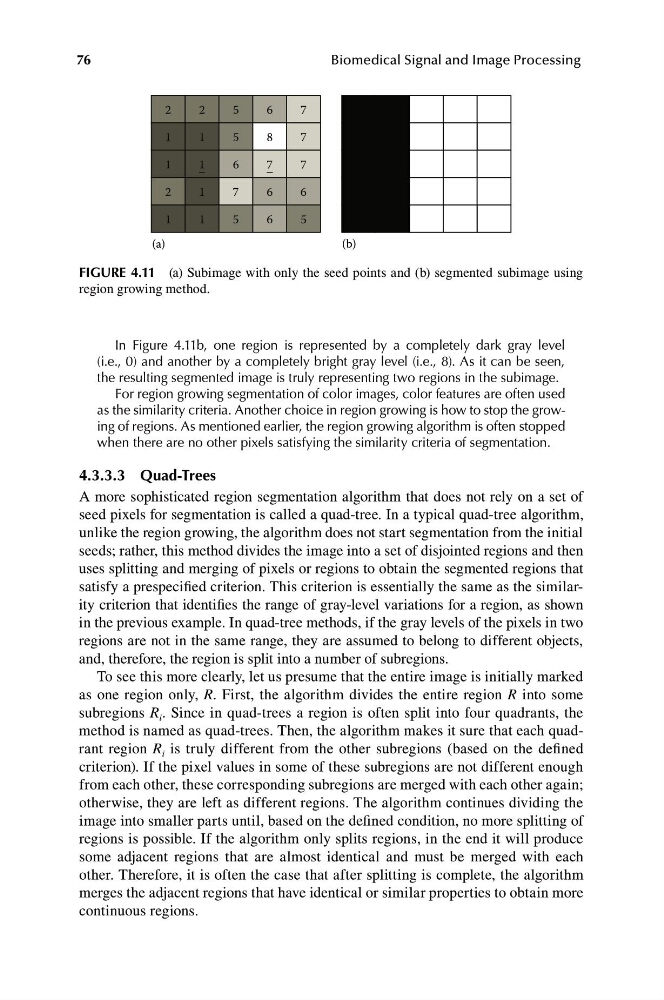
FIGURE 4.11 (a) Subimage with only the seed points and (b) segmented subimage using
region growing method.
In Figure 4.11b, one region is represented by a completely dark gray level
(i.e., 0) and another by a completely bright gray level (i.e., 8). As it can be seen,
the resulting segmented image is truly representing two regions in the subimage.
For region growing segmentation of color images, color features are often used
as the similarity criteria. Another choice in region growing is how to stop the growing of regions. As mentioned earlier, the region growing algorithm is often stopped
when there are no other pixels satisfying the similarity criteria of segmentation.
4.3.3.3 Quad-Trees
A more sophisticated region segmentation algorithm that does not rely on a set of
seed pixels for segmentation is called a quad-tree. In a typical quad-tree algorithm,
unlike the region growing, the algorithm does not start segmentation from the initial
seeds; rather, this method divides the image into a set of disjointed regions and then
uses splitting and merging of pixels or regions to obtain the segmented regions that
satisfy a prespecified criterion. This criterion is essentially the same as the similarity criterion that identifies the range of gray-level variations for a region, as shown
in the previous example. In quad-tree methods, if the gray levels of the pixels in two
regions are not in the same range, they are assumed to belong to different objects,
and, therefore, the region is split into a number of subregions.
To see this more clearly, let us presume that the entire image is initially marked
as one region only, R. First, the algorithm divides the entire region R into some
subregions R i . Since in quad-trees a region is often split into four quadrants, the
method is named as quad-trees. Then, the algorithm makes it sure that each quadrant region R i is truly different from the other subregions (based on the defined
criterion). If the pixel values in some of these subregions are not different enough
from each other, these corresponding subregions are merged with each other again;
otherwise, they are left as different regions. The algorithm continues dividing the
image into smaller parts until, based on the defined condition, no more splitting of
regions is possible. If the algorithm only splits regions, in the end it will produce
some adjacent regions that are almost identical and must be merged with each
other. Therefore, it is often the case that after splitting is complete, the algorithm
merges the adjacent regions that have identical or similar properties to obtain more
continuous regions.