

66
3 Dopaquinone Conversion and Related Reactions
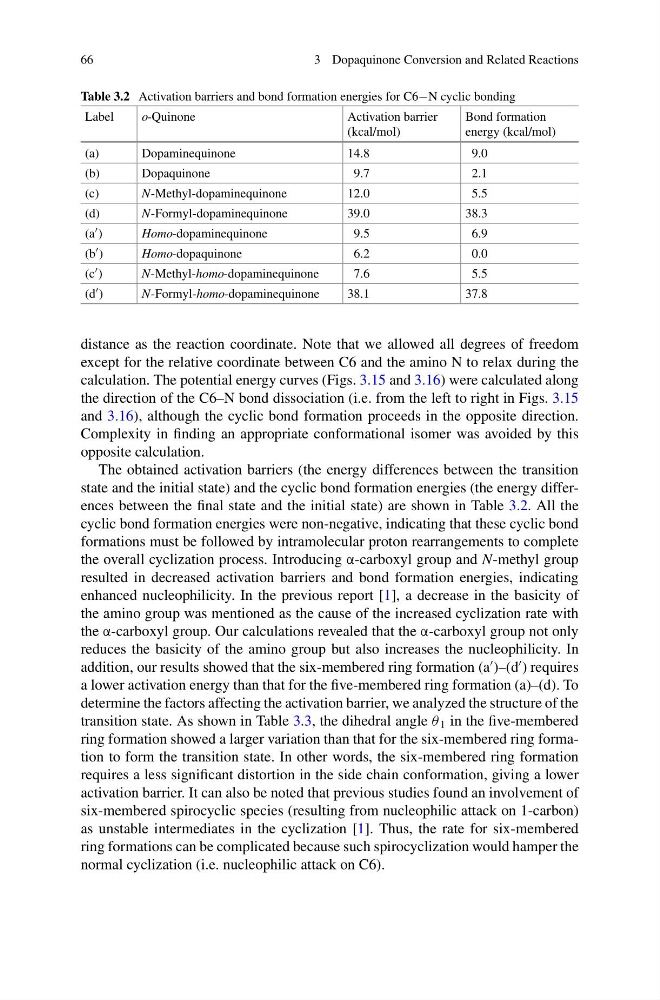
Table 3.2 Activation barriers and bond formation energies for C6−N cyclic bonding
Label
o-Quinone
Activation barrier
(kcal/mol)
Bond formation
energy (kcal/mol)
(a)
Dopaminequinone
14.8
9.0
(b)
Dopaquinone
9.7
2.1
(c)
N-Methyl-dopaminequinone
12.0
5.5
(d)
N-Formyl-dopaminequinone
39.0
38.3
(a )
Homo-dopaminequinone
9.5
6.9
(b )
Homo-dopaquinone
6.2
0.0
(c )
N-Methyl-homo-dopaminequinone
7.6
5.5
(d )
N-Formyl-homo-dopaminequinone
38.1
37.8
distance as the reaction coordinate. Note that we allowed all degrees of freedom
except for the relative coordinate between C6 and the amino N to relax during the
calculation. The potential energy curves (Figs. 3.15 and 3.16) were calculated along
the direction of the C6–N bond dissociation (i.e. from the left to right in Figs. 3.15
and 3.16), although the cyclic bond formation proceeds in the opposite direction.
Complexity in finding an appropriate conformational isomer was avoided by this
opposite calculation.
The obtained activation barriers (the energy differences between the transition
state and the initial state) and the cyclic bond formation energies (the energy differences between the final state and the initial state) are shown in Table 3.2. All the
cyclic bond formation energies were non-negative, indicating that these cyclic bond
formations must be followed by intramolecular proton rearrangements to complete
the overall cyclization process. Introducing α-carboxyl group and N-methyl group
resulted in decreased activation barriers and bond formation energies, indicating
enhanced nucleophilicity. In the previous report [1], a decrease in the basicity of
the amino group was mentioned as the cause of the increased cyclization rate with
the α-carboxyl group. Our calculations revealed that the α-carboxyl group not only
reduces the basicity of the amino group but also increases the nucleophilicity. In
addition, our results showed that the six-membered ring formation (a
)–(d
) requires
a lower activation energy than that for the five-membered ring formation (a)–(d). To
determine the factors affecting the activation barrier, we analyzed the structure of the
transition state. As shown in Table 3.3, the dihedral angle θ 1 in the five-membered
ring formation showed a larger variation than that for the six-membered ring formation to form the transition state. In other words, the six-membered ring formation
requires a less significant distortion in the side chain conformation, giving a lower
activation barrier. It can also be noted that previous studies found an involvement of
six-membered spirocyclic species (resulting from nucleophilic attack on 1-carbon)
as unstable intermediates in the cyclization [1]. Thus, the rate for six-membered
ring formations can be complicated because such spirocyclization would hamper the
normal cyclization (i.e. nucleophilic attack on C6).
3 Dopaquinone Conversion and Related Reactions
Table 3.2 Activation barriers and bond formation energies for C6−N cyclic bonding
Label
o-Quinone
Activation barrier
(kcal/mol)
Bond formation
energy (kcal/mol)
(a)
Dopaminequinone
14.8
9.0
(b)
Dopaquinone
9.7
2.1
(c)
N-Methyl-dopaminequinone
12.0
5.5
(d)
N-Formyl-dopaminequinone
39.0
38.3
(a )
Homo-dopaminequinone
9.5
6.9
(b )
Homo-dopaquinone
6.2
0.0
(c )
N-Methyl-homo-dopaminequinone
7.6
5.5
(d )
N-Formyl-homo-dopaminequinone
38.1
37.8
distance as the reaction coordinate. Note that we allowed all degrees of freedom
except for the relative coordinate between C6 and the amino N to relax during the
calculation. The potential energy curves (Figs. 3.15 and 3.16) were calculated along
the direction of the C6–N bond dissociation (i.e. from the left to right in Figs. 3.15
and 3.16), although the cyclic bond formation proceeds in the opposite direction.
Complexity in finding an appropriate conformational isomer was avoided by this
opposite calculation.
The obtained activation barriers (the energy differences between the transition
state and the initial state) and the cyclic bond formation energies (the energy differences between the final state and the initial state) are shown in Table 3.2. All the
cyclic bond formation energies were non-negative, indicating that these cyclic bond
formations must be followed by intramolecular proton rearrangements to complete
the overall cyclization process. Introducing α-carboxyl group and N-methyl group
resulted in decreased activation barriers and bond formation energies, indicating
enhanced nucleophilicity. In the previous report [1], a decrease in the basicity of
the amino group was mentioned as the cause of the increased cyclization rate with
the α-carboxyl group. Our calculations revealed that the α-carboxyl group not only
reduces the basicity of the amino group but also increases the nucleophilicity. In
addition, our results showed that the six-membered ring formation (a
)–(d
) requires
a lower activation energy than that for the five-membered ring formation (a)–(d). To
determine the factors affecting the activation barrier, we analyzed the structure of the
transition state. As shown in Table 3.3, the dihedral angle θ 1 in the five-membered
ring formation showed a larger variation than that for the six-membered ring formation to form the transition state. In other words, the six-membered ring formation
requires a less significant distortion in the side chain conformation, giving a lower
activation barrier. It can also be noted that previous studies found an involvement of
six-membered spirocyclic species (resulting from nucleophilic attack on 1-carbon)
as unstable intermediates in the cyclization [1]. Thus, the rate for six-membered
ring formations can be complicated because such spirocyclization would hamper the
normal cyclization (i.e. nucleophilic attack on C6).