

38
2 Dopachrome Conversion
dissociating carboxyl group was found several times. “Immediate rotation” here
means an artifactual phenomenon in which the dihedral angle between dopachrome
and the dissociating CO 2 (O=C−C2–C1) suddenly changes by approximately 90°
with 0.05 Å of the bond length increment through the geometrical optimization. To
avoid artifactual underestimation of the activation barrier, the corresponding dihedral
angle was set to be frozen from the point of immediate rotation.
Deprotonation proceeds with the formation of hydronium ion H 3 O
+ . In this
process, water molecule(s) act not only as a dielectric medium but also as a direct
acceptor for the dissociating proton. Therefore, in addition to PCM, we directly put
three H 2 O molecules around the dissociating proton for the calculation of the activation barriers (Fig. 2.2). H 3 O
+ can form hydrogen bonds with three H 2 O molecules at
the maximum. Immediately after the deprotonation, the generated H 3 O
+ is likely to
form two hydrogen bonds with surrounding H 2 O molecules because the hydrogen
that came from dopachrome is not directly facing the H 2 O molecules.
To complete decarboxylation, the negatively charged carboxylate ion must
become electrically neutral. This change in charge state of the carboxyl group gives
significantly different hydrogen bond strength. In order to incorporate this effect in
the calculation, we also put H 2 O molecules around the dissociating carboxyl group.
Specifically, two H 2 O molecules are placed near the carboxyl oxygens (Fig. 2.2).
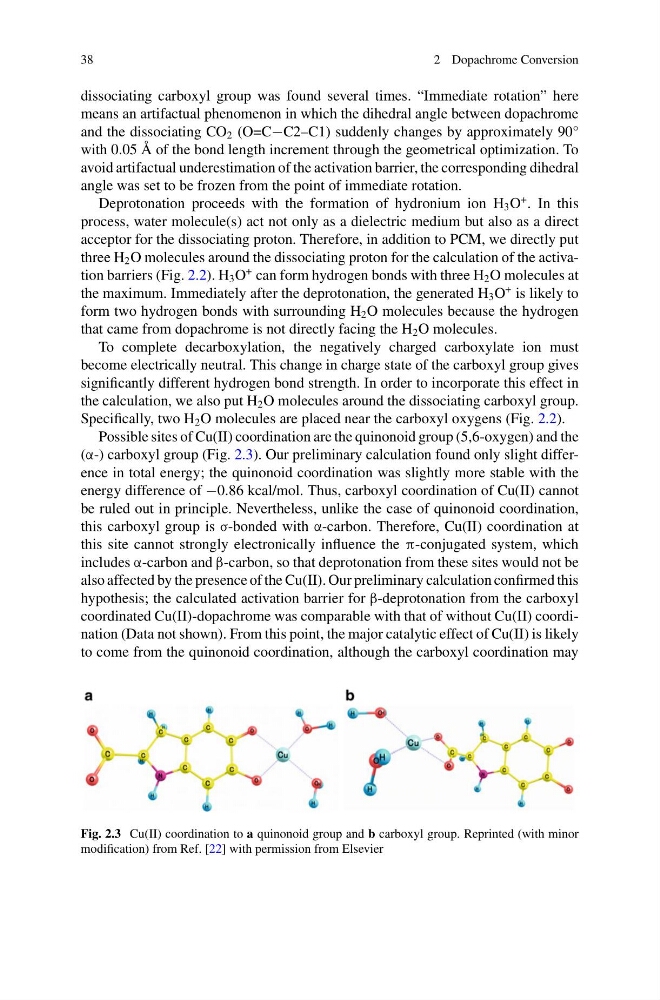
Possible sites of Cu(II) coordination are the quinonoid group (5,6-oxygen) and the
(α-) carboxyl group (Fig. 2.3). Our preliminary calculation found only slight difference in total energy; the quinonoid coordination was slightly more stable with the
energy difference of −0.86 kcal/mol. Thus, carboxyl coordination of Cu(II) cannot
be ruled out in principle. Nevertheless, unlike the case of quinonoid coordination,
this carboxyl group is σ-bonded with α-carbon. Therefore, Cu(II) coordination at
this site cannot strongly electronically influence the π-conjugated system, which
includes α-carbon and β-carbon, so that deprotonation from these sites would not be
also affected by the presence of the Cu(II). Our preliminary calculation confirmed this
hypothesis; the calculated activation barrier for β-deprotonation from the carboxyl
coordinated Cu(II)-dopachrome was comparable with that of without Cu(II) coordination (Data not shown). From this point, the major catalytic effect of Cu(II) is likely
to come from the quinonoid coordination, although the carboxyl coordination may
Fig. 2.3 Cu(II) coordination to a quinonoid group and b carboxyl group. Reprinted (with minor
modification) from Ref. [22] with permission from Elsevier
2 Dopachrome Conversion
dissociating carboxyl group was found several times. “Immediate rotation” here
means an artifactual phenomenon in which the dihedral angle between dopachrome
and the dissociating CO 2 (O=C−C2–C1) suddenly changes by approximately 90°
with 0.05 Å of the bond length increment through the geometrical optimization. To
avoid artifactual underestimation of the activation barrier, the corresponding dihedral
angle was set to be frozen from the point of immediate rotation.
Deprotonation proceeds with the formation of hydronium ion H 3 O
+ . In this
process, water molecule(s) act not only as a dielectric medium but also as a direct
acceptor for the dissociating proton. Therefore, in addition to PCM, we directly put
three H 2 O molecules around the dissociating proton for the calculation of the activation barriers (Fig. 2.2). H 3 O
+ can form hydrogen bonds with three H 2 O molecules at
the maximum. Immediately after the deprotonation, the generated H 3 O
+ is likely to
form two hydrogen bonds with surrounding H 2 O molecules because the hydrogen
that came from dopachrome is not directly facing the H 2 O molecules.
To complete decarboxylation, the negatively charged carboxylate ion must
become electrically neutral. This change in charge state of the carboxyl group gives
significantly different hydrogen bond strength. In order to incorporate this effect in
the calculation, we also put H 2 O molecules around the dissociating carboxyl group.
Specifically, two H 2 O molecules are placed near the carboxyl oxygens (Fig. 2.2).
Possible sites of Cu(II) coordination are the quinonoid group (5,6-oxygen) and the
(α-) carboxyl group (Fig. 2.3). Our preliminary calculation found only slight difference in total energy; the quinonoid coordination was slightly more stable with the
energy difference of −0.86 kcal/mol. Thus, carboxyl coordination of Cu(II) cannot
be ruled out in principle. Nevertheless, unlike the case of quinonoid coordination,
this carboxyl group is σ-bonded with α-carbon. Therefore, Cu(II) coordination at
this site cannot strongly electronically influence the π-conjugated system, which
includes α-carbon and β-carbon, so that deprotonation from these sites would not be
also affected by the presence of the Cu(II). Our preliminary calculation confirmed this
hypothesis; the calculated activation barrier for β-deprotonation from the carboxyl
coordinated Cu(II)-dopachrome was comparable with that of without Cu(II) coordination (Data not shown). From this point, the major catalytic effect of Cu(II) is likely
to come from the quinonoid coordination, although the carboxyl coordination may
Fig. 2.3 Cu(II) coordination to a quinonoid group and b carboxyl group. Reprinted (with minor
modification) from Ref. [22] with permission from Elsevier