

36
2 Dopachrome Conversion
protect the carboxyl group, and then tried to identify possible intermediates during
the conversion [19, 20]. Results show that an intermediate with a quinone methide
structure was identified by HPLC analysis, both in the cases of non-enzymatic and
enzymatic conditions.
2.1.2 Computational Study on Dopachrome Conversion
As reviewed above, progress on the understanding of the chemical nature of
dopachrome conversion has been advancing from the early phase of melanin chemistry study. Especially, the importance of the proton rearrangement processes on
dopachrome conversion was indicated by several studies as influenced by pH and
type of buffer solution. Furthermore, coordinate bond formation between metal ions
and the quinonoid group of dopachrome may play a crucial role in the selective
formation of DHICA.
To understand the conversion mechanism of dopachrome and the catalytic
effects of metal ions, we conducted a density functional theory-based first principles calculation on various molecular structures of prototropic isomers involved in
dopachrome conversion [21, 22]. Here, we investigated Cu(II) as the catalytic factor
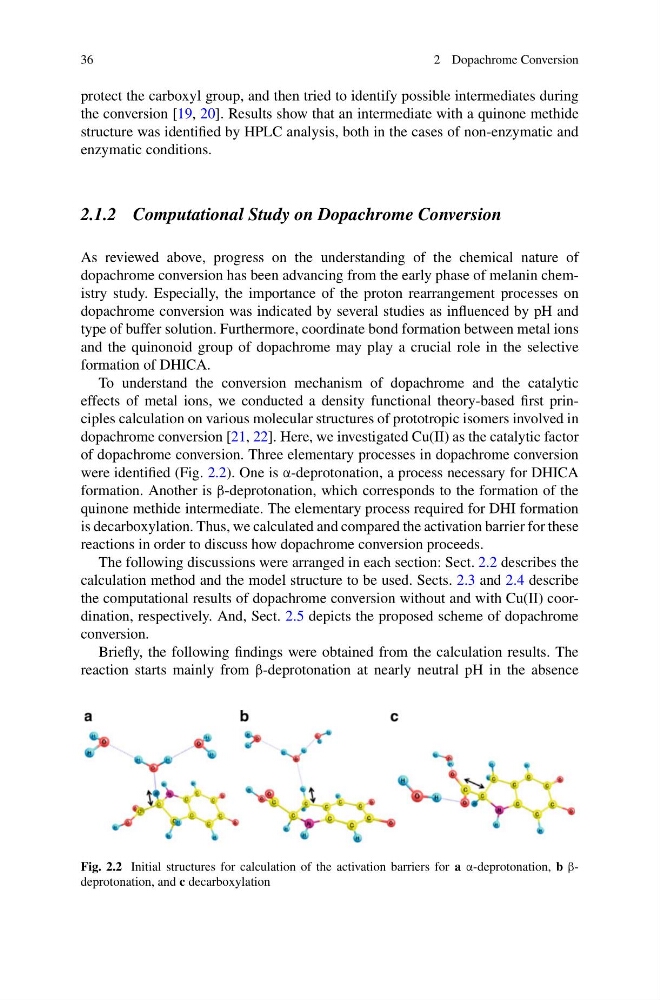
of dopachrome conversion. Three elementary processes in dopachrome conversion
were identified (Fig. 2.2). One is α-deprotonation, a process necessary for DHICA
formation. Another is β-deprotonation, which corresponds to the formation of the
quinone methide intermediate. The elementary process required for DHI formation
is decarboxylation. Thus, we calculated and compared the activation barrier for these
reactions in order to discuss how dopachrome conversion proceeds.
The following discussions were arranged in each section: Sect. 2.2 describes the
calculation method and the model structure to be used. Sects. 2.3 and 2.4 describe
the computational results of dopachrome conversion without and with Cu(II) coordination, respectively. And, Sect. 2.5 depicts the proposed scheme of dopachrome
conversion.
Briefly, the following findings were obtained from the calculation results. The
reaction starts mainly from β-deprotonation at nearly neutral pH in the absence
Fig. 2.2 Initial structures for calculation of the activation barriers for a α-deprotonation, b βdeprotonation, and c decarboxylation
2 Dopachrome Conversion
protect the carboxyl group, and then tried to identify possible intermediates during
the conversion [19, 20]. Results show that an intermediate with a quinone methide
structure was identified by HPLC analysis, both in the cases of non-enzymatic and
enzymatic conditions.
2.1.2 Computational Study on Dopachrome Conversion
As reviewed above, progress on the understanding of the chemical nature of
dopachrome conversion has been advancing from the early phase of melanin chemistry study. Especially, the importance of the proton rearrangement processes on
dopachrome conversion was indicated by several studies as influenced by pH and
type of buffer solution. Furthermore, coordinate bond formation between metal ions
and the quinonoid group of dopachrome may play a crucial role in the selective
formation of DHICA.
To understand the conversion mechanism of dopachrome and the catalytic
effects of metal ions, we conducted a density functional theory-based first principles calculation on various molecular structures of prototropic isomers involved in
dopachrome conversion [21, 22]. Here, we investigated Cu(II) as the catalytic factor
of dopachrome conversion. Three elementary processes in dopachrome conversion
were identified (Fig. 2.2). One is α-deprotonation, a process necessary for DHICA
formation. Another is β-deprotonation, which corresponds to the formation of the
quinone methide intermediate. The elementary process required for DHI formation
is decarboxylation. Thus, we calculated and compared the activation barrier for these
reactions in order to discuss how dopachrome conversion proceeds.
The following discussions were arranged in each section: Sect. 2.2 describes the
calculation method and the model structure to be used. Sects. 2.3 and 2.4 describe
the computational results of dopachrome conversion without and with Cu(II) coordination, respectively. And, Sect. 2.5 depicts the proposed scheme of dopachrome
conversion.
Briefly, the following findings were obtained from the calculation results. The
reaction starts mainly from β-deprotonation at nearly neutral pH in the absence
Fig. 2.2 Initial structures for calculation of the activation barriers for a α-deprotonation, b βdeprotonation, and c decarboxylation