

34
2 Dopachrome Conversion
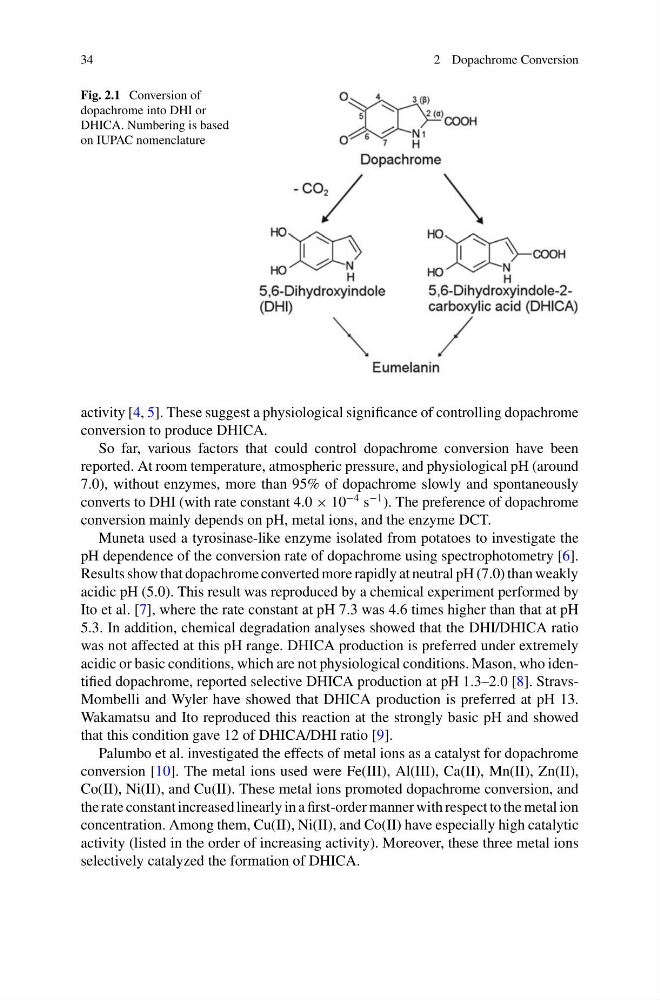
Fig. 2.1 Conversion of
dopachrome into DHI or
DHICA. Numbering is based
on IUPAC nomenclature
activity [4, 5]. These suggest a physiological significance of controlling dopachrome
conversion to produce DHICA.
So far, various factors that could control dopachrome conversion have been
reported. At room temperature, atmospheric pressure, and physiological pH (around
7.0), without enzymes, more than 95% of dopachrome slowly and spontaneously
converts to DHI (with rate constant 4.0 × 10
−4 s
−1 ). The preference of dopachrome
conversion mainly depends on pH, metal ions, and the enzyme DCT.
Muneta used a tyrosinase-like enzyme isolated from potatoes to investigate the
pH dependence of the conversion rate of dopachrome using spectrophotometry [6].
Results show that dopachrome converted more rapidly at neutral pH (7.0) than weakly
acidic pH (5.0). This result was reproduced by a chemical experiment performed by
Ito et al. [7], where the rate constant at pH 7.3 was 4.6 times higher than that at pH
5.3. In addition, chemical degradation analyses showed that the DHI/DHICA ratio
was not affected at this pH range. DHICA production is preferred under extremely
acidic or basic conditions, which are not physiological conditions. Mason, who identified dopachrome, reported selective DHICA production at pH 1.3–2.0 [8]. StravsMombelli and Wyler have showed that DHICA production is preferred at pH 13.
Wakamatsu and Ito reproduced this reaction at the strongly basic pH and showed
that this condition gave 12 of DHICA/DHI ratio [9].
Palumbo et al. investigated the effects of metal ions as a catalyst for dopachrome
conversion [10]. The metal ions used were Fe(III), Al(III), Ca(II), Mn(II), Zn(II),
Co(II), Ni(II), and Cu(II). These metal ions promoted dopachrome conversion, and
the rate constant increased linearly in a first-order manner with respect to the metal ion
concentration. Among them, Cu(II), Ni(II), and Co(II) have especially high catalytic
activity (listed in the order of increasing activity). Moreover, these three metal ions
selectively catalyzed the formation of DHICA.
2 Dopachrome Conversion
Fig. 2.1 Conversion of
dopachrome into DHI or
DHICA. Numbering is based
on IUPAC nomenclature
activity [4, 5]. These suggest a physiological significance of controlling dopachrome
conversion to produce DHICA.
So far, various factors that could control dopachrome conversion have been
reported. At room temperature, atmospheric pressure, and physiological pH (around
7.0), without enzymes, more than 95% of dopachrome slowly and spontaneously
converts to DHI (with rate constant 4.0 × 10
−4 s
−1 ). The preference of dopachrome
conversion mainly depends on pH, metal ions, and the enzyme DCT.
Muneta used a tyrosinase-like enzyme isolated from potatoes to investigate the
pH dependence of the conversion rate of dopachrome using spectrophotometry [6].
Results show that dopachrome converted more rapidly at neutral pH (7.0) than weakly
acidic pH (5.0). This result was reproduced by a chemical experiment performed by
Ito et al. [7], where the rate constant at pH 7.3 was 4.6 times higher than that at pH
5.3. In addition, chemical degradation analyses showed that the DHI/DHICA ratio
was not affected at this pH range. DHICA production is preferred under extremely
acidic or basic conditions, which are not physiological conditions. Mason, who identified dopachrome, reported selective DHICA production at pH 1.3–2.0 [8]. StravsMombelli and Wyler have showed that DHICA production is preferred at pH 13.
Wakamatsu and Ito reproduced this reaction at the strongly basic pH and showed
that this condition gave 12 of DHICA/DHI ratio [9].
Palumbo et al. investigated the effects of metal ions as a catalyst for dopachrome
conversion [10]. The metal ions used were Fe(III), Al(III), Ca(II), Mn(II), Zn(II),
Co(II), Ni(II), and Cu(II). These metal ions promoted dopachrome conversion, and
the rate constant increased linearly in a first-order manner with respect to the metal ion
concentration. Among them, Cu(II), Ni(II), and Co(II) have especially high catalytic
activity (listed in the order of increasing activity). Moreover, these three metal ions
selectively catalyzed the formation of DHICA.