

Prior to aquaculture systems going offshore, they were analyzed through
numerical and physical scale modeling at the Jere Chase Ocean Engineering lab on
campus. These tools help identify strengths and weaknesses of components, simulate
failure scenarios and help determine safety factors before they deployed and field
tested (Fredriksson et al. 2004; Swift et al. 1998; Tsukrov et al. 2000). The backbone
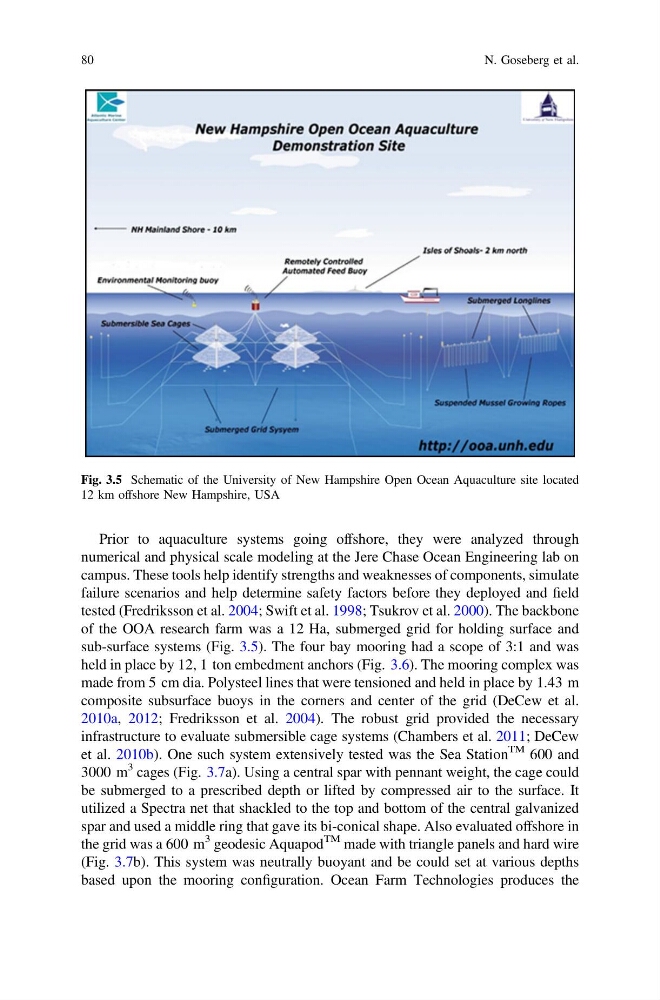
of the OOA research farm was a 12 Ha, submerged grid for holding surface and
sub-surface systems (Fig. 3.5). The four bay mooring had a scope of 3:1 and was
held in place by 12, 1 ton embedment anchors (Fig. 3.6). The mooring complex was
made from 5 cm dia. Polysteel lines that were tensioned and held in place by 1.43 m
composite subsurface buoys in the corners and center of the grid (DeCew et al.
2010a, 2012; Fredriksson et al. 2004). The robust grid provided the necessary
infrastructure to evaluate submersible cage systems (Chambers et al. 2011; DeCew
et al. 2010b). One such system extensively tested was the Sea Station
TM 600 and
3000 m
3 cages (Fig. 3.7a). Using a central spar with pennant weight, the cage could
be submerged to a prescribed depth or lifted by compressed air to the surface. It
utilized a Spectra net that shackled to the top and bottom of the central galvanized
spar and used a middle ring that gave its bi-conical shape. Also evaluated offshore in
the grid was a 600 m
3 geodesic Aquapod
TM made with triangle panels and hard wire
(Fig. 3.7b). This system was neutrally buoyant and be could set at various depths
based upon the mooring configuration. Ocean Farm Technologies produces the
Fig. 3.5 Schematic of the University of New Hampshire Open Ocean Aquaculture site located
12 km offshore New Hampshire, USA
80
N. Goseberg et al.
numerical and physical scale modeling at the Jere Chase Ocean Engineering lab on
campus. These tools help identify strengths and weaknesses of components, simulate
failure scenarios and help determine safety factors before they deployed and field
tested (Fredriksson et al. 2004; Swift et al. 1998; Tsukrov et al. 2000). The backbone
of the OOA research farm was a 12 Ha, submerged grid for holding surface and
sub-surface systems (Fig. 3.5). The four bay mooring had a scope of 3:1 and was
held in place by 12, 1 ton embedment anchors (Fig. 3.6). The mooring complex was
made from 5 cm dia. Polysteel lines that were tensioned and held in place by 1.43 m
composite subsurface buoys in the corners and center of the grid (DeCew et al.
2010a, 2012; Fredriksson et al. 2004). The robust grid provided the necessary
infrastructure to evaluate submersible cage systems (Chambers et al. 2011; DeCew
et al. 2010b). One such system extensively tested was the Sea Station
TM 600 and
3000 m
3 cages (Fig. 3.7a). Using a central spar with pennant weight, the cage could
be submerged to a prescribed depth or lifted by compressed air to the surface. It
utilized a Spectra net that shackled to the top and bottom of the central galvanized
spar and used a middle ring that gave its bi-conical shape. Also evaluated offshore in
the grid was a 600 m
3 geodesic Aquapod
TM made with triangle panels and hard wire
(Fig. 3.7b). This system was neutrally buoyant and be could set at various depths
based upon the mooring configuration. Ocean Farm Technologies produces the
Fig. 3.5 Schematic of the University of New Hampshire Open Ocean Aquaculture site located
12 km offshore New Hampshire, USA
80
N. Goseberg et al.