

In early 2014, a new Marine Spatial Plan (MSP) was introduced that outlines
which activities can take place where and under which conditions. The plan is valid
for a period of 6 years until 2020, after which modifications can be introduced.
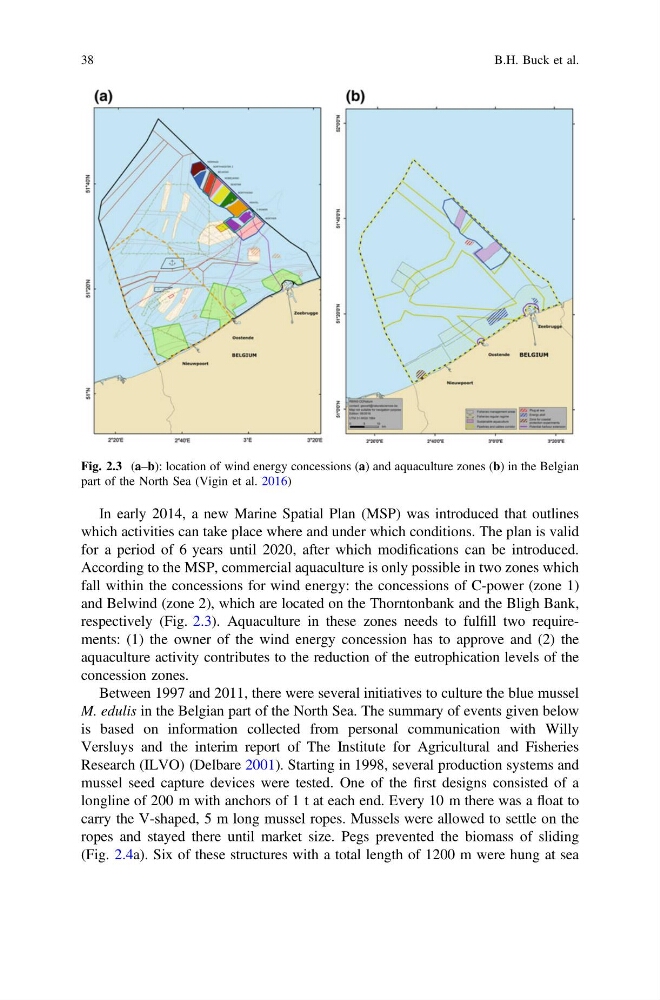
According to the MSP, commercial aquaculture is only possible in two zones which
fall within the concessions for wind energy: the concessions of C-power (zone 1)
and Belwind (zone 2), which are located on the Thorntonbank and the Bligh Bank,
respectively (Fig. 2.3). Aquaculture in these zones needs to fulfill two requirements: (1) the owner of the wind energy concession has to approve and (2) the
aquaculture activity contributes to the reduction of the eutrophication levels of the
concession zones.
Between 1997 and 2011, there were several initiatives to culture the blue mussel
M. edulis in the Belgian part of the North Sea. The summary of events given below
is based on information collected from personal communication with Willy
Versluys and the interim report of The Institute for Agricultural and Fisheries
Research (ILVO) (Delbare 2001). Starting in 1998, several production systems and
mussel seed capture devices were tested. One of the first designs consisted of a
longline of 200 m with anchors of 1 t at each end. Every 10 m there was a float to
carry the V-shaped, 5 m long mussel ropes. Mussels were allowed to settle on the
ropes and stayed there until market size. Pegs prevented the biomass of sliding
(Fig. 2.4a). Six of these structures with a total length of 1200 m were hung at sea
Fig. 2.3 (a–b): location of wind energy concessions (a) and aquaculture zones (b) in the Belgian
part of the North Sea (Vigin et al. 2016)
38
B.H. Buck et al.
which activities can take place where and under which conditions. The plan is valid
for a period of 6 years until 2020, after which modifications can be introduced.
According to the MSP, commercial aquaculture is only possible in two zones which
fall within the concessions for wind energy: the concessions of C-power (zone 1)
and Belwind (zone 2), which are located on the Thorntonbank and the Bligh Bank,
respectively (Fig. 2.3). Aquaculture in these zones needs to fulfill two requirements: (1) the owner of the wind energy concession has to approve and (2) the
aquaculture activity contributes to the reduction of the eutrophication levels of the
concession zones.
Between 1997 and 2011, there were several initiatives to culture the blue mussel
M. edulis in the Belgian part of the North Sea. The summary of events given below
is based on information collected from personal communication with Willy
Versluys and the interim report of The Institute for Agricultural and Fisheries
Research (ILVO) (Delbare 2001). Starting in 1998, several production systems and
mussel seed capture devices were tested. One of the first designs consisted of a
longline of 200 m with anchors of 1 t at each end. Every 10 m there was a float to
carry the V-shaped, 5 m long mussel ropes. Mussels were allowed to settle on the
ropes and stayed there until market size. Pegs prevented the biomass of sliding
(Fig. 2.4a). Six of these structures with a total length of 1200 m were hung at sea
Fig. 2.3 (a–b): location of wind energy concessions (a) and aquaculture zones (b) in the Belgian
part of the North Sea (Vigin et al. 2016)
38
B.H. Buck et al.