

2.6.1 Germany
Germany is one of the leading countries in offshore seaweed science with first trials
of moving seaweed operations offshore in the early 1990s. Therefore, the developments conducted in Germany are discussed in detail in another chapter (Chap. 11
“The German Case Study” within this book) while here, we only provide a short
summary.
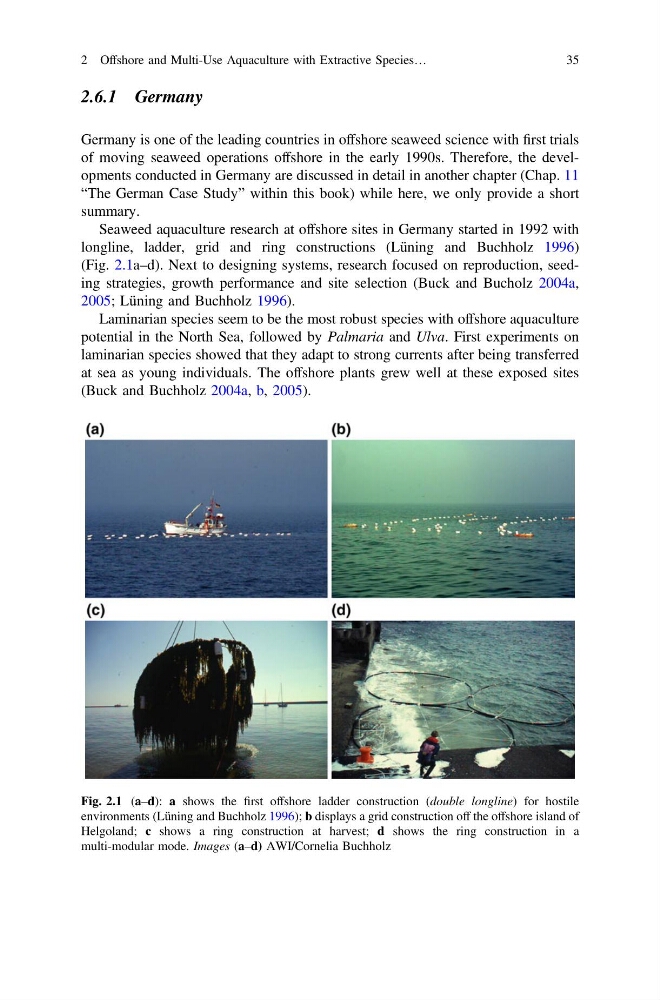
Seaweed aquaculture research at offshore sites in Germany started in 1992 with
longline, ladder, grid and ring constructions (Lüning and Buchholz 1996)
(Fig. 2.1a–d). Next to designing systems, research focused on reproduction, seeding strategies, growth performance and site selection (Buck and Bucholz 2004a,
2005; Lüning and Buchholz 1996).
Laminarian species seem to be the most robust species with offshore aquaculture
potential in the North Sea, followed by Palmaria and Ulva. First experiments on
laminarian species showed that they adapt to strong currents after being transferred
at sea as young individuals. The offshore plants grew well at these exposed sites
(Buck and Buchholz 2004a, b, 2005).
Fig. 2.1 (a–d): a shows the first offshore ladder construction (double longline) for hostile
environments (Lüning and Buchholz 1996); b displays a grid construction off the offshore island of
Helgoland; c shows a ring construction at harvest; d shows the ring construction in a
multi-modular mode. Images (a–d) AWI/Cornelia Buchholz
2 Offshore and Multi-Use Aquaculture with Extractive Species…
35
Germany is one of the leading countries in offshore seaweed science with first trials
of moving seaweed operations offshore in the early 1990s. Therefore, the developments conducted in Germany are discussed in detail in another chapter (Chap. 11
“The German Case Study” within this book) while here, we only provide a short
summary.
Seaweed aquaculture research at offshore sites in Germany started in 1992 with
longline, ladder, grid and ring constructions (Lüning and Buchholz 1996)
(Fig. 2.1a–d). Next to designing systems, research focused on reproduction, seeding strategies, growth performance and site selection (Buck and Bucholz 2004a,
2005; Lüning and Buchholz 1996).
Laminarian species seem to be the most robust species with offshore aquaculture
potential in the North Sea, followed by Palmaria and Ulva. First experiments on
laminarian species showed that they adapt to strong currents after being transferred
at sea as young individuals. The offshore plants grew well at these exposed sites
(Buck and Buchholz 2004a, b, 2005).
Fig. 2.1 (a–d): a shows the first offshore ladder construction (double longline) for hostile
environments (Lüning and Buchholz 1996); b displays a grid construction off the offshore island of
Helgoland; c shows a ring construction at harvest; d shows the ring construction in a
multi-modular mode. Images (a–d) AWI/Cornelia Buchholz
2 Offshore and Multi-Use Aquaculture with Extractive Species…
35