

(FAO 2009). The world’s oceans cover over 70% of the earth’s surface and provide
a large area to situate aquaculture operations that produce marine fish, shellfish, and
plants. Currently, the ocean is underutilized as a location for protein production
with 5% of the global protein supply (Oceanworld 2014) and a mere 2% of the total
human calorie intake (UNEP 2012) acquired from this biome. Demand for food
combined with a shortage of new arable land will require the global population to
attempt to maximize production from the world’s oceans. Potable freshwater and its
distribution and use in the future is another critical reason to utilize the marine
environment for aquaculture (Famiglietti 2014). All living organisms must have
freshwater to live, including humans. The efficiency of rearing a million tons of
protein in the marine environment when compared to producing the same amount
of terrestrial protein becomes evident when the freshwater demand is considered.
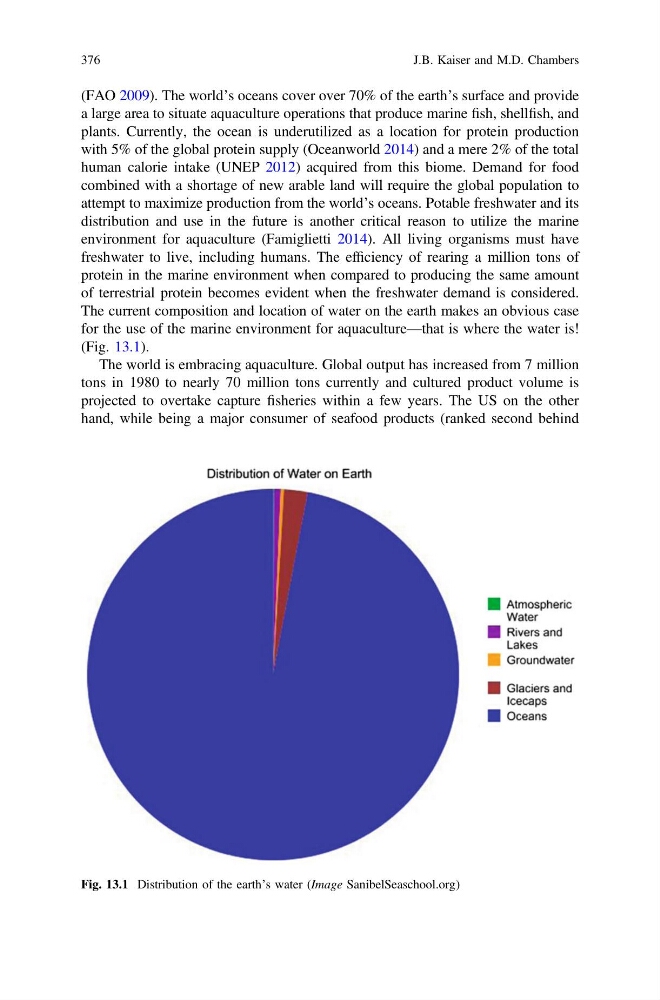
The current composition and location of water on the earth makes an obvious case
for the use of the marine environment for aquaculture—that is where the water is!
(Fig. 13.1).
The world is embracing aquaculture. Global output has increased from 7 million
tons in 1980 to nearly 70 million tons currently and cultured product volume is
projected to overtake capture fisheries within a few years. The US on the other
hand, while being a major consumer of seafood products (ranked second behind
Fig. 13.1 Distribution of the earth’s water (Image SanibelSeaschool.org)
376
J.B. Kaiser and M.D. Chambers
a large area to situate aquaculture operations that produce marine fish, shellfish, and
plants. Currently, the ocean is underutilized as a location for protein production
with 5% of the global protein supply (Oceanworld 2014) and a mere 2% of the total
human calorie intake (UNEP 2012) acquired from this biome. Demand for food
combined with a shortage of new arable land will require the global population to
attempt to maximize production from the world’s oceans. Potable freshwater and its
distribution and use in the future is another critical reason to utilize the marine
environment for aquaculture (Famiglietti 2014). All living organisms must have
freshwater to live, including humans. The efficiency of rearing a million tons of
protein in the marine environment when compared to producing the same amount
of terrestrial protein becomes evident when the freshwater demand is considered.
The current composition and location of water on the earth makes an obvious case
for the use of the marine environment for aquaculture—that is where the water is!
(Fig. 13.1).
The world is embracing aquaculture. Global output has increased from 7 million
tons in 1980 to nearly 70 million tons currently and cultured product volume is
projected to overtake capture fisheries within a few years. The US on the other
hand, while being a major consumer of seafood products (ranked second behind
Fig. 13.1 Distribution of the earth’s water (Image SanibelSeaschool.org)
376
J.B. Kaiser and M.D. Chambers