

The conceptual design of the TROPOS platform involves a central unit associated with modules and satellites (TROPOS 2013b, 2015). This floating central
unit can be moored to the seafloor and builds the core of the platform. The lower
part of the central unit is equipped with a double hull to prevent oil spills. Modules
with different functions can be directly attached to the central unit, and/or satellite
units can be indirectly connected (via undersea cables), each according to
requirements. Satellite units are fixed with their own mooring.
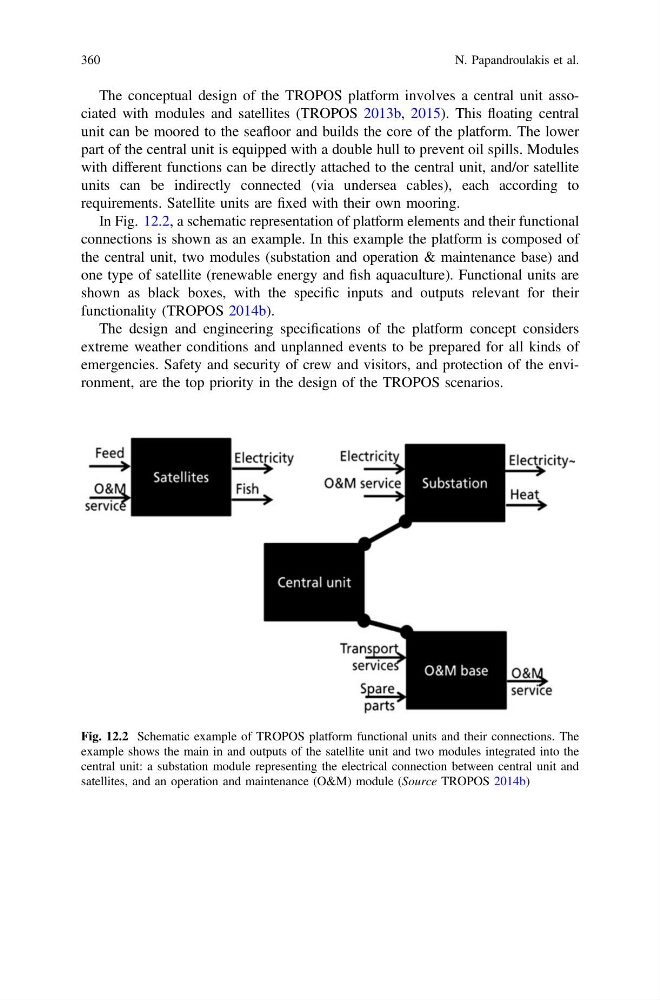
In Fig. 12.2, a schematic representation of platform elements and their functional
connections is shown as an example. In this example the platform is composed of
the central unit, two modules (substation and operation & maintenance base) and
one type of satellite (renewable energy and fish aquaculture). Functional units are
shown as black boxes, with the specific inputs and outputs relevant for their
functionality (TROPOS 2014b).
The design and engineering specifications of the platform concept considers
extreme weather conditions and unplanned events to be prepared for all kinds of
emergencies. Safety and security of crew and visitors, and protection of the environment, are the top priority in the design of the TROPOS scenarios.
Fig. 12.2 Schematic example of TROPOS platform functional units and their connections. The
example shows the main in and outputs of the satellite unit and two modules integrated into the
central unit: a substation module representing the electrical connection between central unit and
satellites, and an operation and maintenance (O&M) module (Source TROPOS 2014b)
360
N. Papandroulakis et al.
unit can be moored to the seafloor and builds the core of the platform. The lower
part of the central unit is equipped with a double hull to prevent oil spills. Modules
with different functions can be directly attached to the central unit, and/or satellite
units can be indirectly connected (via undersea cables), each according to
requirements. Satellite units are fixed with their own mooring.
In Fig. 12.2, a schematic representation of platform elements and their functional
connections is shown as an example. In this example the platform is composed of
the central unit, two modules (substation and operation & maintenance base) and
one type of satellite (renewable energy and fish aquaculture). Functional units are
shown as black boxes, with the specific inputs and outputs relevant for their
functionality (TROPOS 2014b).
The design and engineering specifications of the platform concept considers
extreme weather conditions and unplanned events to be prepared for all kinds of
emergencies. Safety and security of crew and visitors, and protection of the environment, are the top priority in the design of the TROPOS scenarios.
Fig. 12.2 Schematic example of TROPOS platform functional units and their connections. The
example shows the main in and outputs of the satellite unit and two modules integrated into the
central unit: a substation module representing the electrical connection between central unit and
satellites, and an operation and maintenance (O&M) module (Source TROPOS 2014b)
360
N. Papandroulakis et al.