

approach allows for the integration of a range of functions from different sectors. In
the case of TROPOS, functions of four different sectors were integrated, namely
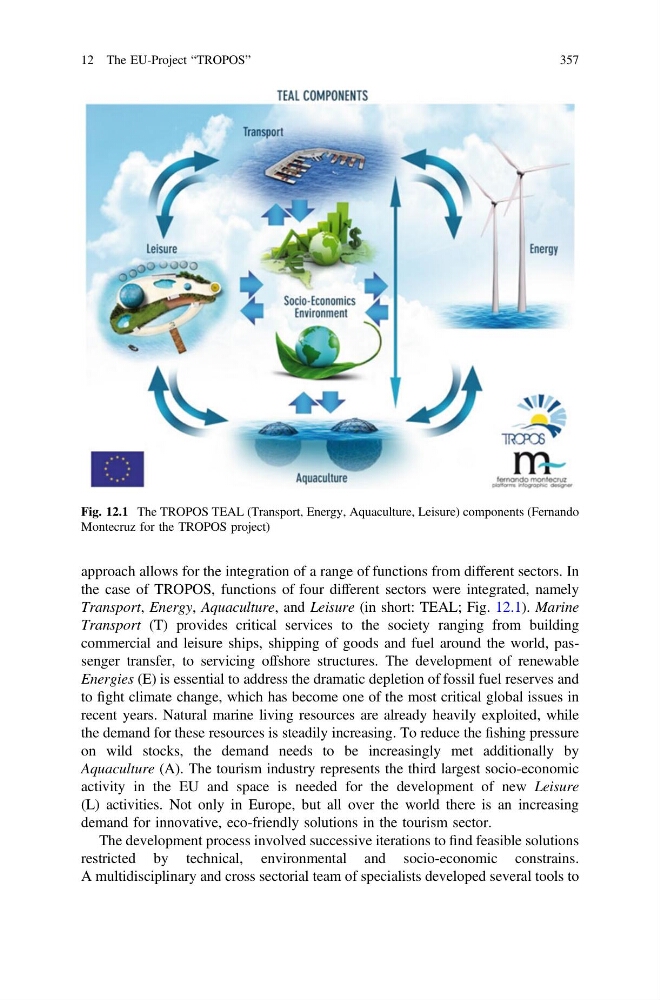
Transport, Energy, Aquaculture, and Leisure (in short: TEAL; Fig. 12.1). Marine
Transport (T) provides critical services to the society ranging from building
commercial and leisure ships, shipping of goods and fuel around the world, passenger transfer, to servicing offshore structures. The development of renewable
Energies (E) is essential to address the dramatic depletion of fossil fuel reserves and
to fight climate change, which has become one of the most critical global issues in
recent years. Natural marine living resources are already heavily exploited, while
the demand for these resources is steadily increasing. To reduce the fishing pressure
on wild stocks, the demand needs to be increasingly met additionally by
Aquaculture (A). The tourism industry represents the third largest socio-economic
activity in the EU and space is needed for the development of new Leisure
(L) activities. Not only in Europe, but all over the world there is an increasing
demand for innovative, eco-friendly solutions in the tourism sector.
The development process involved successive iterations to find feasible solutions
restricted by technical, environmental and socio-economic constrains.
A multidisciplinary and cross sectorial team of specialists developed several tools to
Fig. 12.1 The TROPOS TEAL (Transport, Energy, Aquaculture, Leisure) components (Fernando
Montecruz for the TROPOS project)
12 The EU-Project “TROPOS”
357
the case of TROPOS, functions of four different sectors were integrated, namely
Transport, Energy, Aquaculture, and Leisure (in short: TEAL; Fig. 12.1). Marine
Transport (T) provides critical services to the society ranging from building
commercial and leisure ships, shipping of goods and fuel around the world, passenger transfer, to servicing offshore structures. The development of renewable
Energies (E) is essential to address the dramatic depletion of fossil fuel reserves and
to fight climate change, which has become one of the most critical global issues in
recent years. Natural marine living resources are already heavily exploited, while
the demand for these resources is steadily increasing. To reduce the fishing pressure
on wild stocks, the demand needs to be increasingly met additionally by
Aquaculture (A). The tourism industry represents the third largest socio-economic
activity in the EU and space is needed for the development of new Leisure
(L) activities. Not only in Europe, but all over the world there is an increasing
demand for innovative, eco-friendly solutions in the tourism sector.
The development process involved successive iterations to find feasible solutions
restricted by technical, environmental and socio-economic constrains.
A multidisciplinary and cross sectorial team of specialists developed several tools to
Fig. 12.1 The TROPOS TEAL (Transport, Energy, Aquaculture, Leisure) components (Fernando
Montecruz for the TROPOS project)
12 The EU-Project “TROPOS”
357