

The drag coefficient C D of the artificial test body as well as the fully grown
mussel collector was calculated at velocities of 0.5, 1.0, 1.5, 2.0, and 2.5 m s
−1 to
range between 0.2 and 1.15. The graphs for moth collector types show a pronounced bend at a velocity of 1 m s
−1 . This appears to approximately mark the
minimum speed required for orientation of the collectors within the water column
into the downstream direction. At higher velocities ! 1.5 m s
−1 , C D was almost a
constant.
11.4.1.3 Mussel Longlines: Attachment to Foundations
The development and the conceptual design of offshore foundation structures are
complex and require an interdisciplinary approach. One of the most important
questions pertains whether it is technically possible and economic feasible to use
offshore foundation structures as fixation device for aquaculture operations, such as
a longline construction as one possible culture design. Therefore, wind energy
converters in offshore sites do need an exact description of the loading on the plant.
In general, these loads are caused and influenced by the environmental conditions
such as wind, wave, currents and the soil properties (GL 2005). From the engineers
point of view it is indispensable to have an estimation of the additional loadings
caused by attached longline constructions.
In Project No. 6 “AquaLast” supplemental loads on the support structures of
offshore wind energy converters (OWEC) caused by attached longlines were
investigated. Several alternative connection points were tested. As monopile and
tripod foundations are the most common foundation structures to date, these both
were considered within the modelling approach calculating the respective loads
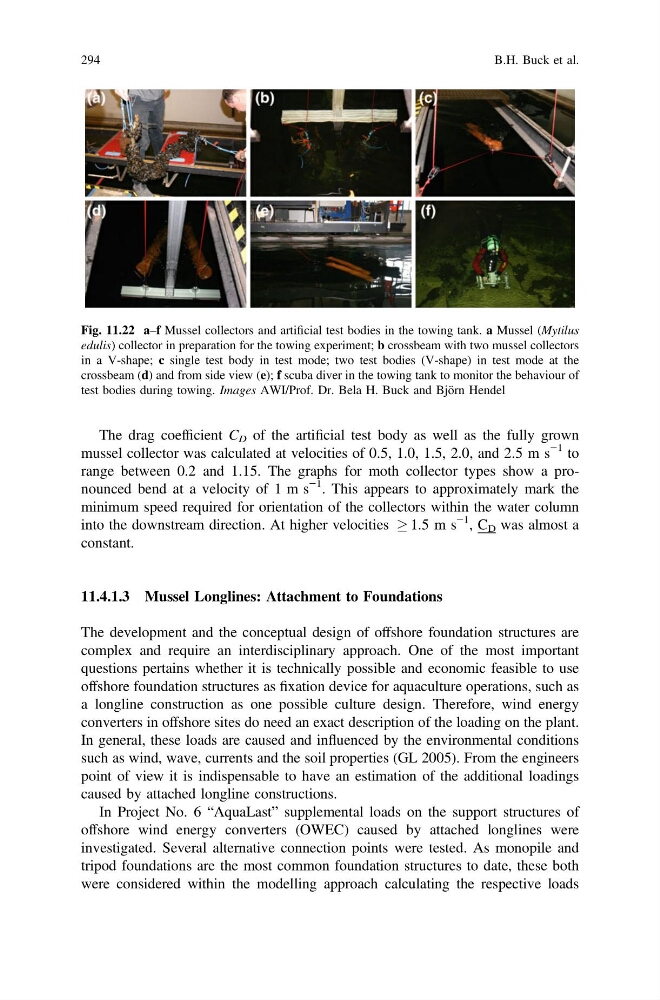
Fig. 11.22 a–f Mussel collectors and artificial test bodies in the towing tank. a Mussel (Mytilus
edulis) collector in preparation for the towing experiment; b crossbeam with two mussel collectors
in a V-shape; c single test body in test mode; two test bodies (V-shape) in test mode at the
crossbeam (d) and from side view (e); f scuba diver in the towing tank to monitor the behaviour of
test bodies during towing. Images AWI/Prof. Dr. Bela H. Buck and Björn Hendel
294
B.H. Buck et al.
mussel collector was calculated at velocities of 0.5, 1.0, 1.5, 2.0, and 2.5 m s
−1 to
range between 0.2 and 1.15. The graphs for moth collector types show a pronounced bend at a velocity of 1 m s
−1 . This appears to approximately mark the
minimum speed required for orientation of the collectors within the water column
into the downstream direction. At higher velocities ! 1.5 m s
−1 , C D was almost a
constant.
11.4.1.3 Mussel Longlines: Attachment to Foundations
The development and the conceptual design of offshore foundation structures are
complex and require an interdisciplinary approach. One of the most important
questions pertains whether it is technically possible and economic feasible to use
offshore foundation structures as fixation device for aquaculture operations, such as
a longline construction as one possible culture design. Therefore, wind energy
converters in offshore sites do need an exact description of the loading on the plant.
In general, these loads are caused and influenced by the environmental conditions
such as wind, wave, currents and the soil properties (GL 2005). From the engineers
point of view it is indispensable to have an estimation of the additional loadings
caused by attached longline constructions.
In Project No. 6 “AquaLast” supplemental loads on the support structures of
offshore wind energy converters (OWEC) caused by attached longlines were
investigated. Several alternative connection points were tested. As monopile and
tripod foundations are the most common foundation structures to date, these both
were considered within the modelling approach calculating the respective loads
Fig. 11.22 a–f Mussel collectors and artificial test bodies in the towing tank. a Mussel (Mytilus
edulis) collector in preparation for the towing experiment; b crossbeam with two mussel collectors
in a V-shape; c single test body in test mode; two test bodies (V-shape) in test mode at the
crossbeam (d) and from side view (e); f scuba diver in the towing tank to monitor the behaviour of
test bodies during towing. Images AWI/Prof. Dr. Bela H. Buck and Björn Hendel
294
B.H. Buck et al.