

would need 31 months to reach the 300 g harvest weight (Buck et al. 2012). This
exceeds the production of D. labrax in cages in the Mediterranean by 4–8 months
(FAO 2005) making an offshore cultivation in the North Sea economically not
feasible.
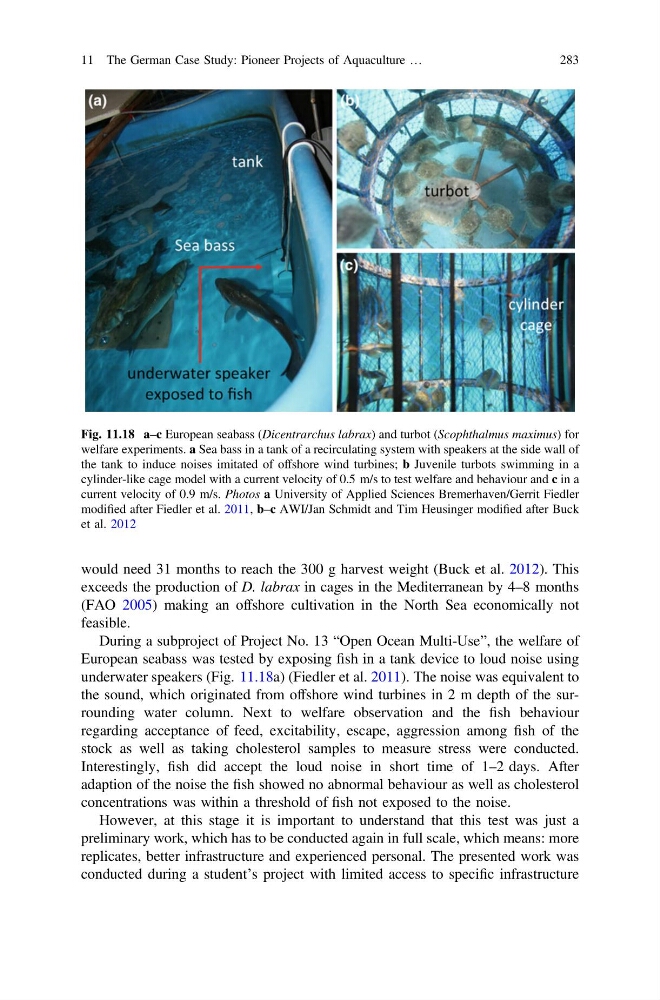
During a subproject of Project No. 13 “Open Ocean Multi-Use”, the welfare of
European seabass was tested by exposing fish in a tank device to loud noise using
underwater speakers (Fig. 11.18a) (Fiedler et al. 2011). The noise was equivalent to
the sound, which originated from offshore wind turbines in 2 m depth of the surrounding water column. Next to welfare observation and the fish behaviour
regarding acceptance of feed, excitability, escape, aggression among fish of the
stock as well as taking cholesterol samples to measure stress were conducted.
Interestingly, fish did accept the loud noise in short time of 1–2 days. After
adaption of the noise the fish showed no abnormal behaviour as well as cholesterol
concentrations was within a threshold of fish not exposed to the noise.
However, at this stage it is important to understand that this test was just a
preliminary work, which has to be conducted again in full scale, which means: more
replicates, better infrastructure and experienced personal. The presented work was
conducted during a student’s project with limited access to specific infrastructure
Fig. 11.18 a–c European seabass (Dicentrarchus labrax) and turbot (Scophthalmus maximus) for
welfare experiments. a Sea bass in a tank of a recirculating system with speakers at the side wall of
the tank to induce noises imitated of offshore wind turbines; b Juvenile turbots swimming in a
cylinder-like cage model with a current velocity of 0.5 m/s to test welfare and behaviour and c in a
current velocity of 0.9 m/s. Photos a University of Applied Sciences Bremerhaven/Gerrit Fiedler
modified after Fiedler et al. 2011, b–c AWI/Jan Schmidt and Tim Heusinger modified after Buck
et al. 2012
11 The German Case Study: Pioneer Projects of Aquaculture …
283
exceeds the production of D. labrax in cages in the Mediterranean by 4–8 months
(FAO 2005) making an offshore cultivation in the North Sea economically not
feasible.
During a subproject of Project No. 13 “Open Ocean Multi-Use”, the welfare of
European seabass was tested by exposing fish in a tank device to loud noise using
underwater speakers (Fig. 11.18a) (Fiedler et al. 2011). The noise was equivalent to
the sound, which originated from offshore wind turbines in 2 m depth of the surrounding water column. Next to welfare observation and the fish behaviour
regarding acceptance of feed, excitability, escape, aggression among fish of the
stock as well as taking cholesterol samples to measure stress were conducted.
Interestingly, fish did accept the loud noise in short time of 1–2 days. After
adaption of the noise the fish showed no abnormal behaviour as well as cholesterol
concentrations was within a threshold of fish not exposed to the noise.
However, at this stage it is important to understand that this test was just a
preliminary work, which has to be conducted again in full scale, which means: more
replicates, better infrastructure and experienced personal. The presented work was
conducted during a student’s project with limited access to specific infrastructure
Fig. 11.18 a–c European seabass (Dicentrarchus labrax) and turbot (Scophthalmus maximus) for
welfare experiments. a Sea bass in a tank of a recirculating system with speakers at the side wall of
the tank to induce noises imitated of offshore wind turbines; b Juvenile turbots swimming in a
cylinder-like cage model with a current velocity of 0.5 m/s to test welfare and behaviour and c in a
current velocity of 0.9 m/s. Photos a University of Applied Sciences Bremerhaven/Gerrit Fiedler
modified after Fiedler et al. 2011, b–c AWI/Jan Schmidt and Tim Heusinger modified after Buck
et al. 2012
11 The German Case Study: Pioneer Projects of Aquaculture …
283