

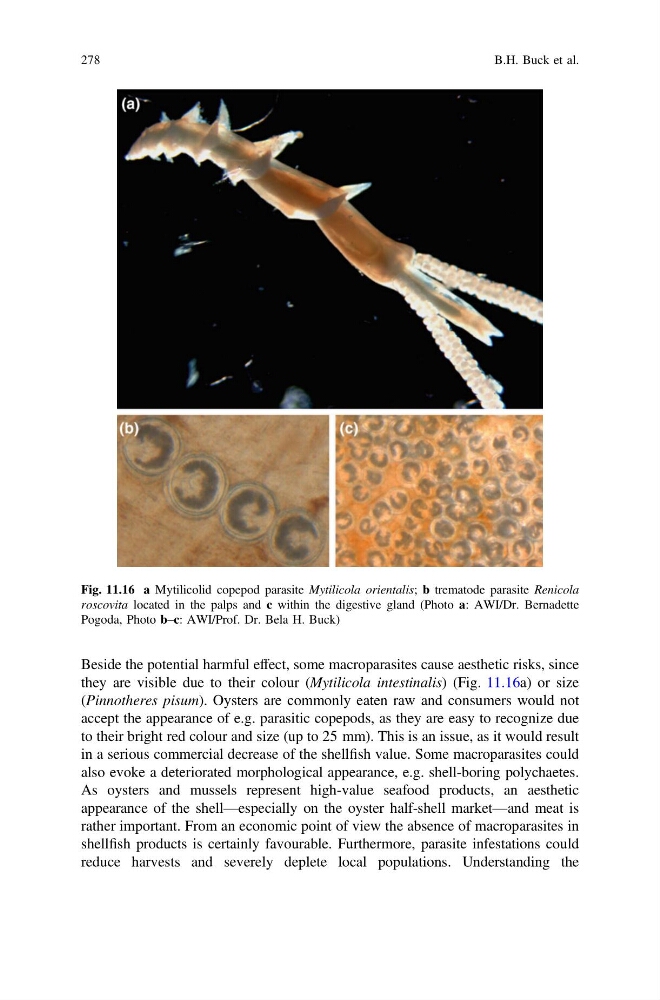
Beside the potential harmful effect, some macroparasites cause aesthetic risks, since
they are visible due to their colour (Mytilicola intestinalis) (Fig. 11.16a) or size
(Pinnotheres pisum). Oysters are commonly eaten raw and consumers would not
accept the appearance of e.g. parasitic copepods, as they are easy to recognize due
to their bright red colour and size (up to 25 mm). This is an issue, as it would result
in a serious commercial decrease of the shellfish value. Some macroparasites could
also evoke a deteriorated morphological appearance, e.g. shell-boring polychaetes.
As oysters and mussels represent high-value seafood products, an aesthetic
appearance of the shell—especially on the oyster half-shell market—and meat is
rather important. From an economic point of view the absence of macroparasites in
shellfish products is certainly favourable. Furthermore, parasite infestations could
reduce harvests and severely deplete local populations. Understanding the
Fig. 11.16 a Mytilicolid copepod parasite Mytilicola orientalis; b trematode parasite Renicola
roscovita located in the palps and c within the digestive gland (Photo a: AWI/Dr. Bernadette
Pogoda, Photo b–c: AWI/Prof. Dr. Bela H. Buck)
278
B.H. Buck et al.
they are visible due to their colour (Mytilicola intestinalis) (Fig. 11.16a) or size
(Pinnotheres pisum). Oysters are commonly eaten raw and consumers would not
accept the appearance of e.g. parasitic copepods, as they are easy to recognize due
to their bright red colour and size (up to 25 mm). This is an issue, as it would result
in a serious commercial decrease of the shellfish value. Some macroparasites could
also evoke a deteriorated morphological appearance, e.g. shell-boring polychaetes.
As oysters and mussels represent high-value seafood products, an aesthetic
appearance of the shell—especially on the oyster half-shell market—and meat is
rather important. From an economic point of view the absence of macroparasites in
shellfish products is certainly favourable. Furthermore, parasite infestations could
reduce harvests and severely deplete local populations. Understanding the
Fig. 11.16 a Mytilicolid copepod parasite Mytilicola orientalis; b trematode parasite Renicola
roscovita located in the palps and c within the digestive gland (Photo a: AWI/Dr. Bernadette
Pogoda, Photo b–c: AWI/Prof. Dr. Bela H. Buck)
278
B.H. Buck et al.