

feeds was tested for the feeding of farmed turbot (Scophthalmus maximus)
(Fig. 11.12a–e). For this purpose, mussels were scraped off the foundation and
transferred to the land-based facilities to produce feed in various mixtures with
Fig. 11.10 Collector types used for the detachment test. ASW Artificial Seaweed Collector (Size
[S]: 10 mm; Material [M]: nylon rope as back bone with 10 cm long PP-leaves attached at both
sites; Origin [O]: Japan); LOC Looped Christmas Tree (M Extruded polypropylene with a straight
trim, strands of lead in the centre help sinking; O New Zealand); LEC Leaded Christmas Tree
(M Extruded polypropylene with a looped trim, strands of lead in the centre help sinking; O New
Zealand); GAR Galician Rope (M Rough surfaced nylon-PE ropes with strands; O Spain); SSC
Self-Sinking Collector (M Polyester net formed as a tube, small stones help sinking; O Norway);
LAD Ladder Collector (S 16 mm; M Parallel running PP-ropes connected every 35 cm by a plastic
bar; O Norway); AQU Aquamats® (M Strands of PP-fleece material with ballast sleeve; O USA);
NFL Naue® Fleece (M PP-fleece, cost-saving alternative to AQU; O Germany); COC Coconut
Rope (S 24 mm; M rope of coconut fibres; O India); REF Reference Collector (M Bushy tufts of a
unravelled 10 mm PP-rope; O Germany) (modified after Brenner and Buck 2010)
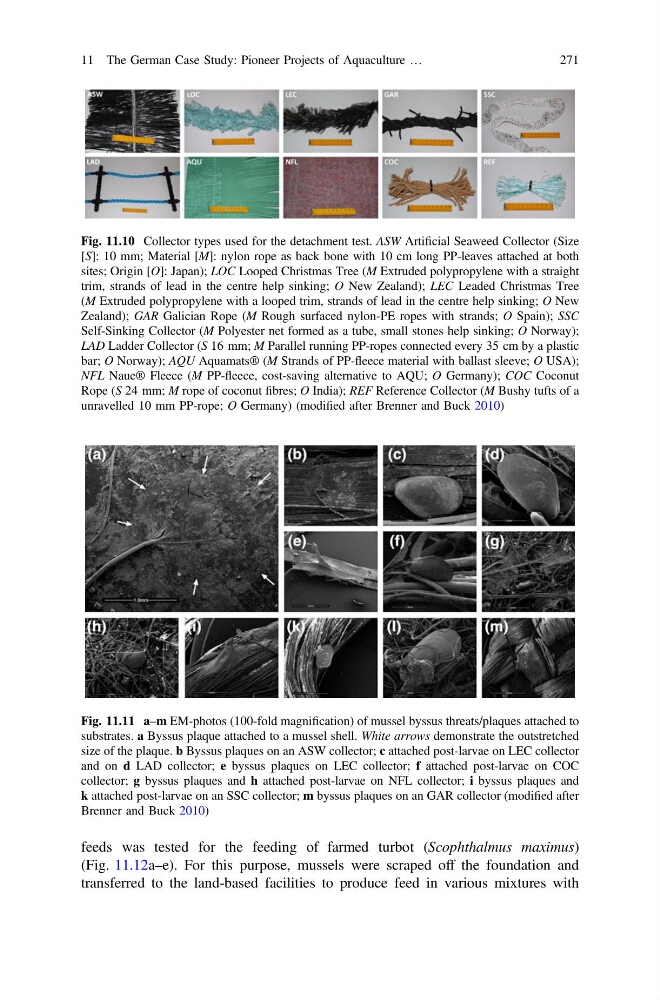
Fig. 11.11 a–m EM-photos (100-fold magnification) of mussel byssus threats/plaques attached to
substrates. a Byssus plaque attached to a mussel shell. White arrows demonstrate the outstretched
size of the plaque. b Byssus plaques on an ASW collector; c attached post-larvae on LEC collector
and on d LAD collector; e byssus plaques on LEC collector; f attached post-larvae on COC
collector; g byssus plaques and h attached post-larvae on NFL collector; i byssus plaques and
k attached post-larvae on an SSC collector; m byssus plaques on an GAR collector (modified after
Brenner and Buck 2010)
11 The German Case Study: Pioneer Projects of Aquaculture …
271
(Fig. 11.12a–e). For this purpose, mussels were scraped off the foundation and
transferred to the land-based facilities to produce feed in various mixtures with
Fig. 11.10 Collector types used for the detachment test. ASW Artificial Seaweed Collector (Size
[S]: 10 mm; Material [M]: nylon rope as back bone with 10 cm long PP-leaves attached at both
sites; Origin [O]: Japan); LOC Looped Christmas Tree (M Extruded polypropylene with a straight
trim, strands of lead in the centre help sinking; O New Zealand); LEC Leaded Christmas Tree
(M Extruded polypropylene with a looped trim, strands of lead in the centre help sinking; O New
Zealand); GAR Galician Rope (M Rough surfaced nylon-PE ropes with strands; O Spain); SSC
Self-Sinking Collector (M Polyester net formed as a tube, small stones help sinking; O Norway);
LAD Ladder Collector (S 16 mm; M Parallel running PP-ropes connected every 35 cm by a plastic
bar; O Norway); AQU Aquamats® (M Strands of PP-fleece material with ballast sleeve; O USA);
NFL Naue® Fleece (M PP-fleece, cost-saving alternative to AQU; O Germany); COC Coconut
Rope (S 24 mm; M rope of coconut fibres; O India); REF Reference Collector (M Bushy tufts of a
unravelled 10 mm PP-rope; O Germany) (modified after Brenner and Buck 2010)
Fig. 11.11 a–m EM-photos (100-fold magnification) of mussel byssus threats/plaques attached to
substrates. a Byssus plaque attached to a mussel shell. White arrows demonstrate the outstretched
size of the plaque. b Byssus plaques on an ASW collector; c attached post-larvae on LEC collector
and on d LAD collector; e byssus plaques on LEC collector; f attached post-larvae on COC
collector; g byssus plaques and h attached post-larvae on NFL collector; i byssus plaques and
k attached post-larvae on an SSC collector; m byssus plaques on an GAR collector (modified after
Brenner and Buck 2010)
11 The German Case Study: Pioneer Projects of Aquaculture …
271