

dominance, and its economic significance (Bartsch et al. 2008). The utilisation of
algal products plays an essential role in many fields of modern everyday life.
Laminariales offer a variety of goods used in human and animal consumption, in
industrial products or for bioremediation (Bartsch et al. 2008).
In the German North Sea, vital abundance of L. hyperborea, L. digitata and S.
latissima is reduced to the rocky shore of the Island of Helgoland as the remaining
coastline is characterized by soft-bottom substrate, not suitable for the fixation of
Laminaria rhizoid holdfasts. For aquaculture production, Laminaria plants are
“seeded” on ropes, which are subsequently fixed to various suspended or floating
culture devices. Detaching L. digitata and S. latissima blade portions from the
meristem induces them to become sporogenous far ahead of their natural reproductive season, making mature sporophytes available all year round (Buchholz and
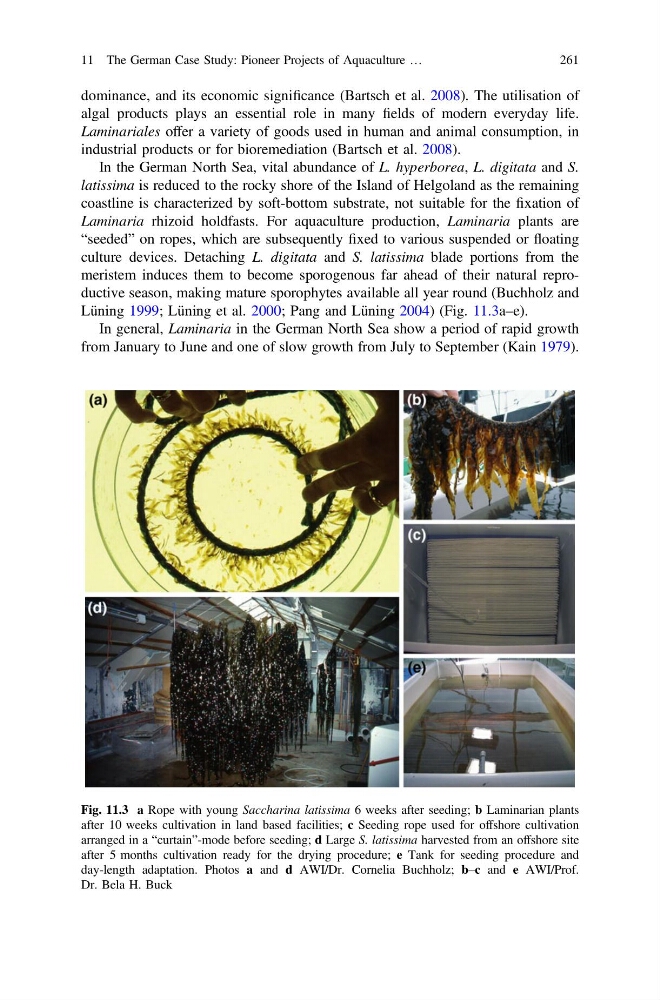
Lüning 1999; Lüning et al. 2000; Pang and Lüning 2004) (Fig. 11.3a–e).
In general, Laminaria in the German North Sea show a period of rapid growth
from January to June and one of slow growth from July to September (Kain 1979).
Fig. 11.3 a Rope with young Saccharina latissima 6 weeks after seeding; b Laminarian plants
after 10 weeks cultivation in land based facilities; c Seeding rope used for offshore cultivation
arranged in a “curtain”-mode before seeding; d Large S. latissima harvested from an offshore site
after 5 months cultivation ready for the drying procedure; e Tank for seeding procedure and
day-length adaptation. Photos a and d AWI/Dr. Cornelia Buchholz; b–c and e AWI/Prof.
Dr. Bela H. Buck
11 The German Case Study: Pioneer Projects of Aquaculture …
261
algal products plays an essential role in many fields of modern everyday life.
Laminariales offer a variety of goods used in human and animal consumption, in
industrial products or for bioremediation (Bartsch et al. 2008).
In the German North Sea, vital abundance of L. hyperborea, L. digitata and S.
latissima is reduced to the rocky shore of the Island of Helgoland as the remaining
coastline is characterized by soft-bottom substrate, not suitable for the fixation of
Laminaria rhizoid holdfasts. For aquaculture production, Laminaria plants are
“seeded” on ropes, which are subsequently fixed to various suspended or floating
culture devices. Detaching L. digitata and S. latissima blade portions from the
meristem induces them to become sporogenous far ahead of their natural reproductive season, making mature sporophytes available all year round (Buchholz and
Lüning 1999; Lüning et al. 2000; Pang and Lüning 2004) (Fig. 11.3a–e).
In general, Laminaria in the German North Sea show a period of rapid growth
from January to June and one of slow growth from July to September (Kain 1979).
Fig. 11.3 a Rope with young Saccharina latissima 6 weeks after seeding; b Laminarian plants
after 10 weeks cultivation in land based facilities; c Seeding rope used for offshore cultivation
arranged in a “curtain”-mode before seeding; d Large S. latissima harvested from an offshore site
after 5 months cultivation ready for the drying procedure; e Tank for seeding procedure and
day-length adaptation. Photos a and d AWI/Dr. Cornelia Buchholz; b–c and e AWI/Prof.
Dr. Bela H. Buck
11 The German Case Study: Pioneer Projects of Aquaculture …
261