

10.5 Case Study: Mussel Culture and Wind Farms
in the Netherlands
In the Dutch debate on multi-use, the emphasis has been on combinations of either
bivalve or seaweed production within offshore wind energy parks. From a market
perspective, the mussel sector is the most logical choice: there is an existing market
for mussels. The market recently has had troubles with the supply of mussel spat
due to governmental restriction on mussel spat collection in the Wadden Sea.
Following the identification of potential for bivalve culture in the North Sea, a
case-study was carried out to investigate the economic benefits for the
co-production mussels and offshore wind energy in the North Sea, summarized here
based on information from Sander van den Burg. This case study focused on spatial
distribution and examined if vacant space in offshore wind parks can be used for
mussels production. It was assumed that mussel production facilities are not
physically attached to the wind turbines or their foundations. Within large offshore
wind energy farms, the wind turbines are placed in clusters, leaving space between
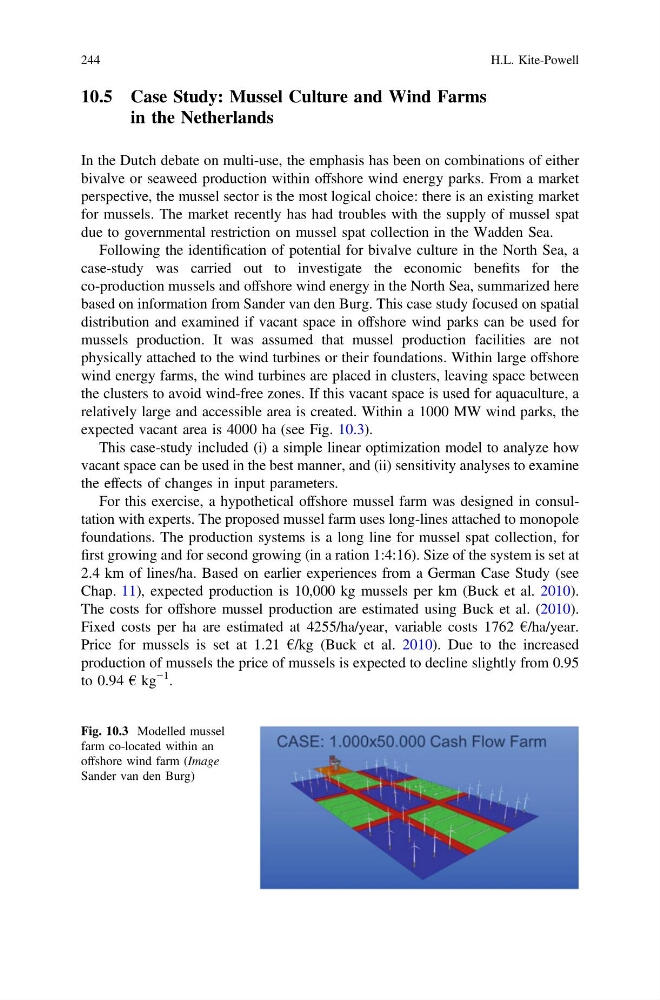
the clusters to avoid wind-free zones. If this vacant space is used for aquaculture, a
relatively large and accessible area is created. Within a 1000 MW wind parks, the
expected vacant area is 4000 ha (see Fig. 10.3).
This case-study included (i) a simple linear optimization model to analyze how
vacant space can be used in the best manner, and (ii) sensitivity analyses to examine
the effects of changes in input parameters.
For this exercise, a hypothetical offshore mussel farm was designed in consultation with experts. The proposed mussel farm uses long-lines attached to monopole
foundations. The production systems is a long line for mussel spat collection, for
first growing and for second growing (in a ration 1:4:16). Size of the system is set at
2.4 km of lines/ha. Based on earlier experiences from a German Case Study (see
Chap. 11), expected production is 10,000 kg mussels per km (Buck et al. 2010).
The costs for offshore mussel production are estimated using Buck et al. (2010).
Fixed costs per ha are estimated at 4255/ha/year, variable costs 1762 €/ha/year.
Price for mussels is set at 1.21 €/kg (Buck et al. 2010). Due to the increased
production of mussels the price of mussels is expected to decline slightly from 0.95
to 0.94 € kg
−1 .
Fig. 10.3 Modelled mussel
farm co-located within an
offshore wind farm (Image
Sander van den Burg)
244
H.L. Kite-Powell
in the Netherlands
In the Dutch debate on multi-use, the emphasis has been on combinations of either
bivalve or seaweed production within offshore wind energy parks. From a market
perspective, the mussel sector is the most logical choice: there is an existing market
for mussels. The market recently has had troubles with the supply of mussel spat
due to governmental restriction on mussel spat collection in the Wadden Sea.
Following the identification of potential for bivalve culture in the North Sea, a
case-study was carried out to investigate the economic benefits for the
co-production mussels and offshore wind energy in the North Sea, summarized here
based on information from Sander van den Burg. This case study focused on spatial
distribution and examined if vacant space in offshore wind parks can be used for
mussels production. It was assumed that mussel production facilities are not
physically attached to the wind turbines or their foundations. Within large offshore
wind energy farms, the wind turbines are placed in clusters, leaving space between
the clusters to avoid wind-free zones. If this vacant space is used for aquaculture, a
relatively large and accessible area is created. Within a 1000 MW wind parks, the
expected vacant area is 4000 ha (see Fig. 10.3).
This case-study included (i) a simple linear optimization model to analyze how
vacant space can be used in the best manner, and (ii) sensitivity analyses to examine
the effects of changes in input parameters.
For this exercise, a hypothetical offshore mussel farm was designed in consultation with experts. The proposed mussel farm uses long-lines attached to monopole
foundations. The production systems is a long line for mussel spat collection, for
first growing and for second growing (in a ration 1:4:16). Size of the system is set at
2.4 km of lines/ha. Based on earlier experiences from a German Case Study (see
Chap. 11), expected production is 10,000 kg mussels per km (Buck et al. 2010).
The costs for offshore mussel production are estimated using Buck et al. (2010).
Fixed costs per ha are estimated at 4255/ha/year, variable costs 1762 €/ha/year.
Price for mussels is set at 1.21 €/kg (Buck et al. 2010). Due to the increased
production of mussels the price of mussels is expected to decline slightly from 0.95
to 0.94 € kg
−1 .
Fig. 10.3 Modelled mussel
farm co-located within an
offshore wind farm (Image
Sander van den Burg)
244
H.L. Kite-Powell