

decreasing trend, while traded value is down from 40 to 32% in 2013 relative to
fresh and brackish species (FAO 2016).
The origins of fish farming may be found far back in time. Freshwater aquaculture emerged at least 3000 years ago in East Asia and the Middle East. Carp in
particular became a very important local food source for China and developed
significantly in the eighteenth and nineteenth centuries (Li 1997). Similarly, the
origins of inshore saltwater aquaculture go far back in time and seem to have
originated independently in several regions. Roman towns relied on closed inshore
lagoons for the provision of saltwater fish and shellfish at least two millennia ago
(McCann 2003). The Polynesian culture of the Hawaiian Islands had developed
extensive inshore lagoon fish farming centuries before the arrival of Europeans
(Ziegler 2002). Little historical research has been undertaken but it is clear that in
Europe, fishponds throughout the pre-modern period were prestigious undertakings,
which catered to the needs of affluent consumers who added diversity and freshness
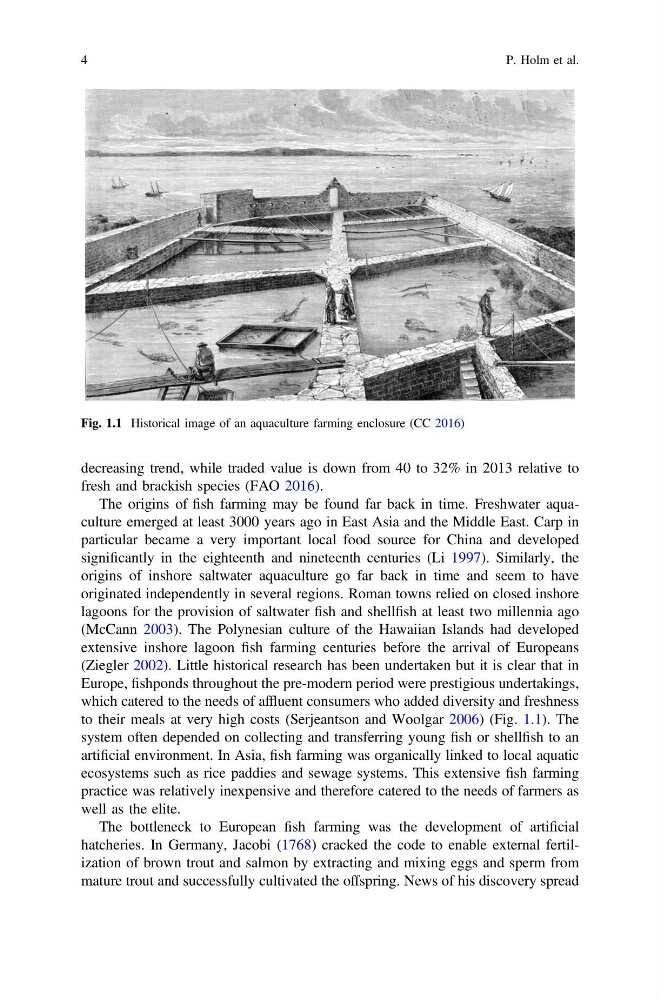
to their meals at very high costs (Serjeantson and Woolgar 2006) (Fig. 1.1). The
system often depended on collecting and transferring young fish or shellfish to an
artificial environment. In Asia, fish farming was organically linked to local aquatic
ecosystems such as rice paddies and sewage systems. This extensive fish farming
practice was relatively inexpensive and therefore catered to the needs of farmers as
well as the elite.
The bottleneck to European fish farming was the development of artificial
hatcheries. In Germany, Jacobi (1768) cracked the code to enable external fertilization of brown trout and salmon by extracting and mixing eggs and sperm from
mature trout and successfully cultivated the offspring. News of his discovery spread
Fig. 1.1 Historical image of an aquaculture farming enclosure (CC 2016)
4
P. Holm et al.
fresh and brackish species (FAO 2016).
The origins of fish farming may be found far back in time. Freshwater aquaculture emerged at least 3000 years ago in East Asia and the Middle East. Carp in
particular became a very important local food source for China and developed
significantly in the eighteenth and nineteenth centuries (Li 1997). Similarly, the
origins of inshore saltwater aquaculture go far back in time and seem to have
originated independently in several regions. Roman towns relied on closed inshore
lagoons for the provision of saltwater fish and shellfish at least two millennia ago
(McCann 2003). The Polynesian culture of the Hawaiian Islands had developed
extensive inshore lagoon fish farming centuries before the arrival of Europeans
(Ziegler 2002). Little historical research has been undertaken but it is clear that in
Europe, fishponds throughout the pre-modern period were prestigious undertakings,
which catered to the needs of affluent consumers who added diversity and freshness
to their meals at very high costs (Serjeantson and Woolgar 2006) (Fig. 1.1). The
system often depended on collecting and transferring young fish or shellfish to an
artificial environment. In Asia, fish farming was organically linked to local aquatic
ecosystems such as rice paddies and sewage systems. This extensive fish farming
practice was relatively inexpensive and therefore catered to the needs of farmers as
well as the elite.
The bottleneck to European fish farming was the development of artificial
hatcheries. In Germany, Jacobi (1768) cracked the code to enable external fertilization of brown trout and salmon by extracting and mixing eggs and sperm from
mature trout and successfully cultivated the offspring. News of his discovery spread
Fig. 1.1 Historical image of an aquaculture farming enclosure (CC 2016)
4
P. Holm et al.