

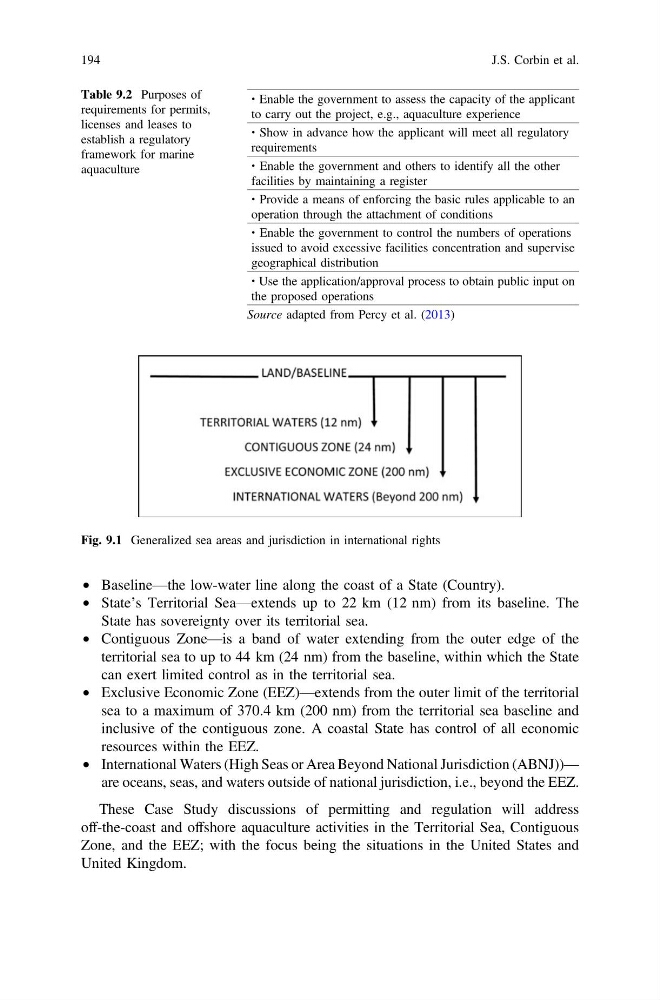
• Baseline—the low-water line along the coast of a State (Country).
• State’s Territorial Sea—extends up to 22 km (12 nm) from its baseline. The
State has sovereignty over its territorial sea.
• Contiguous Zone—is a band of water extending from the outer edge of the
territorial sea to up to 44 km (24 nm) from the baseline, within which the State
can exert limited control as in the territorial sea.
• Exclusive Economic Zone (EEZ)—extends from the outer limit of the territorial
sea to a maximum of 370.4 km (200 nm) from the territorial sea baseline and
inclusive of the contiguous zone. A coastal State has control of all economic
resources within the EEZ.
• International Waters (High Seas or Area Beyond National Jurisdiction (ABNJ))—
are oceans, seas, and waters outside of national jurisdiction, i.e., beyond the EEZ.
These Case Study discussions of permitting and regulation will address
off-the-coast and offshore aquaculture activities in the Territorial Sea, Contiguous
Zone, and the EEZ; with the focus being the situations in the United States and
United Kingdom.
Table 9.2 Purposes of
requirements for permits,
licenses and leases to
establish a regulatory
framework for marine
aquaculture
∙ Enable the government to assess the capacity of the applicant
to carry out the project, e.g., aquaculture experience
∙ Show in advance how the applicant will meet all regulatory
requirements
∙ Enable the government and others to identify all the other
facilities by maintaining a register
∙ Provide a means of enforcing the basic rules applicable to an
operation through the attachment of conditions
∙ Enable the government to control the numbers of operations
issued to avoid excessive facilities concentration and supervise
geographical distribution
∙ Use the application/approval process to obtain public input on
the proposed operations
Source adapted from Percy et al. (2013)
Fig. 9.1 Generalized sea areas and jurisdiction in international rights
194
J.S. Corbin et al.
• State’s Territorial Sea—extends up to 22 km (12 nm) from its baseline. The
State has sovereignty over its territorial sea.
• Contiguous Zone—is a band of water extending from the outer edge of the
territorial sea to up to 44 km (24 nm) from the baseline, within which the State
can exert limited control as in the territorial sea.
• Exclusive Economic Zone (EEZ)—extends from the outer limit of the territorial
sea to a maximum of 370.4 km (200 nm) from the territorial sea baseline and
inclusive of the contiguous zone. A coastal State has control of all economic
resources within the EEZ.
• International Waters (High Seas or Area Beyond National Jurisdiction (ABNJ))—
are oceans, seas, and waters outside of national jurisdiction, i.e., beyond the EEZ.
These Case Study discussions of permitting and regulation will address
off-the-coast and offshore aquaculture activities in the Territorial Sea, Contiguous
Zone, and the EEZ; with the focus being the situations in the United States and
United Kingdom.
Table 9.2 Purposes of
requirements for permits,
licenses and leases to
establish a regulatory
framework for marine
aquaculture
∙ Enable the government to assess the capacity of the applicant
to carry out the project, e.g., aquaculture experience
∙ Show in advance how the applicant will meet all regulatory
requirements
∙ Enable the government and others to identify all the other
facilities by maintaining a register
∙ Provide a means of enforcing the basic rules applicable to an
operation through the attachment of conditions
∙ Enable the government to control the numbers of operations
issued to avoid excessive facilities concentration and supervise
geographical distribution
∙ Use the application/approval process to obtain public input on
the proposed operations
Source adapted from Percy et al. (2013)
Fig. 9.1 Generalized sea areas and jurisdiction in international rights
194
J.S. Corbin et al.