

8.4 Implications for Assessing the Socio-economic Effects
of Offshore Aquaculture in a Multi-use Setting
Combining offshore aquaculture with other activities, such as offshore wind
farming, is an opportunity to share stakeholder resources and can lead to greater
spatial efficiency in the offshore environment. However, next to the apparent
questions on the biological and technical nature of how to link these activities, these
prospected challenges endorse that the participating social actors will have to
negotiate agreements and management regulations for elaborating and coordinating
their individual tasks (Michler-Cieluch and Krause 2008).
So far, the main motivation to undertake this multi-use efforts in the offshore
aquaculture sector can be attributed to the assumed positive socio-economic effects
that such an approach, in which resources and activities are shared and managed
jointly, may hold. Indeed, the decision to partner with mariculture firms may be
primarily motivated by cost considerations for wind energy firms (Reith et al. 2005;
Griffin and Krause 2010). Thus, in an offshore setting where many users are
competing for space, allowing the concurrent use of a wind farm for mariculture
may provide a dual benefit to wind energy producers and aquaculture (Krause et al.
2011). The benefits can be large when firms coordinate core skills to form an
alliance with unique capabilities that neither partner could efficiently provide alone.
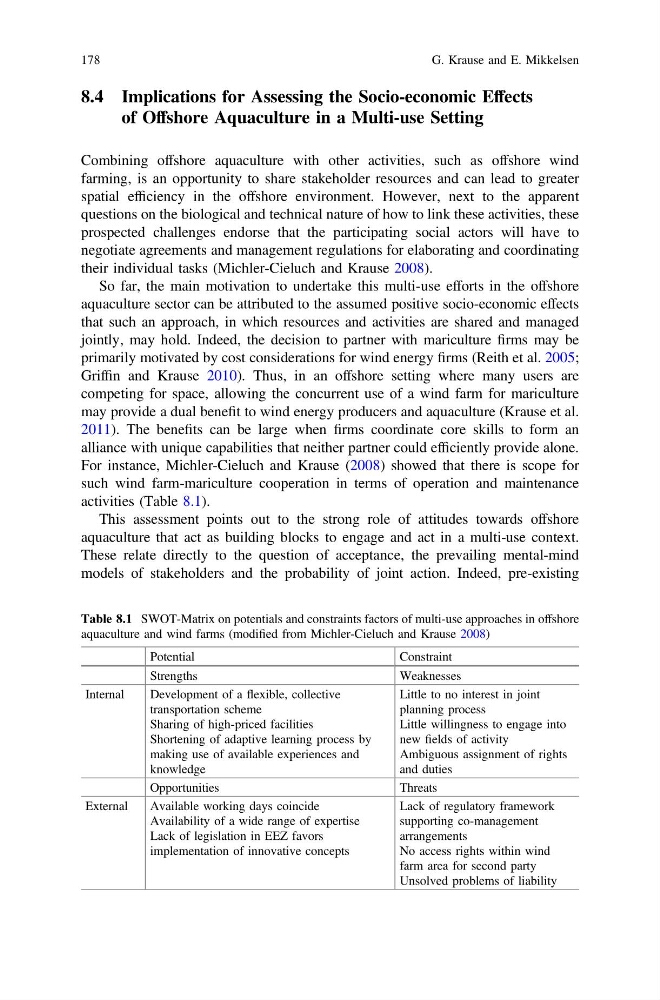
For instance, Michler-Cieluch and Krause (2008) showed that there is scope for
such wind farm-mariculture cooperation in terms of operation and maintenance
activities (Table 8.1).
This assessment points out to the strong role of attitudes towards offshore
aquaculture that act as building blocks to engage and act in a multi-use context.
These relate directly to the question of acceptance, the prevailing mental-mind
models of stakeholders and the probability of joint action. Indeed, pre-existing
Table 8.1 SWOT-Matrix on potentials and constraints factors of multi-use approaches in offshore
aquaculture and wind farms (modified from Michler-Cieluch and Krause 2008)
Potential
Constraint
Strengths
Weaknesses
Internal
Development of a flexible, collective
transportation scheme
Sharing of high-priced facilities
Shortening of adaptive learning process by
making use of available experiences and
knowledge
Little to no interest in joint
planning process
Little willingness to engage into
new fields of activity
Ambiguous assignment of rights
and duties
Opportunities
Threats
External
Available working days coincide
Availability of a wide range of expertise
Lack of legislation in EEZ favors
implementation of innovative concepts
Lack of regulatory framework
supporting co-management
arrangements
No access rights within wind
farm area for second party
Unsolved problems of liability
178
G. Krause and E. Mikkelsen
of Offshore Aquaculture in a Multi-use Setting
Combining offshore aquaculture with other activities, such as offshore wind
farming, is an opportunity to share stakeholder resources and can lead to greater
spatial efficiency in the offshore environment. However, next to the apparent
questions on the biological and technical nature of how to link these activities, these
prospected challenges endorse that the participating social actors will have to
negotiate agreements and management regulations for elaborating and coordinating
their individual tasks (Michler-Cieluch and Krause 2008).
So far, the main motivation to undertake this multi-use efforts in the offshore
aquaculture sector can be attributed to the assumed positive socio-economic effects
that such an approach, in which resources and activities are shared and managed
jointly, may hold. Indeed, the decision to partner with mariculture firms may be
primarily motivated by cost considerations for wind energy firms (Reith et al. 2005;
Griffin and Krause 2010). Thus, in an offshore setting where many users are
competing for space, allowing the concurrent use of a wind farm for mariculture
may provide a dual benefit to wind energy producers and aquaculture (Krause et al.
2011). The benefits can be large when firms coordinate core skills to form an
alliance with unique capabilities that neither partner could efficiently provide alone.
For instance, Michler-Cieluch and Krause (2008) showed that there is scope for
such wind farm-mariculture cooperation in terms of operation and maintenance
activities (Table 8.1).
This assessment points out to the strong role of attitudes towards offshore
aquaculture that act as building blocks to engage and act in a multi-use context.
These relate directly to the question of acceptance, the prevailing mental-mind
models of stakeholders and the probability of joint action. Indeed, pre-existing
Table 8.1 SWOT-Matrix on potentials and constraints factors of multi-use approaches in offshore
aquaculture and wind farms (modified from Michler-Cieluch and Krause 2008)
Potential
Constraint
Strengths
Weaknesses
Internal
Development of a flexible, collective
transportation scheme
Sharing of high-priced facilities
Shortening of adaptive learning process by
making use of available experiences and
knowledge
Little to no interest in joint
planning process
Little willingness to engage into
new fields of activity
Ambiguous assignment of rights
and duties
Opportunities
Threats
External
Available working days coincide
Availability of a wide range of expertise
Lack of legislation in EEZ favors
implementation of innovative concepts
Lack of regulatory framework
supporting co-management
arrangements
No access rights within wind
farm area for second party
Unsolved problems of liability
178
G. Krause and E. Mikkelsen