

• Safety and accessibility. For safety reasons biofouling must be prevented on
stairs and boat landing area, to ensure safe access of maintenance personnel to
the foundation and wind turbine (Fig. 5.1b).
There are several techniques that can be applied to prevent or clean biofouling
on surfaces: antifouling coatings, electrochemical and physical methods for fouling
control, cleaning of surfaces by robots or handheld tools. It is recommended to
inspect the foundation and anodes after a period of 5–10 years. Visual inspection
and quantification of fouling composition and thickness can be combined with
regular cleaning of the external surface.
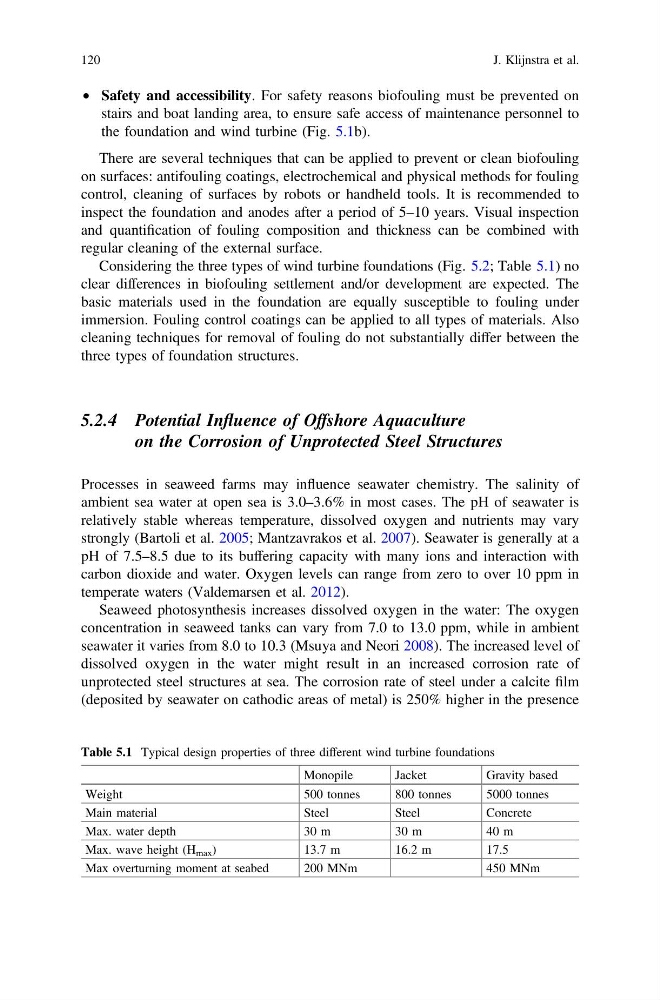
Considering the three types of wind turbine foundations (Fig. 5.2; Table 5.1) no
clear differences in biofouling settlement and/or development are expected. The
basic materials used in the foundation are equally susceptible to fouling under
immersion. Fouling control coatings can be applied to all types of materials. Also
cleaning techniques for removal of fouling do not substantially differ between the
three types of foundation structures.
5.2.4 Potential Influence of Offshore Aquaculture
on the Corrosion of Unprotected Steel Structures
Processes in seaweed farms may influence seawater chemistry. The salinity of
ambient sea water at open sea is 3.0–3.6% in most cases. The pH of seawater is
relatively stable whereas temperature, dissolved oxygen and nutrients may vary
strongly (Bartoli et al. 2005; Mantzavrakos et al. 2007). Seawater is generally at a
pH of 7.5–8.5 due to its buffering capacity with many ions and interaction with
carbon dioxide and water. Oxygen levels can range from zero to over 10 ppm in
temperate waters (Valdemarsen et al. 2012).
Seaweed photosynthesis increases dissolved oxygen in the water: The oxygen
concentration in seaweed tanks can vary from 7.0 to 13.0 ppm, while in ambient
seawater it varies from 8.0 to 10.3 (Msuya and Neori 2008). The increased level of
dissolved oxygen in the water might result in an increased corrosion rate of
unprotected steel structures at sea. The corrosion rate of steel under a calcite film
(deposited by seawater on cathodic areas of metal) is 250% higher in the presence
Table 5.1 Typical design properties of three different wind turbine foundations
Monopile
Jacket
Gravity based
Weight
500 tonnes
800 tonnes
5000 tonnes
Main material
Steel
Steel
Concrete
Max. water depth
30 m
30 m
40 m
Max. wave height (H max )
13.7 m
16.2 m
17.5
Max overturning moment at seabed
200 MNm
450 MNm
120
J. Klijnstra et al.
stairs and boat landing area, to ensure safe access of maintenance personnel to
the foundation and wind turbine (Fig. 5.1b).
There are several techniques that can be applied to prevent or clean biofouling
on surfaces: antifouling coatings, electrochemical and physical methods for fouling
control, cleaning of surfaces by robots or handheld tools. It is recommended to
inspect the foundation and anodes after a period of 5–10 years. Visual inspection
and quantification of fouling composition and thickness can be combined with
regular cleaning of the external surface.
Considering the three types of wind turbine foundations (Fig. 5.2; Table 5.1) no
clear differences in biofouling settlement and/or development are expected. The
basic materials used in the foundation are equally susceptible to fouling under
immersion. Fouling control coatings can be applied to all types of materials. Also
cleaning techniques for removal of fouling do not substantially differ between the
three types of foundation structures.
5.2.4 Potential Influence of Offshore Aquaculture
on the Corrosion of Unprotected Steel Structures
Processes in seaweed farms may influence seawater chemistry. The salinity of
ambient sea water at open sea is 3.0–3.6% in most cases. The pH of seawater is
relatively stable whereas temperature, dissolved oxygen and nutrients may vary
strongly (Bartoli et al. 2005; Mantzavrakos et al. 2007). Seawater is generally at a
pH of 7.5–8.5 due to its buffering capacity with many ions and interaction with
carbon dioxide and water. Oxygen levels can range from zero to over 10 ppm in
temperate waters (Valdemarsen et al. 2012).
Seaweed photosynthesis increases dissolved oxygen in the water: The oxygen
concentration in seaweed tanks can vary from 7.0 to 13.0 ppm, while in ambient
seawater it varies from 8.0 to 10.3 (Msuya and Neori 2008). The increased level of
dissolved oxygen in the water might result in an increased corrosion rate of
unprotected steel structures at sea. The corrosion rate of steel under a calcite film
(deposited by seawater on cathodic areas of metal) is 250% higher in the presence
Table 5.1 Typical design properties of three different wind turbine foundations
Monopile
Jacket
Gravity based
Weight
500 tonnes
800 tonnes
5000 tonnes
Main material
Steel
Steel
Concrete
Max. water depth
30 m
30 m
40 m
Max. wave height (H max )
13.7 m
16.2 m
17.5
Max overturning moment at seabed
200 MNm
450 MNm
120
J. Klijnstra et al.