

grouting failure repair of several monopile foundations, local corrosion attack was
detected on the internal surface area of the unprotected monopile. Until then the
internal area had been a black box: the hedge was sealed to reduce and stop the
internal corrosion process. Nowadays, MIC processes inside monopile foundations
are still not known in very much detail and require further investigation to find
optimal control measures.
Specification of corrosion protection for specific offshore wind structures is still
an issue. The applied standards for European offshore wind farms vary from
onshore related specifications to those deriving from offshore oil and gas specifications. Based on the experiences with coating and cathodic protection failures,
there is a need for an accepted uniform specification. Up to date, such a specification is lacking.
5.2.3 Biofouling on Offshore Structures
Offshore constructions are attractive to biofouling species. Biofouling may result in
increased costs due to antifouling measures that have to be taken: extensive
inspection and maintenance, creation of micro-environments discouraging microbial corrosion, and heightened design criteria as a consequence of the extra
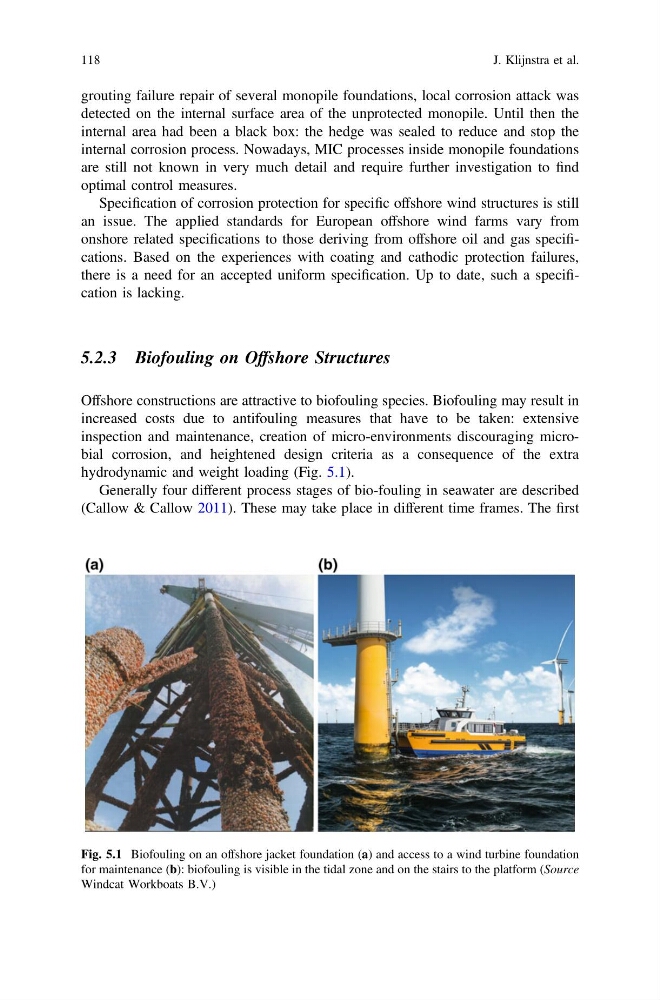
hydrodynamic and weight loading (Fig. 5.1).
Generally four different process stages of bio-fouling in seawater are described
(Callow & Callow 2011). These may take place in different time frames. The first
Fig. 5.1 Biofouling on an offshore jacket foundation (a) and access to a wind turbine foundation
for maintenance (b): biofouling is visible in the tidal zone and on the stairs to the platform (Source
Windcat Workboats B.V.)
118
J. Klijnstra et al.
detected on the internal surface area of the unprotected monopile. Until then the
internal area had been a black box: the hedge was sealed to reduce and stop the
internal corrosion process. Nowadays, MIC processes inside monopile foundations
are still not known in very much detail and require further investigation to find
optimal control measures.
Specification of corrosion protection for specific offshore wind structures is still
an issue. The applied standards for European offshore wind farms vary from
onshore related specifications to those deriving from offshore oil and gas specifications. Based on the experiences with coating and cathodic protection failures,
there is a need for an accepted uniform specification. Up to date, such a specification is lacking.
5.2.3 Biofouling on Offshore Structures
Offshore constructions are attractive to biofouling species. Biofouling may result in
increased costs due to antifouling measures that have to be taken: extensive
inspection and maintenance, creation of micro-environments discouraging microbial corrosion, and heightened design criteria as a consequence of the extra
hydrodynamic and weight loading (Fig. 5.1).
Generally four different process stages of bio-fouling in seawater are described
(Callow & Callow 2011). These may take place in different time frames. The first
Fig. 5.1 Biofouling on an offshore jacket foundation (a) and access to a wind turbine foundation
for maintenance (b): biofouling is visible in the tidal zone and on the stairs to the platform (Source
Windcat Workboats B.V.)
118
J. Klijnstra et al.