

Marine finfish species including summer flounder (Paralichthys dentate), cod
(Gadus morhua), haddock (Melanogrammus aeglefinus), halibut (Hippoglossus
hippoglossus), and steelhead trout (Oncorhynchus mykiss) were cultured and harvested from the research farm (Chambers and Howell 2006; Chambers et al. 2007;
Howell and Chambers 2005; Rillahan et al. 2009, 2011). Hatchery production for
cod, haddock and halibut was challenging with growout time in the sea cages
ranging from 2.5 years (cod) to 3.5 years (halibut). Initially, fish were fed daily
from a vessel through a feed hose that attached to the top of from the surface. An
onboard water pump was used to mix food pellet and seawater in a funnel chamber
before it was pushed down into a cage 12 m below. Autonomous feeders were not
yet developed for the open ocean. Hence the design course that UNH Engineers
embarked on to create three new generations of feeding systems (Rice et al. 2003).
Prototype buoys evolved and scaling up to a final 20 ton version (Fullerton et al.
2004; Turmelle et al. 2006) that was fabricated by AEG in New Brunswick, CA
(Fig. 3.8). The buoy hull was 8.6 Â 6.9 m and had a draft of 3 m fully loaded with
feed and fuel. To keep the buoy upright, 22,135 kg of concrete was poured into
bottom. Fish food was pneumatically blown from a vessel into one of the four,
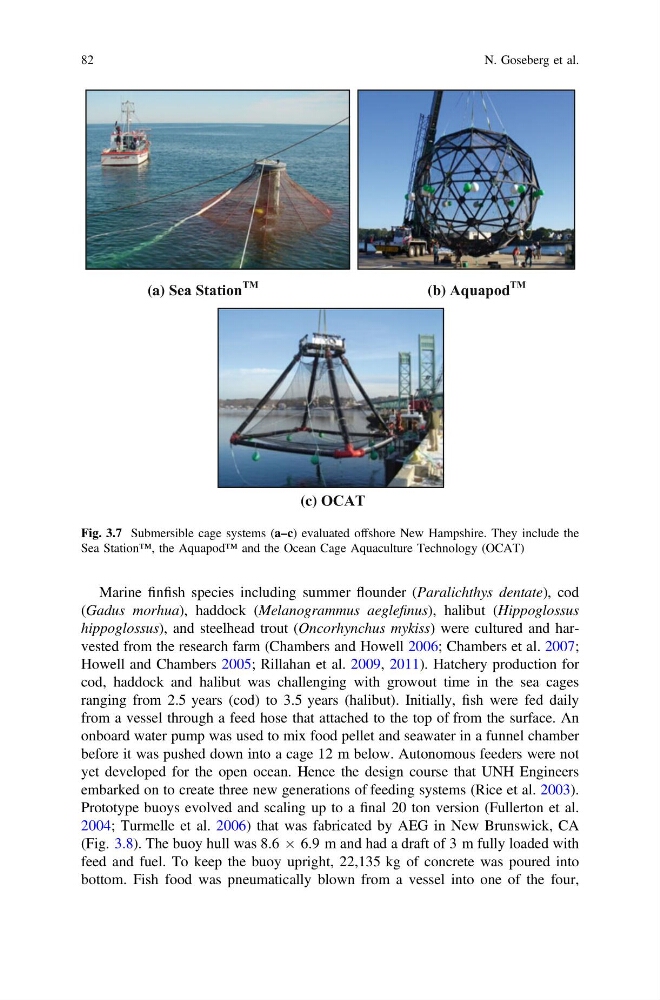
(a) Sea Station
TM
(b) Aquapod
TM
(c) OCAT
Fig. 3.7 Submersible cage systems (a–c) evaluated offshore New Hampshire. They include the
Sea Station™, the Aquapod™ and the Ocean Cage Aquaculture Technology (OCAT)
82
N. Goseberg et al.
(Gadus morhua), haddock (Melanogrammus aeglefinus), halibut (Hippoglossus
hippoglossus), and steelhead trout (Oncorhynchus mykiss) were cultured and harvested from the research farm (Chambers and Howell 2006; Chambers et al. 2007;
Howell and Chambers 2005; Rillahan et al. 2009, 2011). Hatchery production for
cod, haddock and halibut was challenging with growout time in the sea cages
ranging from 2.5 years (cod) to 3.5 years (halibut). Initially, fish were fed daily
from a vessel through a feed hose that attached to the top of from the surface. An
onboard water pump was used to mix food pellet and seawater in a funnel chamber
before it was pushed down into a cage 12 m below. Autonomous feeders were not
yet developed for the open ocean. Hence the design course that UNH Engineers
embarked on to create three new generations of feeding systems (Rice et al. 2003).
Prototype buoys evolved and scaling up to a final 20 ton version (Fullerton et al.
2004; Turmelle et al. 2006) that was fabricated by AEG in New Brunswick, CA
(Fig. 3.8). The buoy hull was 8.6 Â 6.9 m and had a draft of 3 m fully loaded with
feed and fuel. To keep the buoy upright, 22,135 kg of concrete was poured into
bottom. Fish food was pneumatically blown from a vessel into one of the four,
(a) Sea Station
TM
(b) Aquapod
TM
(c) OCAT
Fig. 3.7 Submersible cage systems (a–c) evaluated offshore New Hampshire. They include the
Sea Station™, the Aquapod™ and the Ocean Cage Aquaculture Technology (OCAT)
82
N. Goseberg et al.