

152
Appendix B: Registers
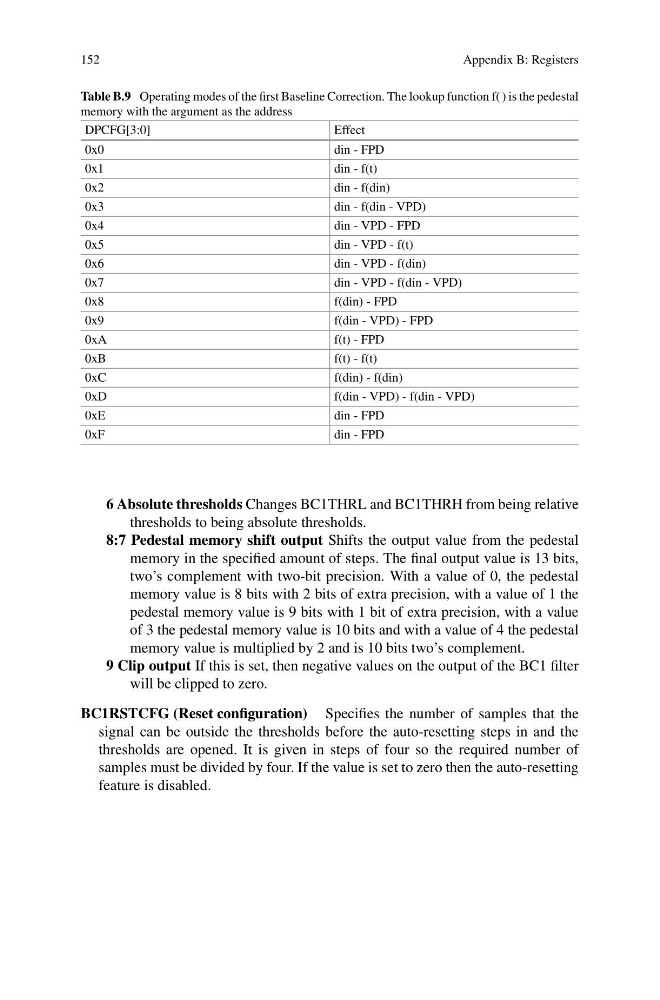
Table B.9 Operating modes of the first Baseline Correction. The lookup function f( ) is the pedestal
memory with the argument as the address
DPCFG[3:0]
Effect
0x0
din - FPD
0x1
din - f(t)
0x2
din - f(din)
0x3
din - f(din - VPD)
0x4
din - VPD - FPD
0x5
din - VPD - f(t)
0x6
din - VPD - f(din)
0x7
din - VPD - f(din - VPD)
0x8
f(din) - FPD
0x9
f(din - VPD) - FPD
0xA
f(t) - FPD
0xB
f(t) - f(t)
0xC
f(din) - f(din)
0xD
f(din - VPD) - f(din - VPD)
0xE
din - FPD
0xF
din - FPD
6 Absolute thresholds Changes BC1THRL and BC1THRH from being relative
thresholds to being absolute thresholds.
8:7 Pedestal memory shift output Shifts the output value from the pedestal
memory in the specified amount of steps. The final output value is 13 bits,
two’s complement with two-bit precision. With a value of 0, the pedestal
memory value is 8 bits with 2 bits of extra precision, with a value of 1 the
pedestal memory value is 9 bits with 1 bit of extra precision, with a value
of 3 the pedestal memory value is 10 bits and with a value of 4 the pedestal
memory value is multiplied by 2 and is 10 bits two’s complement.
9 Clip output If this is set, then negative values on the output of the BC1 filter
will be clipped to zero.
BC1RSTCFG (Reset configuration) Specifies the number of samples that the
signal can be outside the thresholds before the auto-resetting steps in and the
thresholds are opened. It is given in steps of four so the required number of
samples must be divided by four. If the value is set to zero then the auto-resetting
feature is disabled.
Appendix B: Registers
Table B.9 Operating modes of the first Baseline Correction. The lookup function f( ) is the pedestal
memory with the argument as the address
DPCFG[3:0]
Effect
0x0
din - FPD
0x1
din - f(t)
0x2
din - f(din)
0x3
din - f(din - VPD)
0x4
din - VPD - FPD
0x5
din - VPD - f(t)
0x6
din - VPD - f(din)
0x7
din - VPD - f(din - VPD)
0x8
f(din) - FPD
0x9
f(din - VPD) - FPD
0xA
f(t) - FPD
0xB
f(t) - f(t)
0xC
f(din) - f(din)
0xD
f(din - VPD) - f(din - VPD)
0xE
din - FPD
0xF
din - FPD
6 Absolute thresholds Changes BC1THRL and BC1THRH from being relative
thresholds to being absolute thresholds.
8:7 Pedestal memory shift output Shifts the output value from the pedestal
memory in the specified amount of steps. The final output value is 13 bits,
two’s complement with two-bit precision. With a value of 0, the pedestal
memory value is 8 bits with 2 bits of extra precision, with a value of 1 the
pedestal memory value is 9 bits with 1 bit of extra precision, with a value
of 3 the pedestal memory value is 10 bits and with a value of 4 the pedestal
memory value is multiplied by 2 and is 10 bits two’s complement.
9 Clip output If this is set, then negative values on the output of the BC1 filter
will be clipped to zero.
BC1RSTCFG (Reset configuration) Specifies the number of samples that the
signal can be outside the thresholds before the auto-resetting steps in and the
thresholds are opened. It is given in steps of four so the required number of
samples must be divided by four. If the value is set to zero then the auto-resetting
feature is disabled.