

72
3 Applications of Zero-Index Metamaterials
(a)
(b)
(c)
( d)
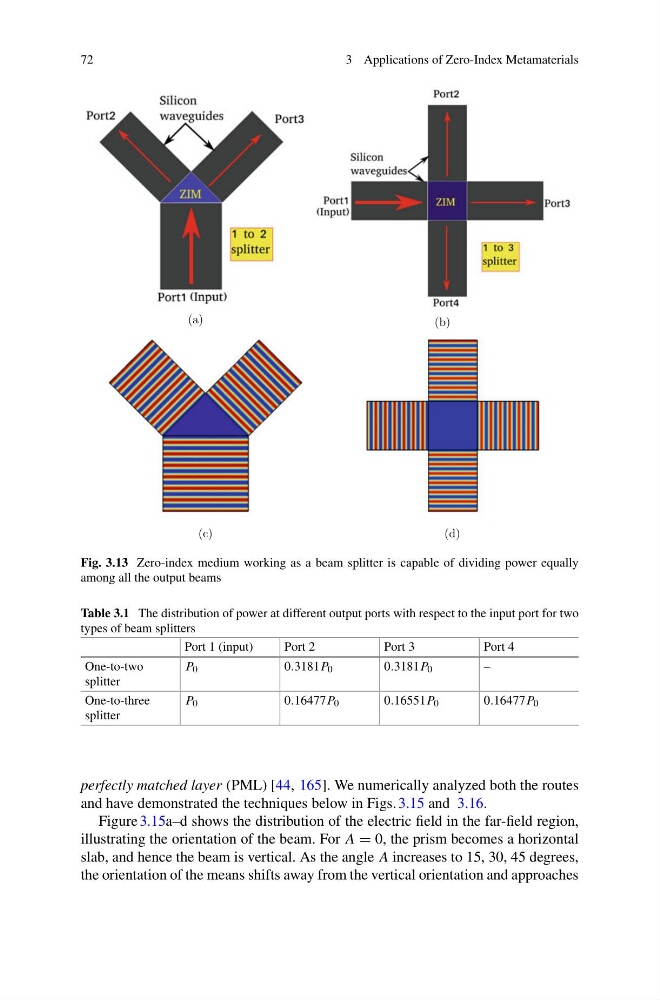
Fig. 3.13 Zero-index medium working as a beam splitter is capable of dividing power equally
among all the output beams
Table 3.1 The distribution of power at different output ports with respect to the input port for two
types of beam splitters
Port 1 (input)
Port 2
Port 3
Port 4
One-to-two
splitter
P 0
0.3181P 0
0.3181P 0
–
One-to-three
splitter
P 0
0.16477P 0
0.16551P 0
0.16477P 0
perfectly matched layer (PML) [44, 165]. We numerically analyzed both the routes
and have demonstrated the techniques below in Figs. 3.15 and 3.16.
Figure 3.15a–d shows the distribution of the electric field in the far-field region,
illustrating the orientation of the beam. For A = 0, the prism becomes a horizontal
slab, and hence the beam is vertical. As the angle A increases to 15, 30, 45 degrees,
the orientation of the means shifts away from the vertical orientation and approaches
3 Applications of Zero-Index Metamaterials
(a)
(b)
(c)
( d)
Fig. 3.13 Zero-index medium working as a beam splitter is capable of dividing power equally
among all the output beams
Table 3.1 The distribution of power at different output ports with respect to the input port for two
types of beam splitters
Port 1 (input)
Port 2
Port 3
Port 4
One-to-two
splitter
P 0
0.3181P 0
0.3181P 0
–
One-to-three
splitter
P 0
0.16477P 0
0.16551P 0
0.16477P 0
perfectly matched layer (PML) [44, 165]. We numerically analyzed both the routes
and have demonstrated the techniques below in Figs. 3.15 and 3.16.
Figure 3.15a–d shows the distribution of the electric field in the far-field region,
illustrating the orientation of the beam. For A = 0, the prism becomes a horizontal
slab, and hence the beam is vertical. As the angle A increases to 15, 30, 45 degrees,
the orientation of the means shifts away from the vertical orientation and approaches