

2.8 Tunability of a Zero-Index Metamaterial
55
(a)
(b)
(c)
(d)
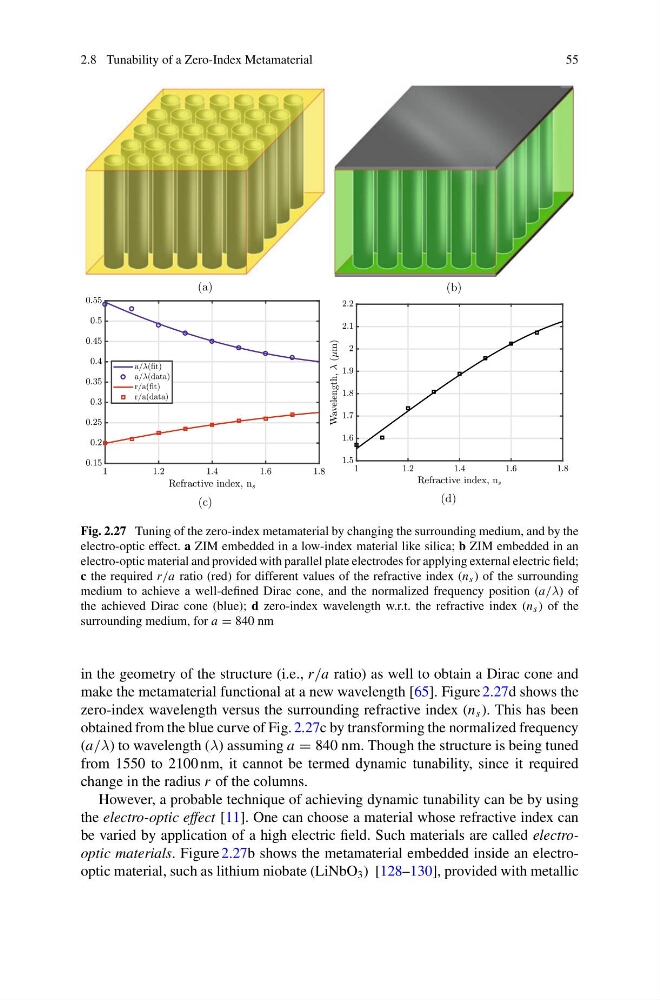
Fig. 2.27 Tuning of the zero-index metamaterial by changing the surrounding medium, and by the
electro-optic effect. a ZIM embedded in a low-index material like silica; b ZIM embedded in an
electro-optic material and provided with parallel plate electrodes for applying external electric field;
c the required r/a ratio (red) for different values of the refractive index (n s ) of the surrounding
medium to achieve a well-defined Dirac cone, and the normalized frequency position (a/λ) of
the achieved Dirac cone (blue); d zero-index wavelength w.r.t. the refractive index (n s ) of the
surrounding medium, for a = 840 nm
in the geometry of the structure (i.e., r/a ratio) as well to obtain a Dirac cone and
make the metamaterial functional at a new wavelength [65]. Figure 2.27d shows the
zero-index wavelength versus the surrounding refractive index (n s ). This has been
obtained from the blue curve of Fig. 2.27c by transforming the normalized frequency
(a/λ) to wavelength (λ) assuming a = 840 nm. Though the structure is being tuned
from 1550 to 2100 nm, it cannot be termed dynamic tunability, since it required
change in the radius r of the columns.
However, a probable technique of achieving dynamic tunability can be by using
the electro-optic effect [11]. One can choose a material whose refractive index can
be varied by application of a high electric field. Such materials are called electrooptic materials. Figure 2.27b shows the metamaterial embedded inside an electrooptic material, such as lithium niobate (LiNbO 3 ) [128–130], provided with metallic
55
(a)
(b)
(c)
(d)
Fig. 2.27 Tuning of the zero-index metamaterial by changing the surrounding medium, and by the
electro-optic effect. a ZIM embedded in a low-index material like silica; b ZIM embedded in an
electro-optic material and provided with parallel plate electrodes for applying external electric field;
c the required r/a ratio (red) for different values of the refractive index (n s ) of the surrounding
medium to achieve a well-defined Dirac cone, and the normalized frequency position (a/λ) of
the achieved Dirac cone (blue); d zero-index wavelength w.r.t. the refractive index (n s ) of the
surrounding medium, for a = 840 nm
in the geometry of the structure (i.e., r/a ratio) as well to obtain a Dirac cone and
make the metamaterial functional at a new wavelength [65]. Figure 2.27d shows the
zero-index wavelength versus the surrounding refractive index (n s ). This has been
obtained from the blue curve of Fig. 2.27c by transforming the normalized frequency
(a/λ) to wavelength (λ) assuming a = 840 nm. Though the structure is being tuned
from 1550 to 2100 nm, it cannot be termed dynamic tunability, since it required
change in the radius r of the columns.
However, a probable technique of achieving dynamic tunability can be by using
the electro-optic effect [11]. One can choose a material whose refractive index can
be varied by application of a high electric field. Such materials are called electrooptic materials. Figure 2.27b shows the metamaterial embedded inside an electrooptic material, such as lithium niobate (LiNbO 3 ) [128–130], provided with metallic