

50
2 Zero-Index Metamaterials
(a)
(b)
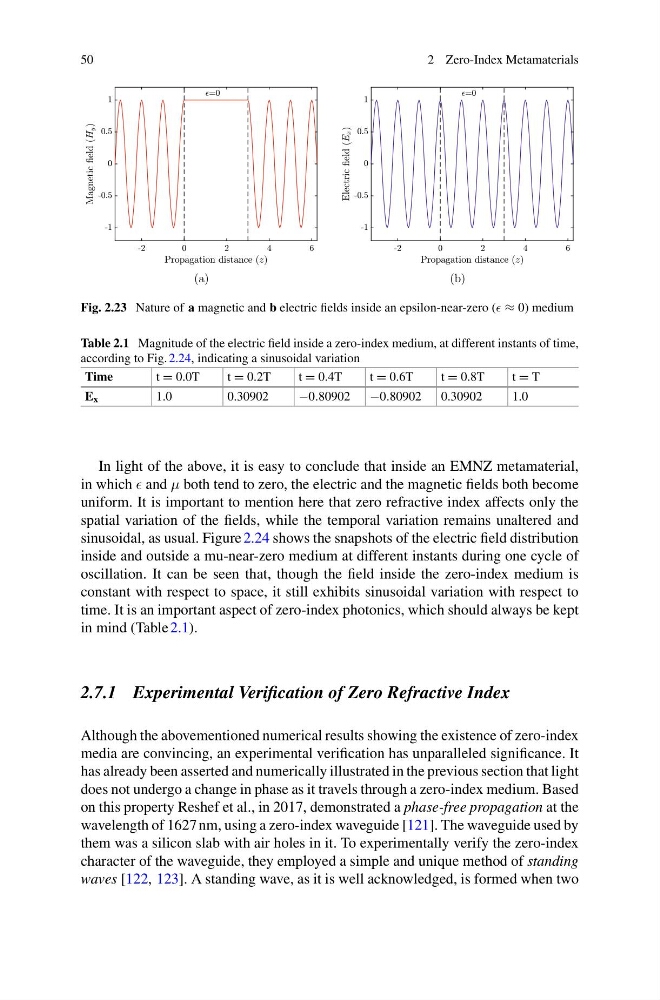
Fig. 2.23 Nature of a magnetic and b electric fields inside an epsilon-near-zero ( ≈ 0) medium
Table 2.1 Magnitude of the electric field inside a zero-index medium, at different instants of time,
according to Fig. 2.24, indicating a sinusoidal variation
Time
t = 0.0T
t = 0.2T
t = 0.4T
t = 0.6T
t = 0.8T
t = T
E x
1.0
0.30902
−0.80902
−0.80902
0.30902
1.0
In light of the above, it is easy to conclude that inside an EMNZ metamaterial,
in which and μ both tend to zero, the electric and the magnetic fields both become
uniform. It is important to mention here that zero refractive index affects only the
spatial variation of the fields, while the temporal variation remains unaltered and
sinusoidal, as usual. Figure 2.24 shows the snapshots of the electric field distribution
inside and outside a mu-near-zero medium at different instants during one cycle of
oscillation. It can be seen that, though the field inside the zero-index medium is
constant with respect to space, it still exhibits sinusoidal variation with respect to
time. It is an important aspect of zero-index photonics, which should always be kept
in mind (Table 2.1).
2.7.1 Experimental Verification of Zero Refractive Index
Although the abovementioned numerical results showing the existence of zero-index
media are convincing, an experimental verification has unparalleled significance. It
has already been asserted and numerically illustrated in the previous section that light
does not undergo a change in phase as it travels through a zero-index medium. Based
on this property Reshef et al., in 2017, demonstrated a phase-free propagation at the
wavelength of 1627 nm, using a zero-index waveguide [121]. The waveguide used by
them was a silicon slab with air holes in it. To experimentally verify the zero-index
character of the waveguide, they employed a simple and unique method of standing
waves [122, 123]. A standing wave, as it is well acknowledged, is formed when two
2 Zero-Index Metamaterials
(a)
(b)
Fig. 2.23 Nature of a magnetic and b electric fields inside an epsilon-near-zero ( ≈ 0) medium
Table 2.1 Magnitude of the electric field inside a zero-index medium, at different instants of time,
according to Fig. 2.24, indicating a sinusoidal variation
Time
t = 0.0T
t = 0.2T
t = 0.4T
t = 0.6T
t = 0.8T
t = T
E x
1.0
0.30902
−0.80902
−0.80902
0.30902
1.0
In light of the above, it is easy to conclude that inside an EMNZ metamaterial,
in which and μ both tend to zero, the electric and the magnetic fields both become
uniform. It is important to mention here that zero refractive index affects only the
spatial variation of the fields, while the temporal variation remains unaltered and
sinusoidal, as usual. Figure 2.24 shows the snapshots of the electric field distribution
inside and outside a mu-near-zero medium at different instants during one cycle of
oscillation. It can be seen that, though the field inside the zero-index medium is
constant with respect to space, it still exhibits sinusoidal variation with respect to
time. It is an important aspect of zero-index photonics, which should always be kept
in mind (Table 2.1).
2.7.1 Experimental Verification of Zero Refractive Index
Although the abovementioned numerical results showing the existence of zero-index
media are convincing, an experimental verification has unparalleled significance. It
has already been asserted and numerically illustrated in the previous section that light
does not undergo a change in phase as it travels through a zero-index medium. Based
on this property Reshef et al., in 2017, demonstrated a phase-free propagation at the
wavelength of 1627 nm, using a zero-index waveguide [121]. The waveguide used by
them was a silicon slab with air holes in it. To experimentally verify the zero-index
character of the waveguide, they employed a simple and unique method of standing
waves [122, 123]. A standing wave, as it is well acknowledged, is formed when two