

48
2 Zero-Index Metamaterials
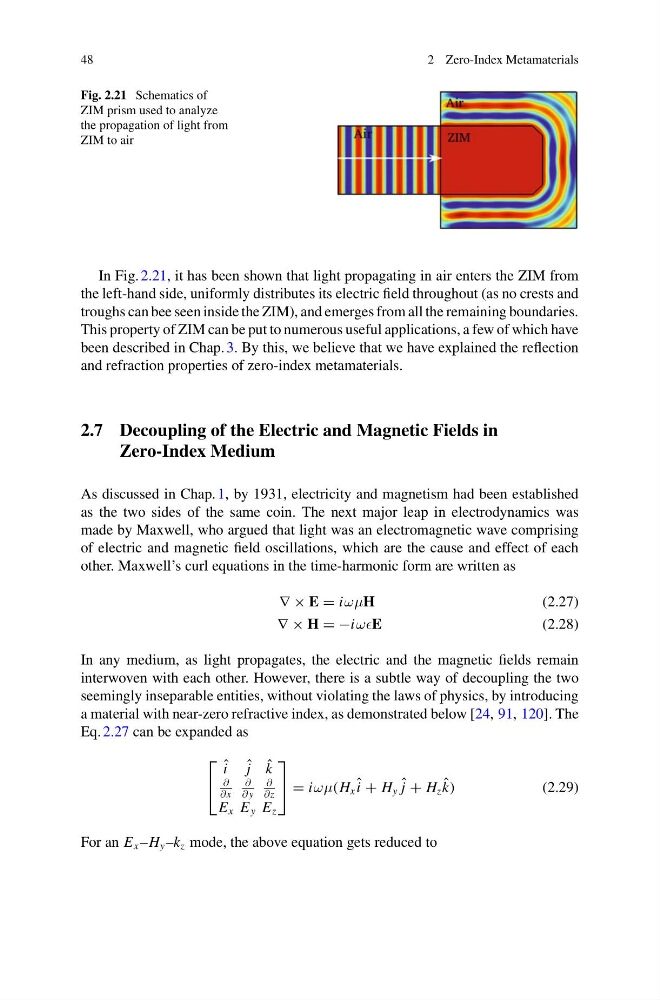
Fig. 2.21 Schematics of
ZIM prism used to analyze
the propagation of light from
ZIM to air
In Fig. 2.21, it has been shown that light propagating in air enters the ZIM from
the left-hand side, uniformly distributes its electric field throughout (as no crests and
troughs can bee seen inside the ZIM), and emerges from all the remaining boundaries.
This property of ZIM can be put to numerous useful applications, a few of which have
been described in Chap. 3. By this, we believe that we have explained the reflection
and refraction properties of zero-index metamaterials.
2.7 Decoupling of the Electric and Magnetic Fields in
Zero-Index Medium
As discussed in Chap. 1, by 1931, electricity and magnetism had been established
as the two sides of the same coin. The next major leap in electrodynamics was
made by Maxwell, who argued that light was an electromagnetic wave comprising
of electric and magnetic field oscillations, which are the cause and effect of each
other. Maxwell’s curl equations in the time-harmonic form are written as
∇ × E = iωμH
(2.27)
∇ × H = −iωωE
(2.28)
In any medium, as light propagates, the electric and the magnetic fields remain
interwoven with each other. However, there is a subtle way of decoupling the two
seemingly inseparable entities, without violating the laws of physics, by introducing
a material with near-zero refractive index, as demonstrated below [24, 91, 120]. The
Eq. 2.27 can be expanded as
⎡
⎣
ˆ
i ˆ
j ˆ
k
∂
∂x
∂
∂ y
∂
∂z
E x E y E z
⎤
⎦ = iωμ(H x ˆ
i + H y ˆ
j + H z ˆ
k)
(2.29)
For an E x –H y –k z mode, the above equation gets reduced to
2 Zero-Index Metamaterials
Fig. 2.21 Schematics of
ZIM prism used to analyze
the propagation of light from
ZIM to air
In Fig. 2.21, it has been shown that light propagating in air enters the ZIM from
the left-hand side, uniformly distributes its electric field throughout (as no crests and
troughs can bee seen inside the ZIM), and emerges from all the remaining boundaries.
This property of ZIM can be put to numerous useful applications, a few of which have
been described in Chap. 3. By this, we believe that we have explained the reflection
and refraction properties of zero-index metamaterials.
2.7 Decoupling of the Electric and Magnetic Fields in
Zero-Index Medium
As discussed in Chap. 1, by 1931, electricity and magnetism had been established
as the two sides of the same coin. The next major leap in electrodynamics was
made by Maxwell, who argued that light was an electromagnetic wave comprising
of electric and magnetic field oscillations, which are the cause and effect of each
other. Maxwell’s curl equations in the time-harmonic form are written as
∇ × E = iωμH
(2.27)
∇ × H = −iωωE
(2.28)
In any medium, as light propagates, the electric and the magnetic fields remain
interwoven with each other. However, there is a subtle way of decoupling the two
seemingly inseparable entities, without violating the laws of physics, by introducing
a material with near-zero refractive index, as demonstrated below [24, 91, 120]. The
Eq. 2.27 can be expanded as
⎡
⎣
ˆ
i ˆ
j ˆ
k
∂
∂x
∂
∂ y
∂
∂z
E x E y E z
⎤
⎦ = iωμ(H x ˆ
i + H y ˆ
j + H z ˆ
k)
(2.29)
For an E x –H y –k z mode, the above equation gets reduced to