

46
2 Zero-Index Metamaterials
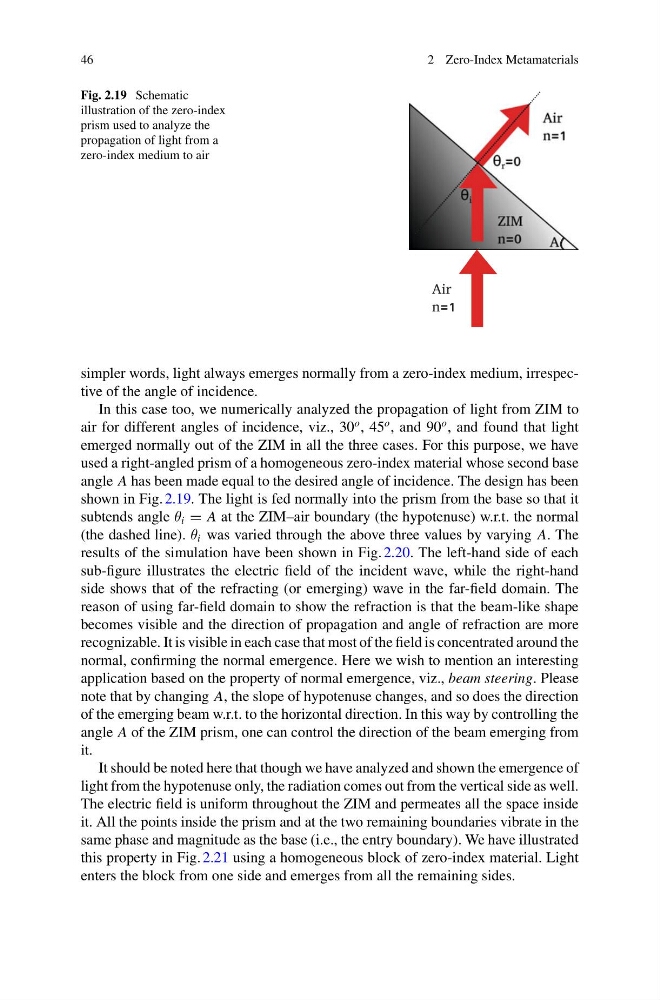
Fig. 2.19 Schematic
illustration of the zero-index
prism used to analyze the
propagation of light from a
zero-index medium to air
simpler words, light always emerges normally from a zero-index medium, irrespective of the angle of incidence.
In this case too, we numerically analyzed the propagation of light from ZIM to
air for different angles of incidence, viz., 30
o , 45
o , and 90
o , and found that light
emerged normally out of the ZIM in all the three cases. For this purpose, we have
used a right-angled prism of a homogeneous zero-index material whose second base
angle A has been made equal to the desired angle of incidence. The design has been
shown in Fig. 2.19. The light is fed normally into the prism from the base so that it
subtends angle θ i = A at the ZIM–air boundary (the hypotenuse) w.r.t. the normal
(the dashed line). θ i was varied through the above three values by varying A. The
results of the simulation have been shown in Fig. 2.20. The left-hand side of each
sub-figure illustrates the electric field of the incident wave, while the right-hand
side shows that of the refracting (or emerging) wave in the far-field domain. The
reason of using far-field domain to show the refraction is that the beam-like shape
becomes visible and the direction of propagation and angle of refraction are more
recognizable. It is visible in each case that most of the field is concentrated around the
normal, confirming the normal emergence. Here we wish to mention an interesting
application based on the property of normal emergence, viz., beam steering. Please
note that by changing A, the slope of hypotenuse changes, and so does the direction
of the emerging beam w.r.t. to the horizontal direction. In this way by controlling the
angle A of the ZIM prism, one can control the direction of the beam emerging from
it.
It should be noted here that though we have analyzed and shown the emergence of
light from the hypotenuse only, the radiation comes out from the vertical side as well.
The electric field is uniform throughout the ZIM and permeates all the space inside
it. All the points inside the prism and at the two remaining boundaries vibrate in the
same phase and magnitude as the base (i.e., the entry boundary). We have illustrated
this property in Fig. 2.21 using a homogeneous block of zero-index material. Light
enters the block from one side and emerges from all the remaining sides.
2 Zero-Index Metamaterials
Fig. 2.19 Schematic
illustration of the zero-index
prism used to analyze the
propagation of light from a
zero-index medium to air
simpler words, light always emerges normally from a zero-index medium, irrespective of the angle of incidence.
In this case too, we numerically analyzed the propagation of light from ZIM to
air for different angles of incidence, viz., 30
o , 45
o , and 90
o , and found that light
emerged normally out of the ZIM in all the three cases. For this purpose, we have
used a right-angled prism of a homogeneous zero-index material whose second base
angle A has been made equal to the desired angle of incidence. The design has been
shown in Fig. 2.19. The light is fed normally into the prism from the base so that it
subtends angle θ i = A at the ZIM–air boundary (the hypotenuse) w.r.t. the normal
(the dashed line). θ i was varied through the above three values by varying A. The
results of the simulation have been shown in Fig. 2.20. The left-hand side of each
sub-figure illustrates the electric field of the incident wave, while the right-hand
side shows that of the refracting (or emerging) wave in the far-field domain. The
reason of using far-field domain to show the refraction is that the beam-like shape
becomes visible and the direction of propagation and angle of refraction are more
recognizable. It is visible in each case that most of the field is concentrated around the
normal, confirming the normal emergence. Here we wish to mention an interesting
application based on the property of normal emergence, viz., beam steering. Please
note that by changing A, the slope of hypotenuse changes, and so does the direction
of the emerging beam w.r.t. to the horizontal direction. In this way by controlling the
angle A of the ZIM prism, one can control the direction of the beam emerging from
it.
It should be noted here that though we have analyzed and shown the emergence of
light from the hypotenuse only, the radiation comes out from the vertical side as well.
The electric field is uniform throughout the ZIM and permeates all the space inside
it. All the points inside the prism and at the two remaining boundaries vibrate in the
same phase and magnitude as the base (i.e., the entry boundary). We have illustrated
this property in Fig. 2.21 using a homogeneous block of zero-index material. Light
enters the block from one side and emerges from all the remaining sides.