

38
2 Zero-Index Metamaterials
(a) Monopole
(b) Transverse dipole
(c) Longitudinal dipole
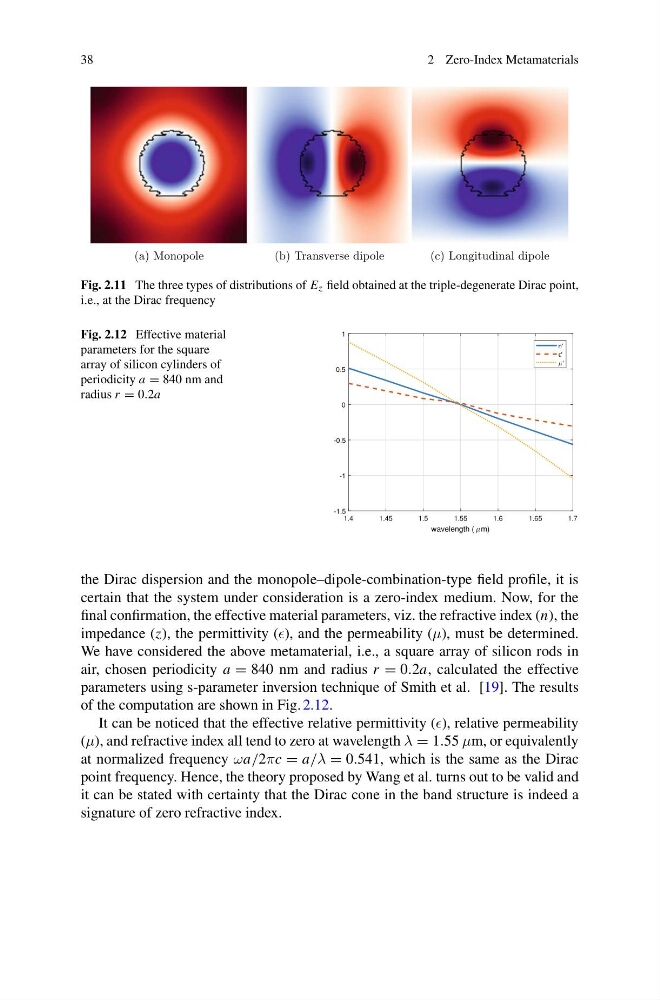
Fig. 2.11 The three types of distributions of E z field obtained at the triple-degenerate Dirac point,
i.e., at the Dirac frequency
Fig. 2.12 Effective material
parameters for the square
array of silicon cylinders of
periodicity a = 840 nm and
radius r = 0.2a
1.4
1.45
1.5
1.55
1.6
1.65
1.7
wavelength ( m)
-1.5
-1
-0.5
0
0.5
1
n'
'
the Dirac dispersion and the monopole–dipole-combination-type field profile, it is
certain that the system under consideration is a zero-index medium. Now, for the
final confirmation, the effective material parameters, viz. the refractive index (n), the
impedance (z), the permittivity (), and the permeability (μ), must be determined.
We have considered the above metamaterial, i.e., a square array of silicon rods in
air, chosen periodicity a = 840 nm and radius r = 0.2a, calculated the effective
parameters using s-parameter inversion technique of Smith et al. [19]. The results
of the computation are shown in Fig. 2.12.
It can be noticed that the effective relative permittivity ( relative permeability
(μ), and refractive index all tend to zero at wavelength λ = 1.55 μm, or equivalently
at normalized frequency ωa/2πc = a/λ = 0.541, which is the same as the Dirac
point frequency. Hence, the theory proposed by Wang et al. turns out to be valid and
it can be stated with certainty that the Dirac cone in the band structure is indeed a
signature of zero refractive index.
2 Zero-Index Metamaterials
(a) Monopole
(b) Transverse dipole
(c) Longitudinal dipole
Fig. 2.11 The three types of distributions of E z field obtained at the triple-degenerate Dirac point,
i.e., at the Dirac frequency
Fig. 2.12 Effective material
parameters for the square
array of silicon cylinders of
periodicity a = 840 nm and
radius r = 0.2a
1.4
1.45
1.5
1.55
1.6
1.65
1.7
wavelength ( m)
-1.5
-1
-0.5
0
0.5
1
n'
'
the Dirac dispersion and the monopole–dipole-combination-type field profile, it is
certain that the system under consideration is a zero-index medium. Now, for the
final confirmation, the effective material parameters, viz. the refractive index (n), the
impedance (z), the permittivity (), and the permeability (μ), must be determined.
We have considered the above metamaterial, i.e., a square array of silicon rods in
air, chosen periodicity a = 840 nm and radius r = 0.2a, calculated the effective
parameters using s-parameter inversion technique of Smith et al. [19]. The results
of the computation are shown in Fig. 2.12.
It can be noticed that the effective relative permittivity ( relative permeability
(μ), and refractive index all tend to zero at wavelength λ = 1.55 μm, or equivalently
at normalized frequency ωa/2πc = a/λ = 0.541, which is the same as the Dirac
point frequency. Hence, the theory proposed by Wang et al. turns out to be valid and
it can be stated with certainty that the Dirac cone in the band structure is indeed a
signature of zero refractive index.