

36
2 Zero-Index Metamaterials
(a)
-0.4 -0.2 0
k
x
(2 π/a)
0.2
-0.4
0.4
0.4
0.2
0
k
y
(2 π/a)
-0.2
0
0.2
0.4
ω a/ 2
π
0.6
0.8
1
0.4
0.2
0
k
y
(2 π/a
-0.2
-0.4 -0.2
0
k
x
(2 π/a)
-0.4
0.2 0.4
0.5
ω a/ 2
0.55
π
0.6
0.65
0.45
(b)
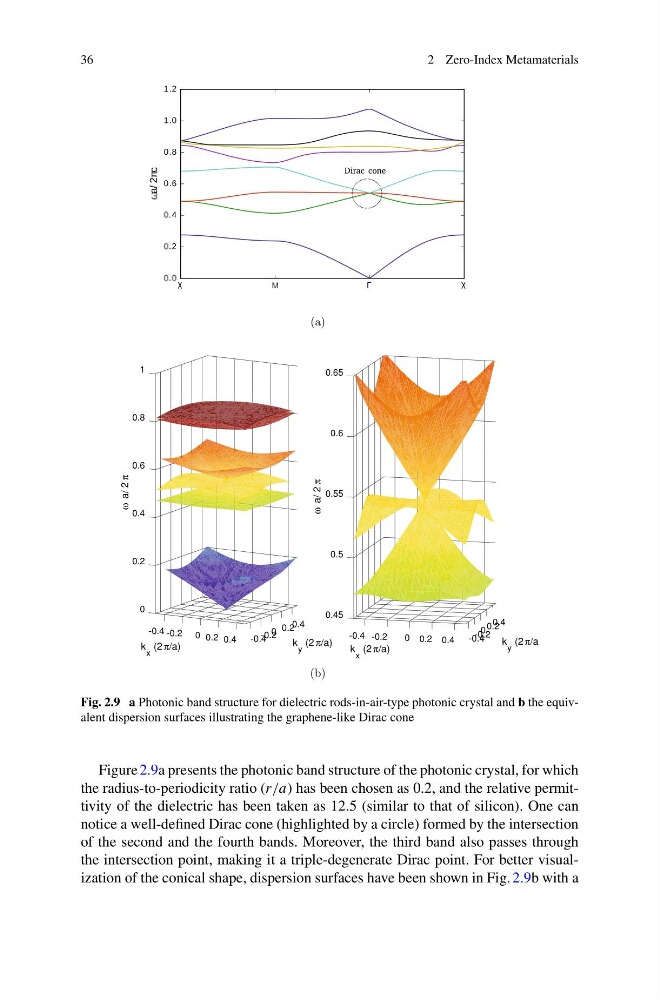
Fig. 2.9 a Photonic band structure for dielectric rods-in-air-type photonic crystal and b the equivalent dispersion surfaces illustrating the graphene-like Dirac cone
Figure 2.9a presents the photonic band structure of the photonic crystal, for which
the radius-to-periodicity ratio (r/a) has been chosen as 0.2, and the relative permittivity of the dielectric has been taken as 12.5 (similar to that of silicon). One can
notice a well-defined Dirac cone (highlighted by a circle) formed by the intersection
of the second and the fourth bands. Moreover, the third band also passes through
the intersection point, making it a triple-degenerate Dirac point. For better visualization of the conical shape, dispersion surfaces have been shown in Fig. 2.9b with a
2 Zero-Index Metamaterials
(a)
-0.4 -0.2 0
k
x
(2 π/a)
0.2
-0.4
0.4
0.4
0.2
0
k
y
(2 π/a)
-0.2
0
0.2
0.4
ω a/ 2
π
0.6
0.8
1
0.4
0.2
0
k
y
(2 π/a
-0.2
-0.4 -0.2
0
k
x
(2 π/a)
-0.4
0.2 0.4
0.5
ω a/ 2
0.55
π
0.6
0.65
0.45
(b)
Fig. 2.9 a Photonic band structure for dielectric rods-in-air-type photonic crystal and b the equivalent dispersion surfaces illustrating the graphene-like Dirac cone
Figure 2.9a presents the photonic band structure of the photonic crystal, for which
the radius-to-periodicity ratio (r/a) has been chosen as 0.2, and the relative permittivity of the dielectric has been taken as 12.5 (similar to that of silicon). One can
notice a well-defined Dirac cone (highlighted by a circle) formed by the intersection
of the second and the fourth bands. Moreover, the third band also passes through
the intersection point, making it a triple-degenerate Dirac point. For better visualization of the conical shape, dispersion surfaces have been shown in Fig. 2.9b with a