

2.4 Zero-Index Metamaterials
33
D
Dirac
Point
0.7
0.8
0.9
1
1.1
1.2
(10 9 rad/sec)
-0.5
-0.4
-0.3
-0.2
-0.1
0
0.1
0.2
0.3
0.4
0.5
k
x
(m -1
)
(a) Dirac dispersion (or Conical dispersion)
0.7
0.8
0.9
1
1.1
1.2
(10 9 rad/sec)
-1.2
-1
-0.8
-0.6
-0.4
-0.2
0
0.2
0.4
Refractive index (n)
D
(b) NZPI nature
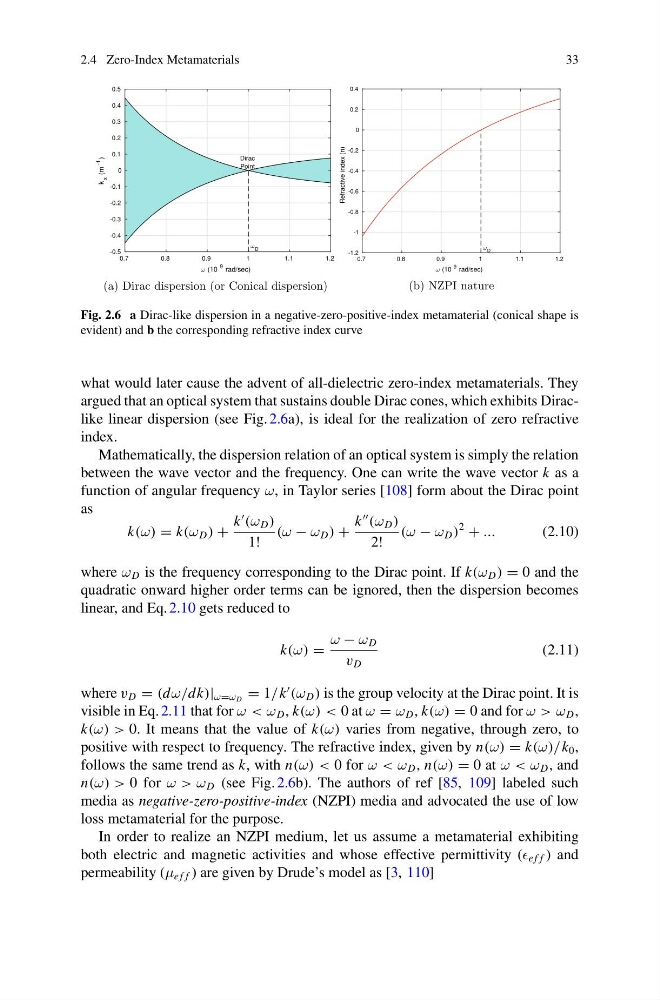
Fig. 2.6 a Dirac-like dispersion in a negative-zero-positive-index metamaterial (conical shape is
evident) and b the corresponding refractive index curve
what would later cause the advent of all-dielectric zero-index metamaterials. They
argued that an optical system that sustains double Dirac cones, which exhibits Diraclike linear dispersion (see Fig. 2.6a), is ideal for the realization of zero refractive
index.
Mathematically, the dispersion relation of an optical system is simply the relation
between the wave vector and the frequency. One can write the wave vector k as a
function of angular frequency ω, in Taylor series [108] form about the Dirac point
as
k(ω) = k(ω D ) +
k
(ω D )
1!
(ω − ω D ) +
k
(ω D )
2!
(ω − ω D )
2
+ ...
(2.10)
where ω D is the frequency corresponding to the Dirac point. If k(ω D ) = 0 and the
quadratic onward higher order terms can be ignored, then the dispersion becomes
linear, and Eq. 2.10 gets reduced to
k(ω) =
ω − ω D
v D
(2.11)
where v D = (dω/dk)| ω=ω D = 1/k
(ω D ) is the group velocity at the Dirac point. It is
visible in Eq. 2.11 that for ω < ω D , k(ω) < 0 at ω = ω D , k(ω) = 0 and for ω > ω D ,
k(ω) > 0. It means that the value of k(ω) varies from negative, through zero, to
positive with respect to frequency. The refractive index, given by n(ω) = k(ω)/k 0 ,
follows the same trend as k, with n(ω) < 0 for ω < ω D , n(ω) = 0 at ω < ω D , and
n(ω) > 0 for ω > ω D (see Fig. 2.6b). The authors of ref [85, 109] labeled such
media as negative-zero-positive-index (NZPI) media and advocated the use of low
loss metamaterial for the purpose.
In order to realize an NZPI medium, let us assume a metamaterial exhibiting
both electric and magnetic activities and whose effective permittivity ( e f f ) and
permeability (μ e f f ) are given by Drude’s model as [3, 110]
33
D
Dirac
Point
0.7
0.8
0.9
1
1.1
1.2
(10 9 rad/sec)
-0.5
-0.4
-0.3
-0.2
-0.1
0
0.1
0.2
0.3
0.4
0.5
k
x
(m -1
)
(a) Dirac dispersion (or Conical dispersion)
0.7
0.8
0.9
1
1.1
1.2
(10 9 rad/sec)
-1.2
-1
-0.8
-0.6
-0.4
-0.2
0
0.2
0.4
Refractive index (n)
D
(b) NZPI nature
Fig. 2.6 a Dirac-like dispersion in a negative-zero-positive-index metamaterial (conical shape is
evident) and b the corresponding refractive index curve
what would later cause the advent of all-dielectric zero-index metamaterials. They
argued that an optical system that sustains double Dirac cones, which exhibits Diraclike linear dispersion (see Fig. 2.6a), is ideal for the realization of zero refractive
index.
Mathematically, the dispersion relation of an optical system is simply the relation
between the wave vector and the frequency. One can write the wave vector k as a
function of angular frequency ω, in Taylor series [108] form about the Dirac point
as
k(ω) = k(ω D ) +
k
(ω D )
1!
(ω − ω D ) +
k
(ω D )
2!
(ω − ω D )
2
+ ...
(2.10)
where ω D is the frequency corresponding to the Dirac point. If k(ω D ) = 0 and the
quadratic onward higher order terms can be ignored, then the dispersion becomes
linear, and Eq. 2.10 gets reduced to
k(ω) =
ω − ω D
v D
(2.11)
where v D = (dω/dk)| ω=ω D = 1/k
(ω D ) is the group velocity at the Dirac point. It is
visible in Eq. 2.11 that for ω < ω D , k(ω) < 0 at ω = ω D , k(ω) = 0 and for ω > ω D ,
k(ω) > 0. It means that the value of k(ω) varies from negative, through zero, to
positive with respect to frequency. The refractive index, given by n(ω) = k(ω)/k 0 ,
follows the same trend as k, with n(ω) < 0 for ω < ω D , n(ω) = 0 at ω < ω D , and
n(ω) > 0 for ω > ω D (see Fig. 2.6b). The authors of ref [85, 109] labeled such
media as negative-zero-positive-index (NZPI) media and advocated the use of low
loss metamaterial for the purpose.
In order to realize an NZPI medium, let us assume a metamaterial exhibiting
both electric and magnetic activities and whose effective permittivity ( e f f ) and
permeability (μ e f f ) are given by Drude’s model as [3, 110]