

28
2 Zero-Index Metamaterials
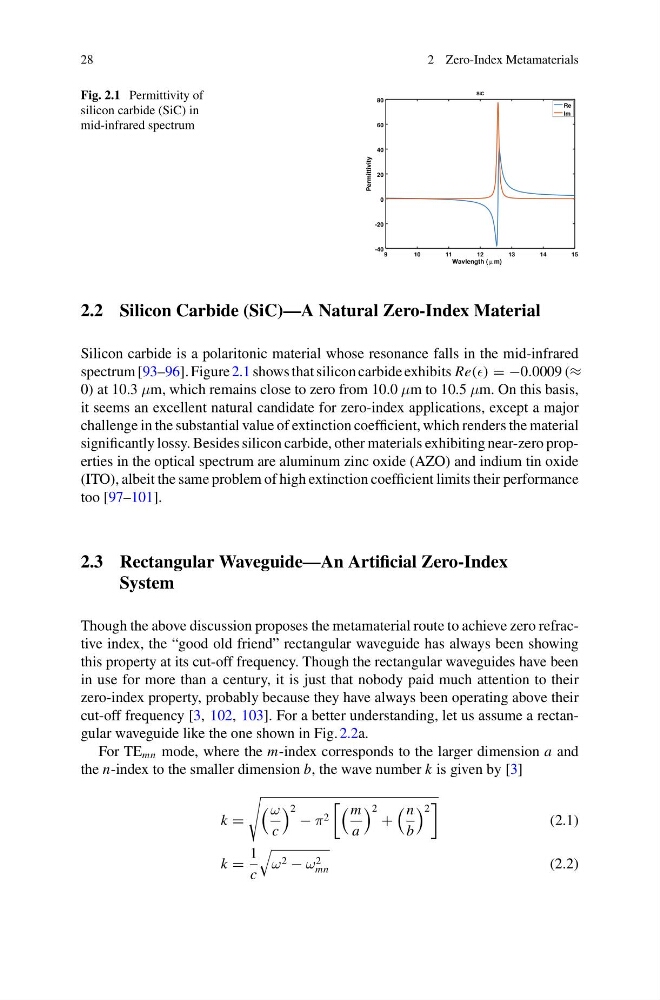
Fig. 2.1 Permittivity of
silicon carbide (SiC) in
mid-infrared spectrum
9
1 0
1 1
1 2
1 3
1 4
1 5
-40
-20
0
20
40
60
80
Wavlength ( μ m)
Permittivity
SiC
Re
Im
2.2 Silicon Carbide (SiC)—A Natural Zero-Index Material
Silicon carbide is a polaritonic material whose resonance falls in the mid-infrared
spectrum [93–96]. Figure 2.1 shows that silicon carbide exhibits Re( = −0.0009 (≈
0) at 10.3 μm, which remains close to zero from 10.0 μm to 10.5 μm. On this basis,
it seems an excellent natural candidate for zero-index applications, except a major
challenge in the substantial value of extinction coefficient, which renders the material
significantly lossy. Besides silicon carbide, other materials exhibiting near-zero properties in the optical spectrum are aluminum zinc oxide (AZO) and indium tin oxide
(ITO), albeit the same problem of high extinction coefficient limits their performance
too [97–101].
2.3 Rectangular Waveguide—An Artificial Zero-Index
System
Though the above discussion proposes the metamaterial route to achieve zero refractive index, the “good old friend” rectangular waveguide has always been showing
this property at its cut-off frequency. Though the rectangular waveguides have been
in use for more than a century, it is just that nobody paid much attention to their
zero-index property, probably because they have always been operating above their
cut-off frequency [3, 102, 103]. For a better understanding, let us assume a rectangular waveguide like the one shown in Fig. 2.2a.
For TE mn mode, where the m-index corresponds to the larger dimension a and
the n-index to the smaller dimension b, the wave number k is given by [3]
k =
ω
c
2 − π 2
m
a
2 +
n
b
2
(2.1)
k =
1
c
ω 2 − ω 2
mn
(2.2)
2 Zero-Index Metamaterials
Fig. 2.1 Permittivity of
silicon carbide (SiC) in
mid-infrared spectrum
9
1 0
1 1
1 2
1 3
1 4
1 5
-40
-20
0
20
40
60
80
Wavlength ( μ m)
Permittivity
SiC
Re
Im
2.2 Silicon Carbide (SiC)—A Natural Zero-Index Material
Silicon carbide is a polaritonic material whose resonance falls in the mid-infrared
spectrum [93–96]. Figure 2.1 shows that silicon carbide exhibits Re( = −0.0009 (≈
0) at 10.3 μm, which remains close to zero from 10.0 μm to 10.5 μm. On this basis,
it seems an excellent natural candidate for zero-index applications, except a major
challenge in the substantial value of extinction coefficient, which renders the material
significantly lossy. Besides silicon carbide, other materials exhibiting near-zero properties in the optical spectrum are aluminum zinc oxide (AZO) and indium tin oxide
(ITO), albeit the same problem of high extinction coefficient limits their performance
too [97–101].
2.3 Rectangular Waveguide—An Artificial Zero-Index
System
Though the above discussion proposes the metamaterial route to achieve zero refractive index, the “good old friend” rectangular waveguide has always been showing
this property at its cut-off frequency. Though the rectangular waveguides have been
in use for more than a century, it is just that nobody paid much attention to their
zero-index property, probably because they have always been operating above their
cut-off frequency [3, 102, 103]. For a better understanding, let us assume a rectangular waveguide like the one shown in Fig. 2.2a.
For TE mn mode, where the m-index corresponds to the larger dimension a and
the n-index to the smaller dimension b, the wave number k is given by [3]
k =
ω
c
2 − π 2
m
a
2 +
n
b
2
(2.1)
k =
1
c
ω 2 − ω 2
mn
(2.2)