

4.6 Second-Harmonic Generation
103
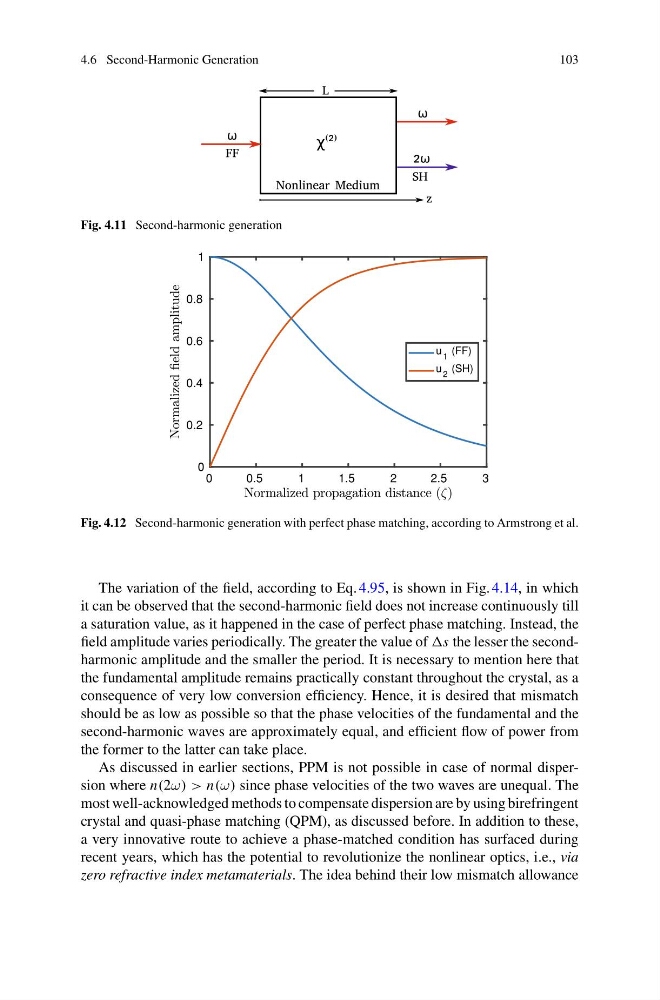
Fig. 4.11 Second-harmonic generation
0
0.5
1
1.5
2
2.5
3
0
0.2
0.4
0.6
0.8
1
u 1 (FF)
u 2 (SH)
Fig. 4.12 Second-harmonic generation with perfect phase matching, according to Armstrong et al.
The variation of the field, according to Eq. 4.95, is shown in Fig. 4.14, in which
it can be observed that the second-harmonic field does not increase continuously till
a saturation value, as it happened in the case of perfect phase matching. Instead, the
field amplitude varies periodically. The greater the value of the lesser the secondharmonic amplitude and the smaller the period. It is necessary to mention here that
the fundamental amplitude remains practically constant throughout the crystal, as a
consequence of very low conversion efficiency. Hence, it is desired that mismatch
should be as low as possible so that the phase velocities of the fundamental and the
second-harmonic waves are approximately equal, and efficient flow of power from
the former to the latter can take place.
As discussed in earlier sections, PPM is not possible in case of normal dispersion where n(2ω) > n(ω) since phase velocities of the two waves are unequal. The
most well-acknowledged methods to compensate dispersion are by using birefringent
crystal and quasi-phase matching (QPM), as discussed before. In addition to these,
a very innovative route to achieve a phase-matched condition has surfaced during
recent years, which has the potential to revolutionize the nonlinear optics, i.e., via
zero refractive index metamaterials. The idea behind their low mismatch allowance
103
Fig. 4.11 Second-harmonic generation
0
0.5
1
1.5
2
2.5
3
0
0.2
0.4
0.6
0.8
1
u 1 (FF)
u 2 (SH)
Fig. 4.12 Second-harmonic generation with perfect phase matching, according to Armstrong et al.
The variation of the field, according to Eq. 4.95, is shown in Fig. 4.14, in which
it can be observed that the second-harmonic field does not increase continuously till
a saturation value, as it happened in the case of perfect phase matching. Instead, the
field amplitude varies periodically. The greater the value of the lesser the secondharmonic amplitude and the smaller the period. It is necessary to mention here that
the fundamental amplitude remains practically constant throughout the crystal, as a
consequence of very low conversion efficiency. Hence, it is desired that mismatch
should be as low as possible so that the phase velocities of the fundamental and the
second-harmonic waves are approximately equal, and efficient flow of power from
the former to the latter can take place.
As discussed in earlier sections, PPM is not possible in case of normal dispersion where n(2ω) > n(ω) since phase velocities of the two waves are unequal. The
most well-acknowledged methods to compensate dispersion are by using birefringent
crystal and quasi-phase matching (QPM), as discussed before. In addition to these,
a very innovative route to achieve a phase-matched condition has surfaced during
recent years, which has the potential to revolutionize the nonlinear optics, i.e., via
zero refractive index metamaterials. The idea behind their low mismatch allowance