

100
4 Nonlinear Optics with Zero-Index Metamaterials
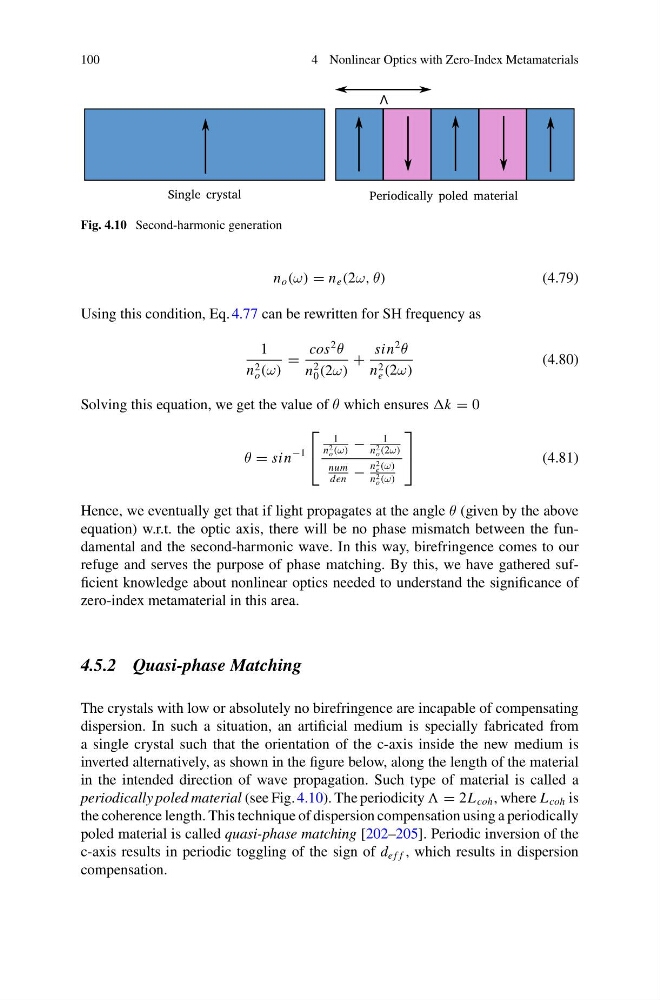
Fig. 4.10 Second-harmonic generation
n o (ω) = n e (2ω, θ)
(4.79)
Using this condition, Eq. 4.77 can be rewritten for SH frequency as
1
n 2
o (ω)
=
cos
2
θ
n
2
0 (2ω)
+
sin
2
θ
n 2
e (2ω)
(4.80)
Solving this equation, we get the value of θ which ensures = 0
θ = sin
−1
⎡
⎣
1
n 2
o (ω)
−
1
n 2
o (2ω)
num
den
−
n 2
e (ω)
n 2
o (ω)
⎤
⎦
(4.81)
Hence, we eventually get that if light propagates at the angle θ (given by the above
equation) w.r.t. the optic axis, there will be no phase mismatch between the fundamental and the second-harmonic wave. In this way, birefringence comes to our
refuge and serves the purpose of phase matching. By this, we have gathered sufficient knowledge about nonlinear optics needed to understand the significance of
zero-index metamaterial in this area.
4.5.2 Quasi-phase Matching
The crystals with low or absolutely no birefringence are incapable of compensating
dispersion. In such a situation, an artificial medium is specially fabricated from
a single crystal such that the orientation of the c-axis inside the new medium is
inverted alternatively, as shown in the figure below, along the length of the material
in the intended direction of wave propagation. Such type of material is called a
periodically poled material (see Fig. 4.10). The periodicity = 2L coh , where L coh is
the coherence length. This technique of dispersion compensation using a periodically
poled material is called quasi-phase matching [202–205]. Periodic inversion of the
c-axis results in periodic toggling of the sign of d e f f , which results in dispersion
compensation.
4 Nonlinear Optics with Zero-Index Metamaterials
Fig. 4.10 Second-harmonic generation
n o (ω) = n e (2ω, θ)
(4.79)
Using this condition, Eq. 4.77 can be rewritten for SH frequency as
1
n 2
o (ω)
=
cos
2
θ
n
2
0 (2ω)
+
sin
2
θ
n 2
e (2ω)
(4.80)
Solving this equation, we get the value of θ which ensures = 0
θ = sin
−1
⎡
⎣
1
n 2
o (ω)
−
1
n 2
o (2ω)
num
den
−
n 2
e (ω)
n 2
o (ω)
⎤
⎦
(4.81)
Hence, we eventually get that if light propagates at the angle θ (given by the above
equation) w.r.t. the optic axis, there will be no phase mismatch between the fundamental and the second-harmonic wave. In this way, birefringence comes to our
refuge and serves the purpose of phase matching. By this, we have gathered sufficient knowledge about nonlinear optics needed to understand the significance of
zero-index metamaterial in this area.
4.5.2 Quasi-phase Matching
The crystals with low or absolutely no birefringence are incapable of compensating
dispersion. In such a situation, an artificial medium is specially fabricated from
a single crystal such that the orientation of the c-axis inside the new medium is
inverted alternatively, as shown in the figure below, along the length of the material
in the intended direction of wave propagation. Such type of material is called a
periodically poled material (see Fig. 4.10). The periodicity = 2L coh , where L coh is
the coherence length. This technique of dispersion compensation using a periodically
poled material is called quasi-phase matching [202–205]. Periodic inversion of the
c-axis results in periodic toggling of the sign of d e f f , which results in dispersion
compensation.