

98
4 Nonlinear Optics with Zero-Index Metamaterials
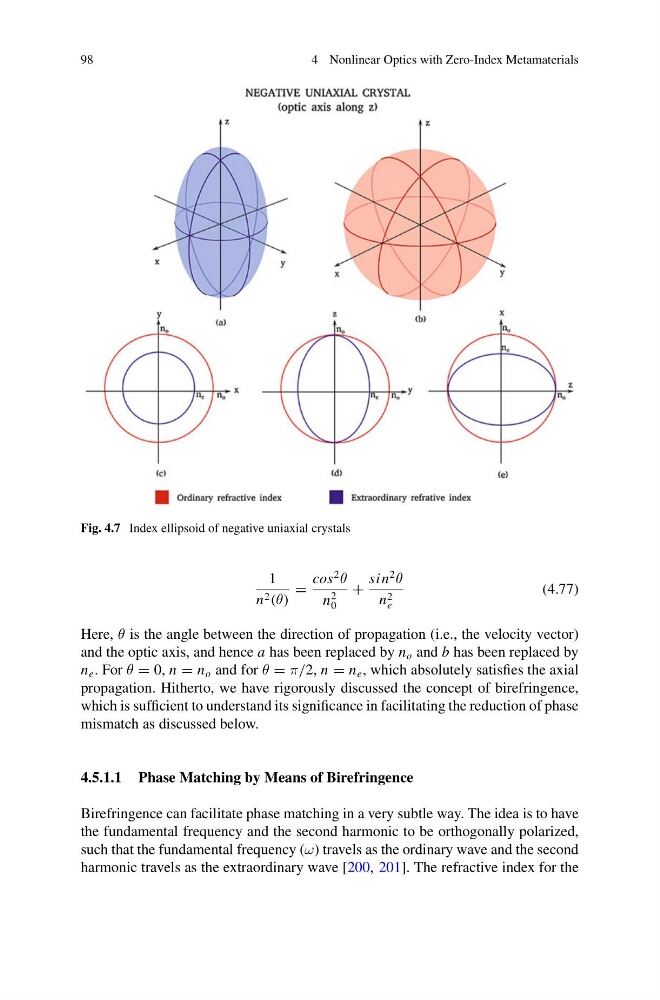
Fig. 4.7 Index ellipsoid of negative uniaxial crystals
1
n 2 (θ)
=
cos
2
θ
n
2
0
+
sin
2
θ
n 2
e
(4.77)
Here, θ is the angle between the direction of propagation (i.e., the velocity vector)
and the optic axis, and hence a has been replaced by n o and b has been replaced by
n e . For θ = 0, n = n o and for θ = π/2, n = n e , which absolutely satisfies the axial
propagation. Hitherto, we have rigorously discussed the concept of birefringence,
which is sufficient to understand its significance in facilitating the reduction of phase
mismatch as discussed below.
4.5.1.1 Phase Matching by Means of Birefringence
Birefringence can facilitate phase matching in a very subtle way. The idea is to have
the fundamental frequency and the second harmonic to be orthogonally polarized,
such that the fundamental frequency (ω) travels as the ordinary wave and the second
harmonic travels as the extraordinary wave [200, 201]. The refractive index for the
4 Nonlinear Optics with Zero-Index Metamaterials
Fig. 4.7 Index ellipsoid of negative uniaxial crystals
1
n 2 (θ)
=
cos
2
θ
n
2
0
+
sin
2
θ
n 2
e
(4.77)
Here, θ is the angle between the direction of propagation (i.e., the velocity vector)
and the optic axis, and hence a has been replaced by n o and b has been replaced by
n e . For θ = 0, n = n o and for θ = π/2, n = n e , which absolutely satisfies the axial
propagation. Hitherto, we have rigorously discussed the concept of birefringence,
which is sufficient to understand its significance in facilitating the reduction of phase
mismatch as discussed below.
4.5.1.1 Phase Matching by Means of Birefringence
Birefringence can facilitate phase matching in a very subtle way. The idea is to have
the fundamental frequency and the second harmonic to be orthogonally polarized,
such that the fundamental frequency (ω) travels as the ordinary wave and the second
harmonic travels as the extraordinary wave [200, 201]. The refractive index for the