

96
4 Nonlinear Optics with Zero-Index Metamaterials
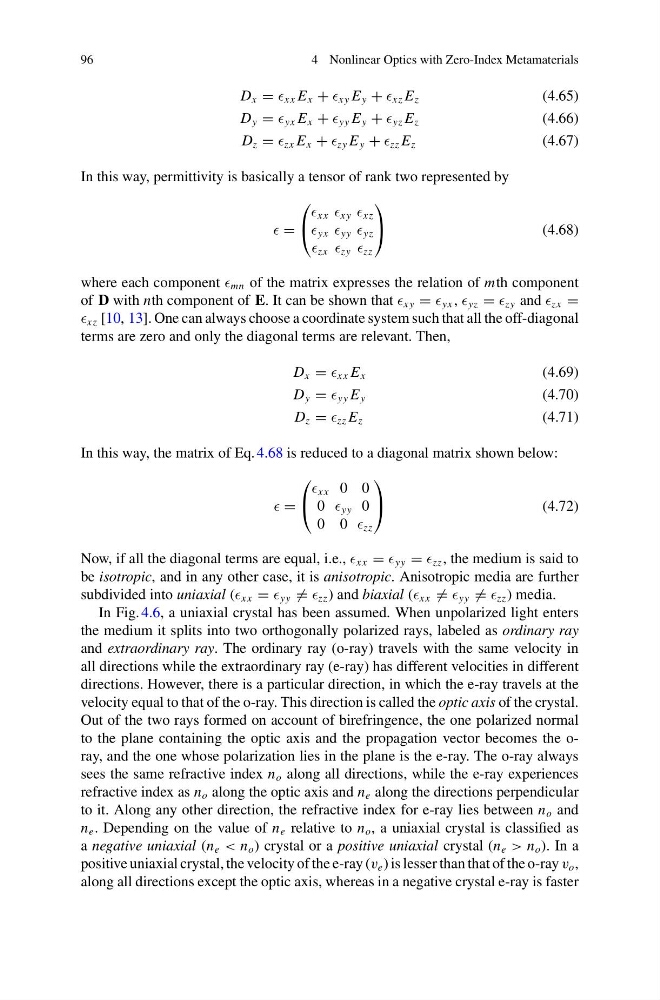
D x = xx E x + xy E y + xz E z
(4.65)
D y = yx E x + yy E y + yz E z
(4.66)
D z = zx E x + zy E y + zz E z
(4.67)
In this way, permittivity is basically a tensor of rank two represented by
=
⎛
⎝
xx xy xz
yx yy yz
zx zy zz
⎞
⎠
(4.68)
where each component mn of the matrix expresses the relation of mth component
of D with nth component of E. It can be shown that xy = yx , yz = zy and zx =
xz [10, 13]. One can always choose a coordinate system such that all the off-diagonal
terms are zero and only the diagonal terms are relevant. Then,
D x = xx E x
(4.69)
D y = yy E y
(4.70)
D z = zz E z
(4.71)
In this way, the matrix of Eq. 4.68 is reduced to a diagonal matrix shown below:
=
⎛
⎝
xx 0 0
0 yy 0
0 0 zz
⎞
⎠
(4.72)
Now, if all the diagonal terms are equal, i.e., xx = yy = zz , the medium is said to
be isotropic, and in any other case, it is anisotropic. Anisotropic media are further
subdivided into uniaxial ( xx = yy = zz ) and biaxial ( xx = yy = zz ) media.
In Fig. 4.6, a uniaxial crystal has been assumed. When unpolarized light enters
the medium it splits into two orthogonally polarized rays, labeled as ordinary ray
and extraordinary ray. The ordinary ray (o-ray) travels with the same velocity in
all directions while the extraordinary ray (e-ray) has different velocities in different
directions. However, there is a particular direction, in which the e-ray travels at the
velocity equal to that of the o-ray. This direction is called the optic axis of the crystal.
Out of the two rays formed on account of birefringence, the one polarized normal
to the plane containing the optic axis and the propagation vector becomes the oray, and the one whose polarization lies in the plane is the e-ray. The o-ray always
sees the same refractive index n o along all directions, while the e-ray experiences
refractive index as n o along the optic axis and n e along the directions perpendicular
to it. Along any other direction, the refractive index for e-ray lies between n o and
n e . Depending on the value of n e relative to n o , a uniaxial crystal is classified as
a negative uniaxial (n e < n o ) crystal or a positive uniaxial crystal (n e > n o ). In a
positive uniaxial crystal, the velocity of the e-ray (v e ) is lesser than that of the o-ray v o ,
along all directions except the optic axis, whereas in a negative crystal e-ray is faster
4 Nonlinear Optics with Zero-Index Metamaterials
D x = xx E x + xy E y + xz E z
(4.65)
D y = yx E x + yy E y + yz E z
(4.66)
D z = zx E x + zy E y + zz E z
(4.67)
In this way, permittivity is basically a tensor of rank two represented by
=
⎛
⎝
xx xy xz
yx yy yz
zx zy zz
⎞
⎠
(4.68)
where each component mn of the matrix expresses the relation of mth component
of D with nth component of E. It can be shown that xy = yx , yz = zy and zx =
xz [10, 13]. One can always choose a coordinate system such that all the off-diagonal
terms are zero and only the diagonal terms are relevant. Then,
D x = xx E x
(4.69)
D y = yy E y
(4.70)
D z = zz E z
(4.71)
In this way, the matrix of Eq. 4.68 is reduced to a diagonal matrix shown below:
=
⎛
⎝
xx 0 0
0 yy 0
0 0 zz
⎞
⎠
(4.72)
Now, if all the diagonal terms are equal, i.e., xx = yy = zz , the medium is said to
be isotropic, and in any other case, it is anisotropic. Anisotropic media are further
subdivided into uniaxial ( xx = yy = zz ) and biaxial ( xx = yy = zz ) media.
In Fig. 4.6, a uniaxial crystal has been assumed. When unpolarized light enters
the medium it splits into two orthogonally polarized rays, labeled as ordinary ray
and extraordinary ray. The ordinary ray (o-ray) travels with the same velocity in
all directions while the extraordinary ray (e-ray) has different velocities in different
directions. However, there is a particular direction, in which the e-ray travels at the
velocity equal to that of the o-ray. This direction is called the optic axis of the crystal.
Out of the two rays formed on account of birefringence, the one polarized normal
to the plane containing the optic axis and the propagation vector becomes the oray, and the one whose polarization lies in the plane is the e-ray. The o-ray always
sees the same refractive index n o along all directions, while the e-ray experiences
refractive index as n o along the optic axis and n e along the directions perpendicular
to it. Along any other direction, the refractive index for e-ray lies between n o and
n e . Depending on the value of n e relative to n o , a uniaxial crystal is classified as
a negative uniaxial (n e < n o ) crystal or a positive uniaxial crystal (n e > n o ). In a
positive uniaxial crystal, the velocity of the e-ray (v e ) is lesser than that of the o-ray v o ,
along all directions except the optic axis, whereas in a negative crystal e-ray is faster