

94
4 Nonlinear Optics with Zero-Index Metamaterials
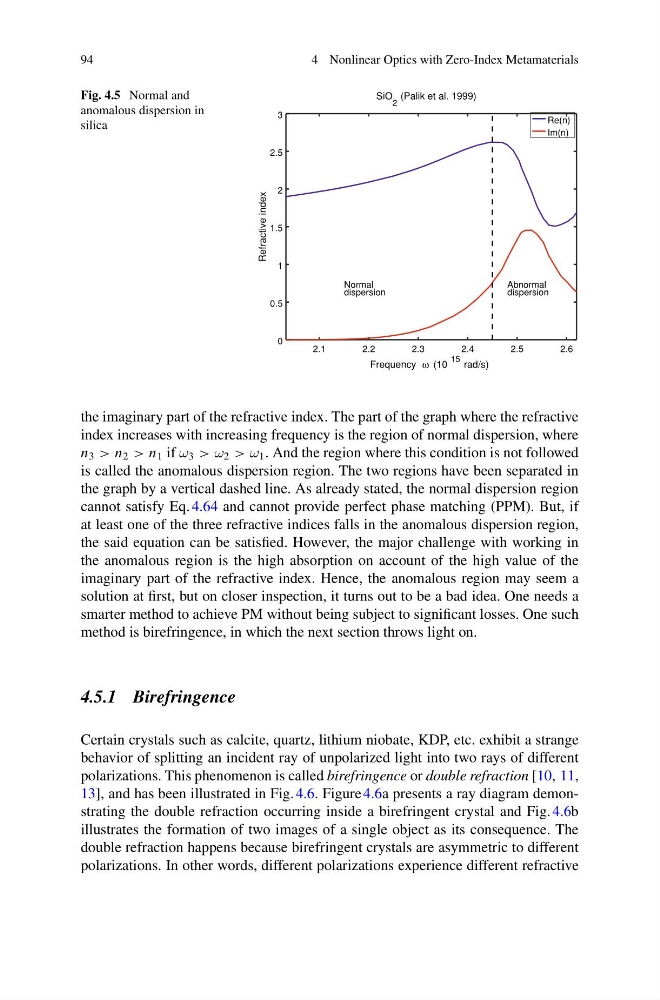
Fig. 4.5 Normal and
anomalous dispersion in
silica
2.1
2.2
2.3
2.4
2.5
2.6
0
0.5
1
1.5
2
2.5
3
Frequency ω (10
15 rad/s)
Refractive index
Abnormal
dispersion
Normal
dispersion
SiO
2
(Palik et al. 1999)
Re(n)
Im(n)
the imaginary part of the refractive index. The part of the graph where the refractive
index increases with increasing frequency is the region of normal dispersion, where
n 3 > n 2 > n 1 if ω 3 > ω 2 > ω 1 . And the region where this condition is not followed
is called the anomalous dispersion region. The two regions have been separated in
the graph by a vertical dashed line. As already stated, the normal dispersion region
cannot satisfy Eq. 4.64 and cannot provide perfect phase matching (PPM). But, if
at least one of the three refractive indices falls in the anomalous dispersion region,
the said equation can be satisfied. However, the major challenge with working in
the anomalous region is the high absorption on account of the high value of the
imaginary part of the refractive index. Hence, the anomalous region may seem a
solution at first, but on closer inspection, it turns out to be a bad idea. One needs a
smarter method to achieve PM without being subject to significant losses. One such
method is birefringence, in which the next section throws light on.
4.5.1 Birefringence
Certain crystals such as calcite, quartz, lithium niobate, KDP, etc. exhibit a strange
behavior of splitting an incident ray of unpolarized light into two rays of different
polarizations. This phenomenon is called birefringence or double refraction [10, 11,
13], and has been illustrated in Fig. 4.6. Figure 4.6a presents a ray diagram demonstrating the double refraction occurring inside a birefringent crystal and Fig. 4.6b
illustrates the formation of two images of a single object as its consequence. The
double refraction happens because birefringent crystals are asymmetric to different
polarizations. In other words, different polarizations experience different refractive
4 Nonlinear Optics with Zero-Index Metamaterials
Fig. 4.5 Normal and
anomalous dispersion in
silica
2.1
2.2
2.3
2.4
2.5
2.6
0
0.5
1
1.5
2
2.5
3
Frequency ω (10
15 rad/s)
Refractive index
Abnormal
dispersion
Normal
dispersion
SiO
2
(Palik et al. 1999)
Re(n)
Im(n)
the imaginary part of the refractive index. The part of the graph where the refractive
index increases with increasing frequency is the region of normal dispersion, where
n 3 > n 2 > n 1 if ω 3 > ω 2 > ω 1 . And the region where this condition is not followed
is called the anomalous dispersion region. The two regions have been separated in
the graph by a vertical dashed line. As already stated, the normal dispersion region
cannot satisfy Eq. 4.64 and cannot provide perfect phase matching (PPM). But, if
at least one of the three refractive indices falls in the anomalous dispersion region,
the said equation can be satisfied. However, the major challenge with working in
the anomalous region is the high absorption on account of the high value of the
imaginary part of the refractive index. Hence, the anomalous region may seem a
solution at first, but on closer inspection, it turns out to be a bad idea. One needs a
smarter method to achieve PM without being subject to significant losses. One such
method is birefringence, in which the next section throws light on.
4.5.1 Birefringence
Certain crystals such as calcite, quartz, lithium niobate, KDP, etc. exhibit a strange
behavior of splitting an incident ray of unpolarized light into two rays of different
polarizations. This phenomenon is called birefringence or double refraction [10, 11,
13], and has been illustrated in Fig. 4.6. Figure 4.6a presents a ray diagram demonstrating the double refraction occurring inside a birefringent crystal and Fig. 4.6b
illustrates the formation of two images of a single object as its consequence. The
double refraction happens because birefringent crystals are asymmetric to different
polarizations. In other words, different polarizations experience different refractive