

5.3 Goal and Scope Definition (Phase 1)
69
explanations of each phase and additional examples of applying LCA, see Jolliet
et al. (2015), Hauschild et al. (2018), and ISO (2006b).
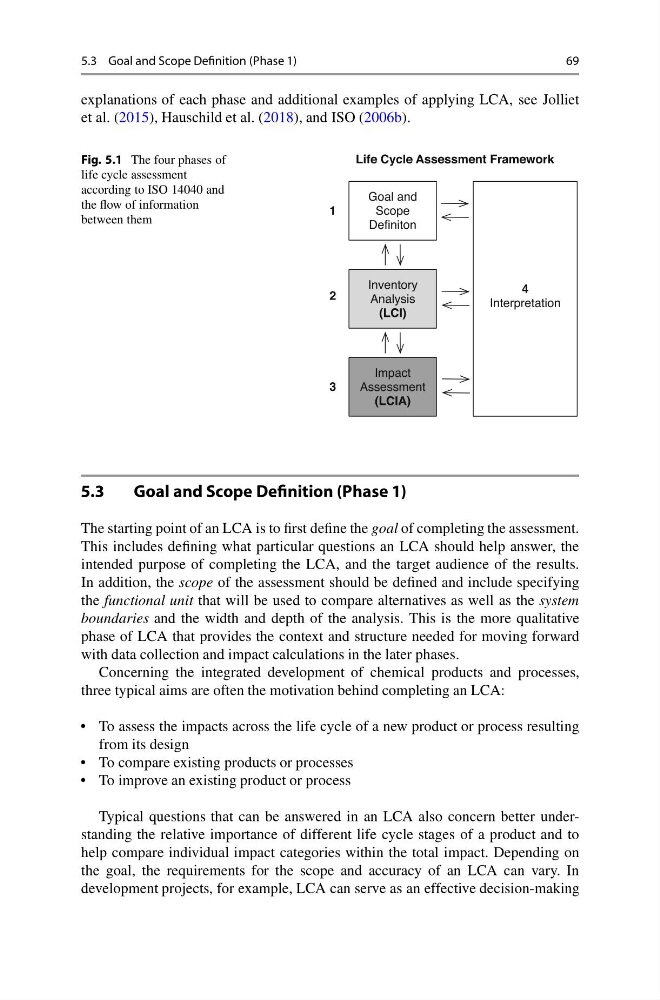
Fig. 5.1 The four phases of
life cycle assessment
according to ISO 14040 and
the flow of information
between them
5.3
Goal and Scope Definition (Phase 1)
The starting point of an LCA is to first define the goal of completing the assessment.
This includes defining what particular questions an LCA should help answer, the
intended purpose of completing the LCA, and the target audience of the results.
In addition, the scope of the assessment should be defined and include specifying
the functional unit that will be used to compare alternatives as well as the system
boundaries and the width and depth of the analysis. This is the more qualitative
phase of LCA that provides the context and structure needed for moving forward
with data collection and impact calculations in the later phases.
Concerning the integrated development of chemical products and processes,
three typical aims are often the motivation behind completing an LCA:
• To assess the impacts across the life cycle of a new product or process resulting
from its design
• To compare existing products or processes
• To improve an existing product or process
Typical questions that can be answered in an LCA also concern better understanding the relative importance of different life cycle stages of a product and to
help compare individual impact categories within the total impact. Depending on
the goal, the requirements for the scope and accuracy of an LCA can vary. In
development projects, for example, LCA can serve as an effective decision-making
69
explanations of each phase and additional examples of applying LCA, see Jolliet
et al. (2015), Hauschild et al. (2018), and ISO (2006b).
Fig. 5.1 The four phases of
life cycle assessment
according to ISO 14040 and
the flow of information
between them
5.3
Goal and Scope Definition (Phase 1)
The starting point of an LCA is to first define the goal of completing the assessment.
This includes defining what particular questions an LCA should help answer, the
intended purpose of completing the LCA, and the target audience of the results.
In addition, the scope of the assessment should be defined and include specifying
the functional unit that will be used to compare alternatives as well as the system
boundaries and the width and depth of the analysis. This is the more qualitative
phase of LCA that provides the context and structure needed for moving forward
with data collection and impact calculations in the later phases.
Concerning the integrated development of chemical products and processes,
three typical aims are often the motivation behind completing an LCA:
• To assess the impacts across the life cycle of a new product or process resulting
from its design
• To compare existing products or processes
• To improve an existing product or process
Typical questions that can be answered in an LCA also concern better understanding the relative importance of different life cycle stages of a product and to
help compare individual impact categories within the total impact. Depending on
the goal, the requirements for the scope and accuracy of an LCA can vary. In
development projects, for example, LCA can serve as an effective decision-making