

3.3 Product Legislation
39
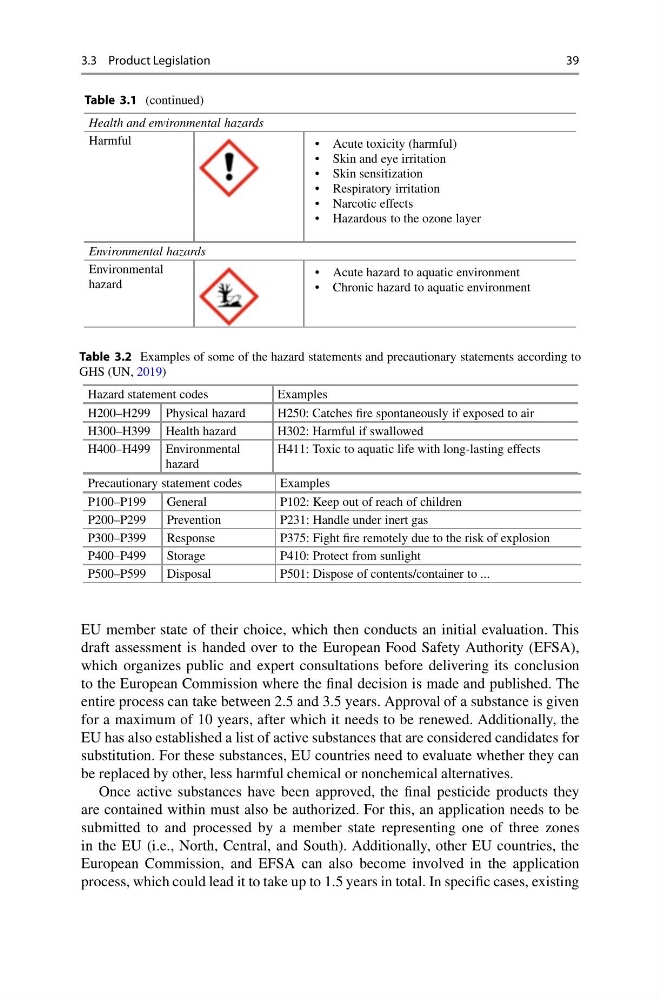
Table 3.1 (continued)
Health and environmental hazards
Harmful
• Acute toxicity (harmful)
• Skin and eye irritation
• Skin sensitization
• Respiratory irritation
• Narcotic effects
• Hazardous to the ozone layer
Environmental hazards
Environmental
hazard
• Acute hazard to aquatic environment
• Chronic hazard to aquatic environment
Table 3.2 Examples of some of the hazard statements and precautionary statements according to
GHS (UN, 2019)
Hazard statement codes
Examples
H200–H299 Physical hazard
H250: Catches fire spontaneously if exposed to air
H300–H399 Health hazard
H302: Harmful if swallowed
H400–H499 Environmental
hazard
H411: Toxic to aquatic life with long-lasting effects
Precautionary statement codes
Examples
P100–P199
General
P102: Keep out of reach of children
P200–P299
Prevention
P231: Handle under inert gas
P300–P399
Response
P375: Fight fire remotely due to the risk of explosion
P400–P499
Storage
P410: Protect from sunlight
P500–P599
Disposal
P501: Dispose of contents/container to ...
EU member state of their choice, which then conducts an initial evaluation. This
draft assessment is handed over to the European Food Safety Authority (EFSA),
which organizes public and expert consultations before delivering its conclusion
to the European Commission where the final decision is made and published. The
entire process can take between 2.5 and 3.5 years. Approval of a substance is given
for a maximum of 10 years, after which it needs to be renewed. Additionally, the
EU has also established a list of active substances that are considered candidates for
substitution. For these substances, EU countries need to evaluate whether they can
be replaced by other, less harmful chemical or nonchemical alternatives.
Once active substances have been approved, the final pesticide products they
are contained within must also be authorized. For this, an application needs to be
submitted to and processed by a member state representing one of three zones
in the EU (i.e., North, Central, and South). Additionally, other EU countries, the
European Commission, and EFSA can also become involved in the application
process, which could lead it to take up to 1.5 years in total. In specific cases, existing
39
Table 3.1 (continued)
Health and environmental hazards
Harmful
• Acute toxicity (harmful)
• Skin and eye irritation
• Skin sensitization
• Respiratory irritation
• Narcotic effects
• Hazardous to the ozone layer
Environmental hazards
Environmental
hazard
• Acute hazard to aquatic environment
• Chronic hazard to aquatic environment
Table 3.2 Examples of some of the hazard statements and precautionary statements according to
GHS (UN, 2019)
Hazard statement codes
Examples
H200–H299 Physical hazard
H250: Catches fire spontaneously if exposed to air
H300–H399 Health hazard
H302: Harmful if swallowed
H400–H499 Environmental
hazard
H411: Toxic to aquatic life with long-lasting effects
Precautionary statement codes
Examples
P100–P199
General
P102: Keep out of reach of children
P200–P299
Prevention
P231: Handle under inert gas
P300–P399
Response
P375: Fight fire remotely due to the risk of explosion
P400–P499
Storage
P410: Protect from sunlight
P500–P599
Disposal
P501: Dispose of contents/container to ...
EU member state of their choice, which then conducts an initial evaluation. This
draft assessment is handed over to the European Food Safety Authority (EFSA),
which organizes public and expert consultations before delivering its conclusion
to the European Commission where the final decision is made and published. The
entire process can take between 2.5 and 3.5 years. Approval of a substance is given
for a maximum of 10 years, after which it needs to be renewed. Additionally, the
EU has also established a list of active substances that are considered candidates for
substitution. For these substances, EU countries need to evaluate whether they can
be replaced by other, less harmful chemical or nonchemical alternatives.
Once active substances have been approved, the final pesticide products they
are contained within must also be authorized. For this, an application needs to be
submitted to and processed by a member state representing one of three zones
in the EU (i.e., North, Central, and South). Additionally, other EU countries, the
European Commission, and EFSA can also become involved in the application
process, which could lead it to take up to 1.5 years in total. In specific cases, existing