

310
G Case Study Solutions
• In addition, the installation of a depressurization valve and a rupture disk
followed by an alkaline absorption column for the case of HCN and H 2 S
release should be evaluated.
(b)
• HCN is still produced as a by-product.
G.3
Life Cycle Assessment
G.3.1 Phase 1: Goal and Scope Definition
(a) The goal of the LCA is to identify the sources of the largest impacts considering
climate change, toxicity, and cumulative energy demand for the current reaction
design to produce 3-amino-2-isopropylthio benzonitrile.
(b) Based on the description provided, the system boundaries can be defined
as illustrated in Fig. 10.3 and used to define the boundary for the process
risk assessment. The reactants (including solvents), heating energy, and waste
solvents are within the scope of this LCA.
(c) The production of one batch (290 kg) of the product 3-amino-2-isopropylthio
benzonitrile can be used as the functional unit.
(d) The target audience of this LCA is internal members of the company, which
likely includes process engineers and company management. While the process
engineers familiar with the plant may have highly relevant technical knowledge
in the field, management may not. Thus it is important to deliver the results of
the LCA in a format that would be understandable and useful for both groups.
G.3.2 Phase 2: Inventory Analysis
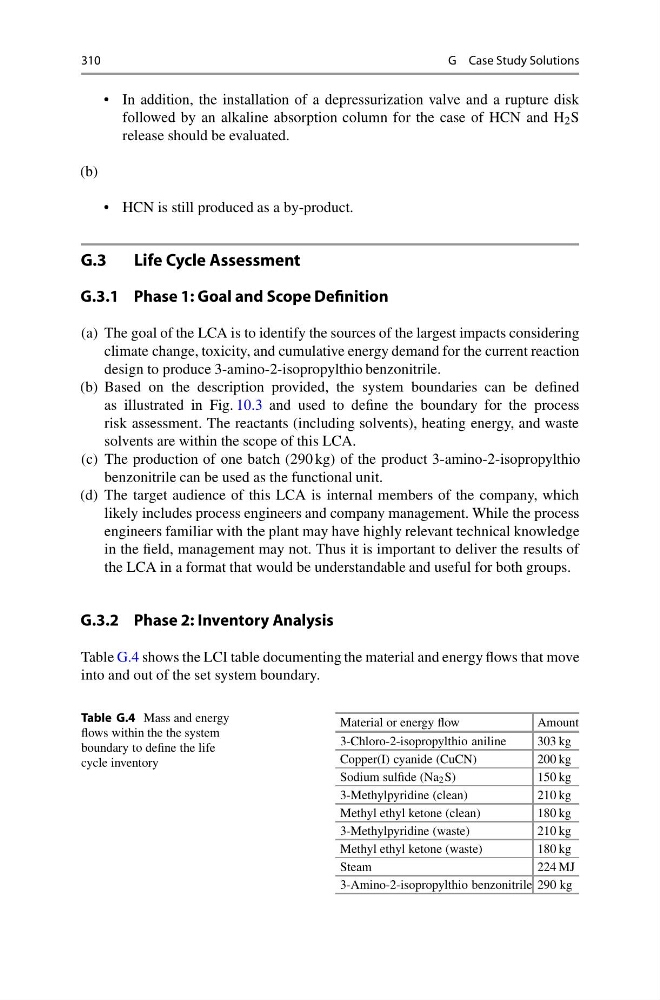
Table G.4 shows the LCI table documenting the material and energy flows that move
into and out of the set system boundary.
Table G.4 Mass and energy
flows within the the system
boundary to define the life
cycle inventory
Material or energy flow
Amount
3-Chloro-2-isopropylthio aniline
303 kg
Copper(I) cyanide (CuCN)
200 kg
Sodium sulfide (Na 2 S)
150 kg
3-Methylpyridine (clean)
210 kg
Methyl ethyl ketone (clean)
180 kg
3-Methylpyridine (waste)
210 kg
Methyl ethyl ketone (waste)
180 kg
Steam
224 MJ
3-Amino-2-isopropylthio benzonitrile 290 kg
G Case Study Solutions
• In addition, the installation of a depressurization valve and a rupture disk
followed by an alkaline absorption column for the case of HCN and H 2 S
release should be evaluated.
(b)
• HCN is still produced as a by-product.
G.3
Life Cycle Assessment
G.3.1 Phase 1: Goal and Scope Definition
(a) The goal of the LCA is to identify the sources of the largest impacts considering
climate change, toxicity, and cumulative energy demand for the current reaction
design to produce 3-amino-2-isopropylthio benzonitrile.
(b) Based on the description provided, the system boundaries can be defined
as illustrated in Fig. 10.3 and used to define the boundary for the process
risk assessment. The reactants (including solvents), heating energy, and waste
solvents are within the scope of this LCA.
(c) The production of one batch (290 kg) of the product 3-amino-2-isopropylthio
benzonitrile can be used as the functional unit.
(d) The target audience of this LCA is internal members of the company, which
likely includes process engineers and company management. While the process
engineers familiar with the plant may have highly relevant technical knowledge
in the field, management may not. Thus it is important to deliver the results of
the LCA in a format that would be understandable and useful for both groups.
G.3.2 Phase 2: Inventory Analysis
Table G.4 shows the LCI table documenting the material and energy flows that move
into and out of the set system boundary.
Table G.4 Mass and energy
flows within the the system
boundary to define the life
cycle inventory
Material or energy flow
Amount
3-Chloro-2-isopropylthio aniline
303 kg
Copper(I) cyanide (CuCN)
200 kg
Sodium sulfide (Na 2 S)
150 kg
3-Methylpyridine (clean)
210 kg
Methyl ethyl ketone (clean)
180 kg
3-Methylpyridine (waste)
210 kg
Methyl ethyl ketone (waste)
180 kg
Steam
224 MJ
3-Amino-2-isopropylthio benzonitrile 290 kg