

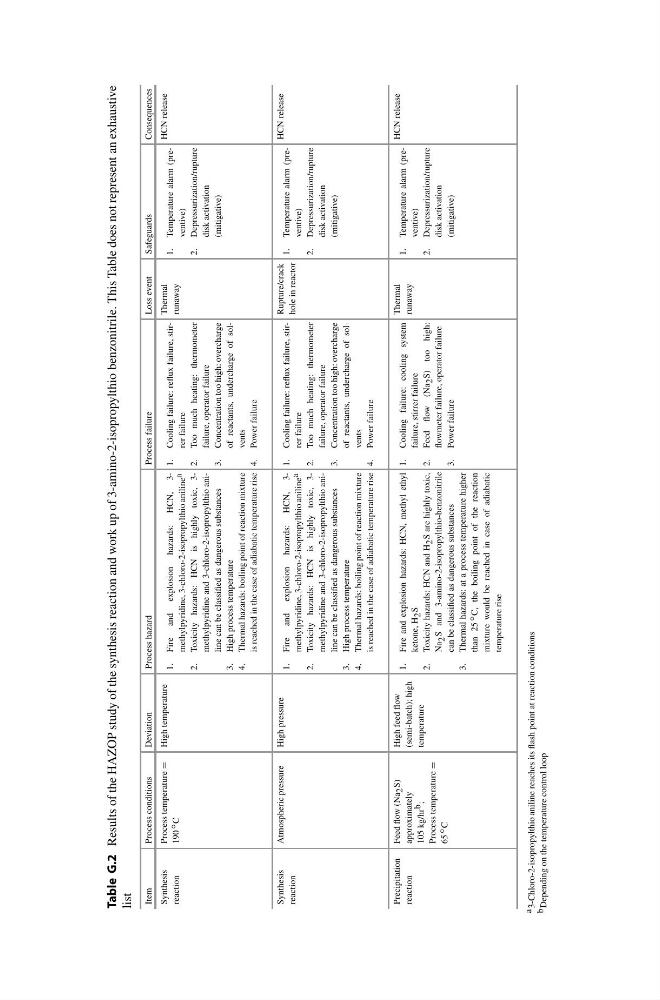
Table G.2
Results of the HAZOP study of the synthesis reaction and work up of 3-amino-2-isopropylthio benzonitrile. This Table does not represent an exhaustive
list
Item
Process conditions
Deviation
Process hazard
Process failure
Loss event
Safeguards
Consequences
Synthesis
reaction
Process temperature
=
190 ◦
C
High temperature
1. Fire and explosion hazards: HCN, 3methylpyridine, 3-chloro-2-isopropylthio aniline a
2. Toxicity hazards: HCN is highly toxic, 3methylpyridine and 3-chloro-2-isopropylthio aniline can be classified as dangerous substances
3. High process temperature
4. Thermal hazards: boiling point of reaction mixture
is reached in the case of adiabatic temperature rise
1. Cooling failure: reflux failure, stirrer failure
2. Too much heating: thermometer
failure, operator failure
3. Concentration too high: overcharge
of reactants, undercharge of solvents
4. Power failure
Thermal
runaway
1. Temperature alarm (preventive)
2. Depressurization/rupture
disk activation
(mitigative)
HCN release
Synthesis
reaction
Atmospheric pressure
High pressure
1. Fire and explosion hazards: HCN, 3methylpyridine, 3-chloro-2-isopropylthio aniline a
2. Toxicity hazards: HCN is highly toxic, 3methylpyridine and 3-chloro-2-isopropylthio aniline can be classified as dangerous substances
3. High process temperature
4. Thermal hazards: boiling point of reaction mixture
is reached in the case of adiabatic temperature rise
1. Cooling failure: reflux failure, stirrer failure
2. Too much heating: thermometer
failure, operator failure
3. Concentration too high: overcharge
of reactants, undercharge of solvents
4. Power failure
Rupture/crack
hole in reactor
1. Temperature alarm (preventive)
2. Depressurization/rupture
disk activation
(mitigative)
HCN release
Precipitation
reaction
Feed flow (Na
2 S)
approximately
105 kg/hr b
;
Process temperature
=
65 ◦
C
High feed flow
(semi-batch); high
temperature
1. Fire and explosion hazards: HCN, methyl ethyl
ketone, H
2 S
2. Toxicity hazards: HCN and H
2 S are highly toxic,
Na
2 S and 3-amino-2-isopropylthio-benzonitrile
can be classified as dangerous substances
3. Thermal hazards: at a process temperature higher
than 25 ◦
C, the boiling point of the reaction
mixture would be reached in case of adiabatic
temperature rise
1. Cooling failure: cooling system
failure, stirrer failure
2. Feed flow (Na
2 S) too high:
flowmeter failure, operator failure
3. Power failure
Thermal
runaway
1. Temperature alarm (preventive)
2. Depressurization/rupture
disk activation
(mitigative)
HCN release
a
3-Chloro-2-isopropylthio aniline reaches its flash point at reaction conditions
b
Depending on the temperature control loop
Results of the HAZOP study of the synthesis reaction and work up of 3-amino-2-isopropylthio benzonitrile. This Table does not represent an exhaustive
list
Item
Process conditions
Deviation
Process hazard
Process failure
Loss event
Safeguards
Consequences
Synthesis
reaction
Process temperature
=
190 ◦
C
High temperature
1. Fire and explosion hazards: HCN, 3methylpyridine, 3-chloro-2-isopropylthio aniline a
2. Toxicity hazards: HCN is highly toxic, 3methylpyridine and 3-chloro-2-isopropylthio aniline can be classified as dangerous substances
3. High process temperature
4. Thermal hazards: boiling point of reaction mixture
is reached in the case of adiabatic temperature rise
1. Cooling failure: reflux failure, stirrer failure
2. Too much heating: thermometer
failure, operator failure
3. Concentration too high: overcharge
of reactants, undercharge of solvents
4. Power failure
Thermal
runaway
1. Temperature alarm (preventive)
2. Depressurization/rupture
disk activation
(mitigative)
HCN release
Synthesis
reaction
Atmospheric pressure
High pressure
1. Fire and explosion hazards: HCN, 3methylpyridine, 3-chloro-2-isopropylthio aniline a
2. Toxicity hazards: HCN is highly toxic, 3methylpyridine and 3-chloro-2-isopropylthio aniline can be classified as dangerous substances
3. High process temperature
4. Thermal hazards: boiling point of reaction mixture
is reached in the case of adiabatic temperature rise
1. Cooling failure: reflux failure, stirrer failure
2. Too much heating: thermometer
failure, operator failure
3. Concentration too high: overcharge
of reactants, undercharge of solvents
4. Power failure
Rupture/crack
hole in reactor
1. Temperature alarm (preventive)
2. Depressurization/rupture
disk activation
(mitigative)
HCN release
Precipitation
reaction
Feed flow (Na
2 S)
approximately
105 kg/hr b
;
Process temperature
=
65 ◦
C
High feed flow
(semi-batch); high
temperature
1. Fire and explosion hazards: HCN, methyl ethyl
ketone, H
2 S
2. Toxicity hazards: HCN and H
2 S are highly toxic,
Na
2 S and 3-amino-2-isopropylthio-benzonitrile
can be classified as dangerous substances
3. Thermal hazards: at a process temperature higher
than 25 ◦
C, the boiling point of the reaction
mixture would be reached in case of adiabatic
temperature rise
1. Cooling failure: cooling system
failure, stirrer failure
2. Feed flow (Na
2 S) too high:
flowmeter failure, operator failure
3. Power failure
Thermal
runaway
1. Temperature alarm (preventive)
2. Depressurization/rupture
disk activation
(mitigative)
HCN release
a
3-Chloro-2-isopropylthio aniline reaches its flash point at reaction conditions
b
Depending on the temperature control loop