

E.4 Probability Analysis for the Grinding Process of Cyanuric Chloride
293
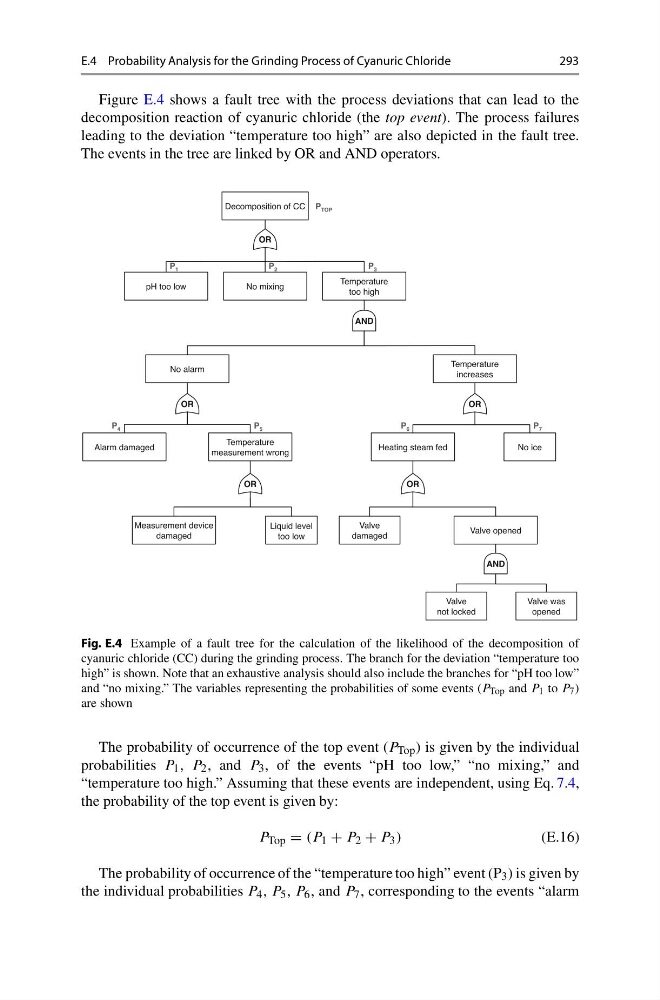
Figure E.4 shows a fault tree with the process deviations that can lead to the
decomposition reaction of cyanuric chloride (the top event). The process failures
leading to the deviation “temperature too high” are also depicted in the fault tree.
The events in the tree are linked by OR and AND operators.
Fig. E.4 Example of a fault tree for the calculation of the likelihood of the decomposition of
cyanuric chloride (CC) during the grinding process. The branch for the deviation “temperature too
high” is shown. Note that an exhaustive analysis should also include the branches for “pH too low”
and “no mixing.” The variables representing the probabilities of some events (P Top and P 1 to P 7 )
are shown
The probability of occurrence of the top event (P Top ) is given by the individual
probabilities P 1 , P 2 , and P 3 , of the events “pH too low,” “no mixing,” and
“temperature too high.” Assuming that these events are independent, using Eq. 7.4,
the probability of the top event is given by:
P Top = (P 1 + P 2 + P 3 )
(E.16)
The probability of occurrence of the “temperature too high” event (P 3 ) is given by
the individual probabilities P 4 , P 5 , P 6 , and P 7 , corresponding to the events “alarm
293
Figure E.4 shows a fault tree with the process deviations that can lead to the
decomposition reaction of cyanuric chloride (the top event). The process failures
leading to the deviation “temperature too high” are also depicted in the fault tree.
The events in the tree are linked by OR and AND operators.
Fig. E.4 Example of a fault tree for the calculation of the likelihood of the decomposition of
cyanuric chloride (CC) during the grinding process. The branch for the deviation “temperature too
high” is shown. Note that an exhaustive analysis should also include the branches for “pH too low”
and “no mixing.” The variables representing the probabilities of some events (P Top and P 1 to P 7 )
are shown
The probability of occurrence of the top event (P Top ) is given by the individual
probabilities P 1 , P 2 , and P 3 , of the events “pH too low,” “no mixing,” and
“temperature too high.” Assuming that these events are independent, using Eq. 7.4,
the probability of the top event is given by:
P Top = (P 1 + P 2 + P 3 )
(E.16)
The probability of occurrence of the “temperature too high” event (P 3 ) is given by
the individual probabilities P 4 , P 5 , P 6 , and P 7 , corresponding to the events “alarm