

C.4 Risk Management of Fire and Explosion Hazards
277
separation), e.g., in the stirring, pouring, and spraying of liquids and in the
comminution 3 and mixing of solids.
To avoid accumulating electrostatic charges, ensure that all equipment parts
are grounded. Areas that are at risk of explosion due to the presence of gases,
vapors, or dust should be protected from ignition sources, and ignition by hot
surfaces should be avoided through the specification of temperature classes for
processing equipment (see Table C.4).
5. Constructing Explosion Protection
This approach attempts to limit the effects of explosions to a manageable level,
for example, by using:
• Explosion-proof construction methods providing building structures with the
strength to handle the maximum explosion pressure
• Explosion pressure relief systems that allow for pressure from an explosion to
be released safely
• Explosion suppression systems that inject a suppressant into the affected
equipment when an explosion is detected. The suppressant absorbs the heat
from the explosion, thus stopping it.
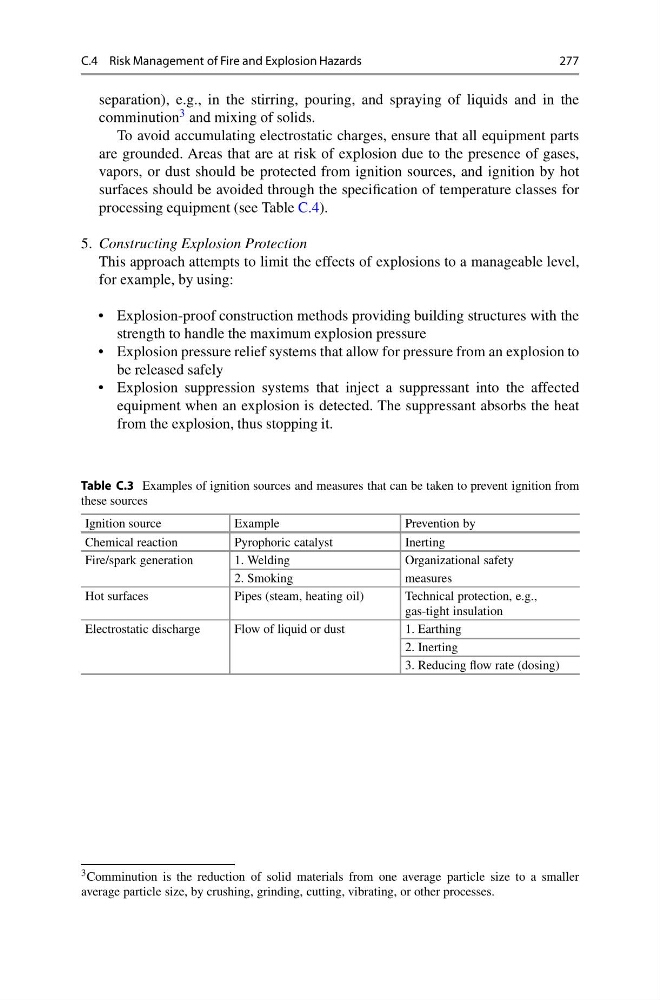
Table C.3 Examples of ignition sources and measures that can be taken to prevent ignition from
these sources
Ignition source
Example
Prevention by
Chemical reaction
Pyrophoric catalyst
Inerting
Fire/spark generation
1. Welding
Organizational safety
2. Smoking
measures
Hot surfaces
Pipes (steam, heating oil)
Technical protection, e.g.,
gas-tight insulation
Electrostatic discharge
Flow of liquid or dust
1. Earthing
2. Inerting
3. Reducing flow rate (dosing)
3 Comminution is the reduction of solid materials from one average particle size to a smaller
average particle size, by crushing, grinding, cutting, vibrating, or other processes.
277
separation), e.g., in the stirring, pouring, and spraying of liquids and in the
comminution 3 and mixing of solids.
To avoid accumulating electrostatic charges, ensure that all equipment parts
are grounded. Areas that are at risk of explosion due to the presence of gases,
vapors, or dust should be protected from ignition sources, and ignition by hot
surfaces should be avoided through the specification of temperature classes for
processing equipment (see Table C.4).
5. Constructing Explosion Protection
This approach attempts to limit the effects of explosions to a manageable level,
for example, by using:
• Explosion-proof construction methods providing building structures with the
strength to handle the maximum explosion pressure
• Explosion pressure relief systems that allow for pressure from an explosion to
be released safely
• Explosion suppression systems that inject a suppressant into the affected
equipment when an explosion is detected. The suppressant absorbs the heat
from the explosion, thus stopping it.
Table C.3 Examples of ignition sources and measures that can be taken to prevent ignition from
these sources
Ignition source
Example
Prevention by
Chemical reaction
Pyrophoric catalyst
Inerting
Fire/spark generation
1. Welding
Organizational safety
2. Smoking
measures
Hot surfaces
Pipes (steam, heating oil)
Technical protection, e.g.,
gas-tight insulation
Electrostatic discharge
Flow of liquid or dust
1. Earthing
2. Inerting
3. Reducing flow rate (dosing)
3 Comminution is the reduction of solid materials from one average particle size to a smaller
average particle size, by crushing, grinding, cutting, vibrating, or other processes.