

272
C Fires and Explosions
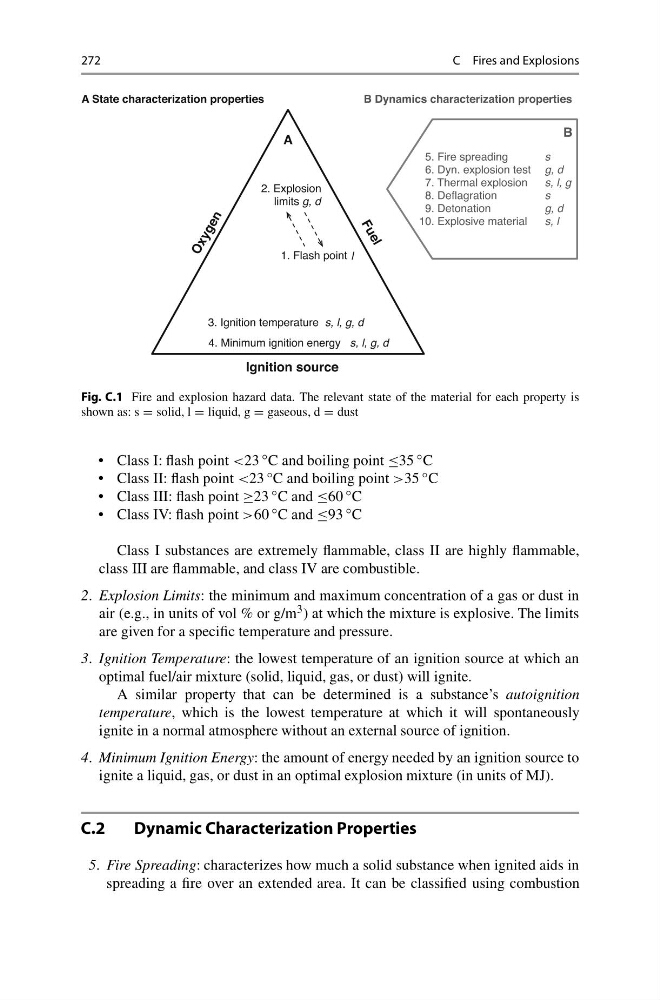
Fig. C.1 Fire and explosion hazard data. The relevant state of the material for each property is
shown as: s = solid, l = liquid, g = gaseous, d = dust
• Class I: flash point <23 ◦ C and boiling point ≤35 ◦ C
• Class II: flash point <23 ◦ C and boiling point >35 ◦ C
• Class III: flash point ≥23 ◦ C and ≤60 ◦ C
• Class IV: flash point >60 ◦ C and ≤93 ◦ C
Class I substances are extremely flammable, class II are highly flammable,
class III are flammable, and class IV are combustible.
2. Explosion Limits: the minimum and maximum concentration of a gas or dust in
air (e.g., in units of vol % or g/m 3 ) at which the mixture is explosive. The limits
are given for a specific temperature and pressure.
3. Ignition Temperature: the lowest temperature of an ignition source at which an
optimal fuel/air mixture (solid, liquid, gas, or dust) will ignite.
A similar property that can be determined is a substance’s autoignition
temperature, which is the lowest temperature at which it will spontaneously
ignite in a normal atmosphere without an external source of ignition.
4. Minimum Ignition Energy: the amount of energy needed by an ignition source to
ignite a liquid, gas, or dust in an optimal explosion mixture (in units of MJ).
C.2
Dynamic Characterization Properties
5. Fire Spreading: characterizes how much a solid substance when ignited aids in
spreading a fire over an extended area. It can be classified using combustion
C Fires and Explosions
Fig. C.1 Fire and explosion hazard data. The relevant state of the material for each property is
shown as: s = solid, l = liquid, g = gaseous, d = dust
• Class I: flash point <23 ◦ C and boiling point ≤35 ◦ C
• Class II: flash point <23 ◦ C and boiling point >35 ◦ C
• Class III: flash point ≥23 ◦ C and ≤60 ◦ C
• Class IV: flash point >60 ◦ C and ≤93 ◦ C
Class I substances are extremely flammable, class II are highly flammable,
class III are flammable, and class IV are combustible.
2. Explosion Limits: the minimum and maximum concentration of a gas or dust in
air (e.g., in units of vol % or g/m 3 ) at which the mixture is explosive. The limits
are given for a specific temperature and pressure.
3. Ignition Temperature: the lowest temperature of an ignition source at which an
optimal fuel/air mixture (solid, liquid, gas, or dust) will ignite.
A similar property that can be determined is a substance’s autoignition
temperature, which is the lowest temperature at which it will spontaneously
ignite in a normal atmosphere without an external source of ignition.
4. Minimum Ignition Energy: the amount of energy needed by an ignition source to
ignite a liquid, gas, or dust in an optimal explosion mixture (in units of MJ).
C.2
Dynamic Characterization Properties
5. Fire Spreading: characterizes how much a solid substance when ignited aids in
spreading a fire over an extended area. It can be classified using combustion