

268
B Environmental Distribution and Exposure
B.2.2 Hydrolysis
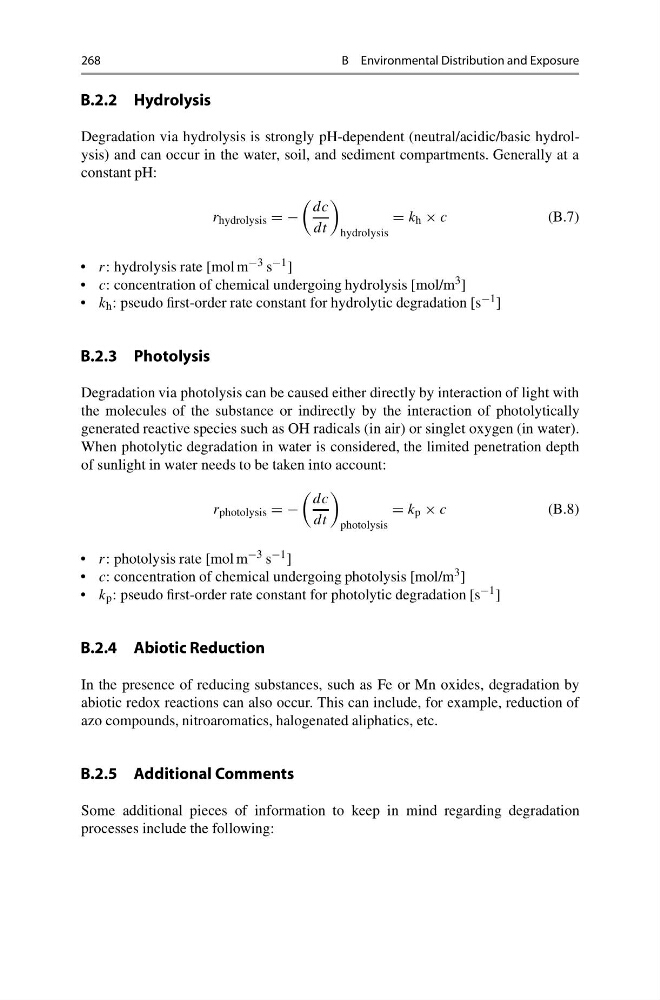
Degradation via hydrolysis is strongly pH-dependent (neutral/acidic/basic hydrolysis) and can occur in the water, soil, and sediment compartments. Generally at a
constant pH:
r hydrolysis = −
dc
dt
hydrolysis
= k h × c
(B.7)
• r: hydrolysis rate [mol m −3 s −1 ]
• c: concentration of chemical undergoing hydrolysis [mol/m 3 ]
• k h : pseudo first-order rate constant for hydrolytic degradation [s −1 ]
B.2.3 Photolysis
Degradation via photolysis can be caused either directly by interaction of light with
the molecules of the substance or indirectly by the interaction of photolytically
generated reactive species such as OH radicals (in air) or singlet oxygen (in water).
When photolytic degradation in water is considered, the limited penetration depth
of sunlight in water needs to be taken into account:
r photolysis = −
dc
dt
photolysis
= k p × c
(B.8)
• r: photolysis rate [mol m −3 s −1 ]
• c: concentration of chemical undergoing photolysis [mol/m 3 ]
• k p : pseudo first-order rate constant for photolytic degradation [s −1 ]
B.2.4 Abiotic Reduction
In the presence of reducing substances, such as Fe or Mn oxides, degradation by
abiotic redox reactions can also occur. This can include, for example, reduction of
azo compounds, nitroaromatics, halogenated aliphatics, etc.
B.2.5 Additional Comments
Some additional pieces of information to keep in mind regarding degradation
processes include the following:
B Environmental Distribution and Exposure
B.2.2 Hydrolysis
Degradation via hydrolysis is strongly pH-dependent (neutral/acidic/basic hydrolysis) and can occur in the water, soil, and sediment compartments. Generally at a
constant pH:
r hydrolysis = −
dc
dt
hydrolysis
= k h × c
(B.7)
• r: hydrolysis rate [mol m −3 s −1 ]
• c: concentration of chemical undergoing hydrolysis [mol/m 3 ]
• k h : pseudo first-order rate constant for hydrolytic degradation [s −1 ]
B.2.3 Photolysis
Degradation via photolysis can be caused either directly by interaction of light with
the molecules of the substance or indirectly by the interaction of photolytically
generated reactive species such as OH radicals (in air) or singlet oxygen (in water).
When photolytic degradation in water is considered, the limited penetration depth
of sunlight in water needs to be taken into account:
r photolysis = −
dc
dt
photolysis
= k p × c
(B.8)
• r: photolysis rate [mol m −3 s −1 ]
• c: concentration of chemical undergoing photolysis [mol/m 3 ]
• k p : pseudo first-order rate constant for photolytic degradation [s −1 ]
B.2.4 Abiotic Reduction
In the presence of reducing substances, such as Fe or Mn oxides, degradation by
abiotic redox reactions can also occur. This can include, for example, reduction of
azo compounds, nitroaromatics, halogenated aliphatics, etc.
B.2.5 Additional Comments
Some additional pieces of information to keep in mind regarding degradation
processes include the following: