

230
9 Societal Dialogue on Risks and Benefits
• personally apologizing to the affected population regardless of the company’s
legal liability
• providing information on the facts and the planned course of action openly and
in a form understandable to lay persons
Longer-Term
• considering the feelings (possibly fear, anger) of the population during risk
management, e.g., openly communicating and discussing how to improve safety
measures as a result of the accident
• learning from feedback received from the population
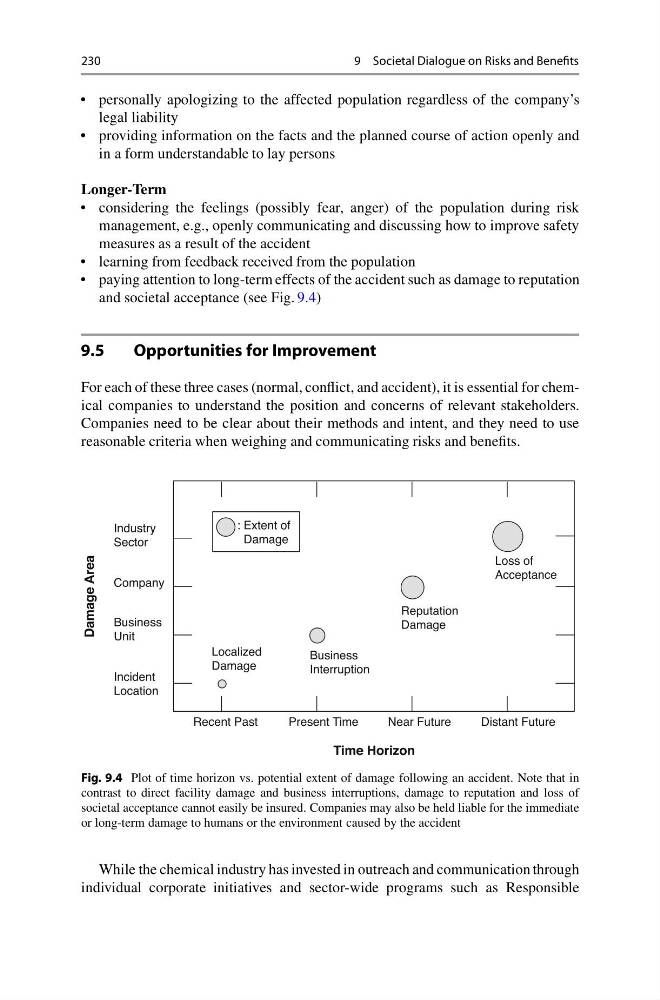
• paying attention to long-term effects of the accident such as damage to reputation
and societal acceptance (see Fig. 9.4)
9.5
Opportunities for Improvement
For each of these three cases (normal, conflict, and accident), it is essential for chemical companies to understand the position and concerns of relevant stakeholders.
Companies need to be clear about their methods and intent, and they need to use
reasonable criteria when weighing and communicating risks and benefits.
Fig. 9.4 Plot of time horizon vs. potential extent of damage following an accident. Note that in
contrast to direct facility damage and business interruptions, damage to reputation and loss of
societal acceptance cannot easily be insured. Companies may also be held liable for the immediate
or long-term damage to humans or the environment caused by the accident
While the chemical industry has invested in outreach and communication through
individual corporate initiatives and sector-wide programs such as Responsible
9 Societal Dialogue on Risks and Benefits
• personally apologizing to the affected population regardless of the company’s
legal liability
• providing information on the facts and the planned course of action openly and
in a form understandable to lay persons
Longer-Term
• considering the feelings (possibly fear, anger) of the population during risk
management, e.g., openly communicating and discussing how to improve safety
measures as a result of the accident
• learning from feedback received from the population
• paying attention to long-term effects of the accident such as damage to reputation
and societal acceptance (see Fig. 9.4)
9.5
Opportunities for Improvement
For each of these three cases (normal, conflict, and accident), it is essential for chemical companies to understand the position and concerns of relevant stakeholders.
Companies need to be clear about their methods and intent, and they need to use
reasonable criteria when weighing and communicating risks and benefits.
Fig. 9.4 Plot of time horizon vs. potential extent of damage following an accident. Note that in
contrast to direct facility damage and business interruptions, damage to reputation and loss of
societal acceptance cannot easily be insured. Companies may also be held liable for the immediate
or long-term damage to humans or the environment caused by the accident
While the chemical industry has invested in outreach and communication through
individual corporate initiatives and sector-wide programs such as Responsible