

8.3 Assessing Thermal Risks
209
• Adiabatic reaction conditions: upon cooling system failure, the heat transfer is
severely limited. As an adiabatic system is independent of technical operating
parameters, it can, therefore, be easily represented in a model.
• Batch reaction: unconverted reactants are present at the time of the cooling
failure.
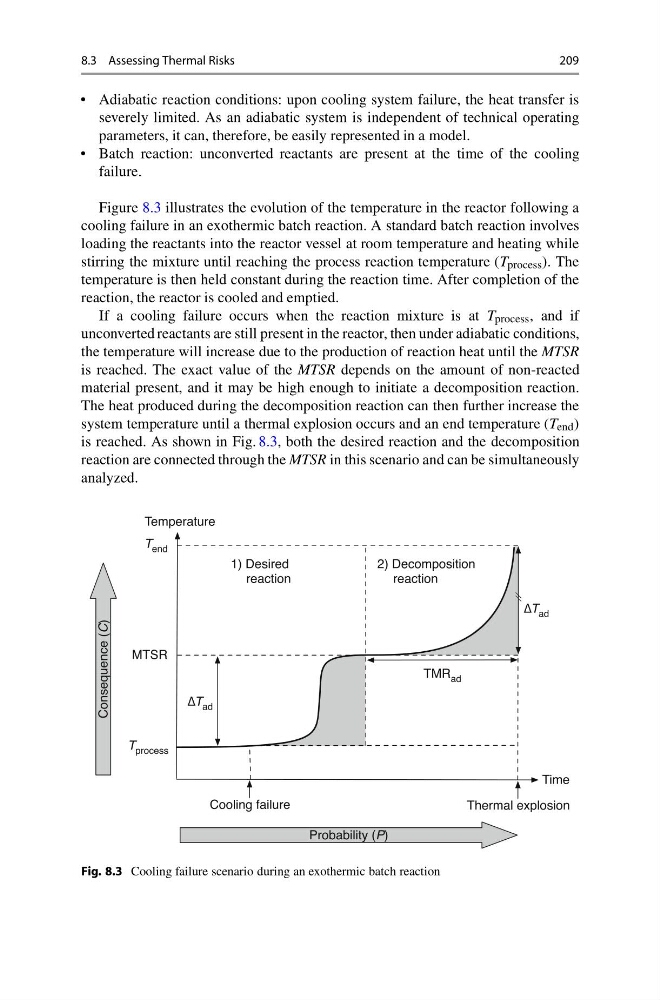
Figure 8.3 illustrates the evolution of the temperature in the reactor following a
cooling failure in an exothermic batch reaction. A standard batch reaction involves
loading the reactants into the reactor vessel at room temperature and heating while
stirring the mixture until reaching the process reaction temperature (T process ). The
temperature is then held constant during the reaction time. After completion of the
reaction, the reactor is cooled and emptied.
If a cooling failure occurs when the reaction mixture is at T process , and if
unconverted reactants are still present in the reactor, then under adiabatic conditions,
the temperature will increase due to the production of reaction heat until the MTSR
is reached. The exact value of the MTSR depends on the amount of non-reacted
material present, and it may be high enough to initiate a decomposition reaction.
The heat produced during the decomposition reaction can then further increase the
system temperature until a thermal explosion occurs and an end temperature (T end )
is reached. As shown in Fig. 8.3, both the desired reaction and the decomposition
reaction are connected through the MTSR in this scenario and can be simultaneously
analyzed.
Fig. 8.3 Cooling failure scenario during an exothermic batch reaction
209
• Adiabatic reaction conditions: upon cooling system failure, the heat transfer is
severely limited. As an adiabatic system is independent of technical operating
parameters, it can, therefore, be easily represented in a model.
• Batch reaction: unconverted reactants are present at the time of the cooling
failure.
Figure 8.3 illustrates the evolution of the temperature in the reactor following a
cooling failure in an exothermic batch reaction. A standard batch reaction involves
loading the reactants into the reactor vessel at room temperature and heating while
stirring the mixture until reaching the process reaction temperature (T process ). The
temperature is then held constant during the reaction time. After completion of the
reaction, the reactor is cooled and emptied.
If a cooling failure occurs when the reaction mixture is at T process , and if
unconverted reactants are still present in the reactor, then under adiabatic conditions,
the temperature will increase due to the production of reaction heat until the MTSR
is reached. The exact value of the MTSR depends on the amount of non-reacted
material present, and it may be high enough to initiate a decomposition reaction.
The heat produced during the decomposition reaction can then further increase the
system temperature until a thermal explosion occurs and an end temperature (T end )
is reached. As shown in Fig. 8.3, both the desired reaction and the decomposition
reaction are connected through the MTSR in this scenario and can be simultaneously
analyzed.
Fig. 8.3 Cooling failure scenario during an exothermic batch reaction