

194
7 Risk Assessment and Management of Chemical Processes
This result shows that dangerous concentrations of HCl will travel more than
1 km from the emission source, which is outside of the working area and into
the surrounding community. Considering this and the toxicity of HCl, the effect
on people is determined as being “high.” For the thermal explosion, the effects on
people and property are also classified as “high.”
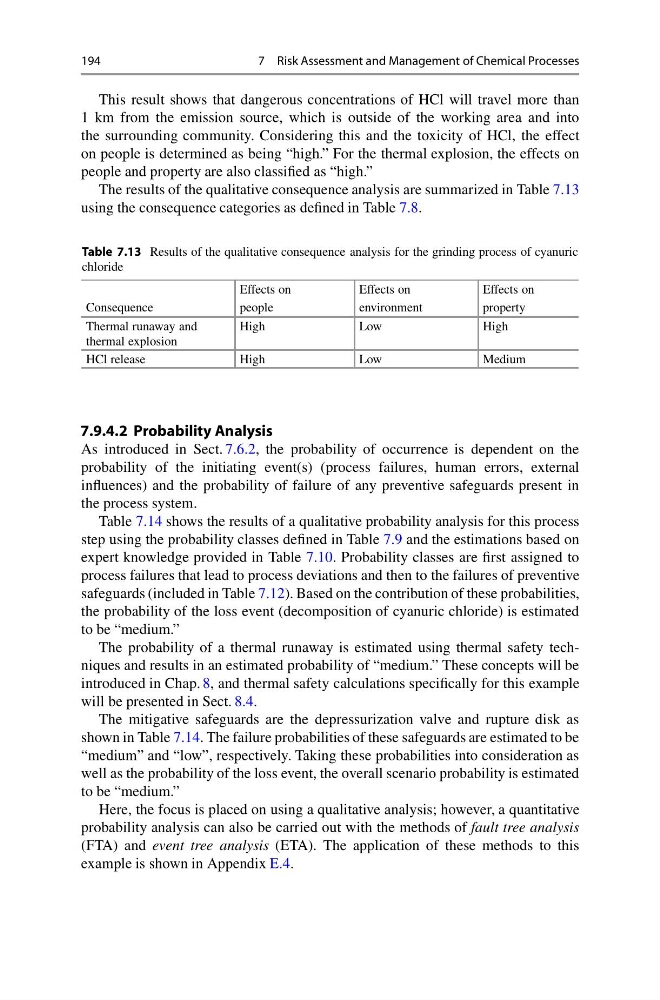
The results of the qualitative consequence analysis are summarized in Table 7.13
using the consequence categories as defined in Table 7.8.
Table 7.13 Results of the qualitative consequence analysis for the grinding process of cyanuric
chloride
Effects on
Effects on
Effects on
Consequence
people
environment
property
Thermal runaway and
thermal explosion
High
Low
High
HCl release
High
Low
Medium
7.9.4.2 Probability Analysis
As introduced in Sect. 7.6.2, the probability of occurrence is dependent on the
probability of the initiating event(s) (process failures, human errors, external
influences) and the probability of failure of any preventive safeguards present in
the process system.
Table 7.14 shows the results of a qualitative probability analysis for this process
step using the probability classes defined in Table 7.9 and the estimations based on
expert knowledge provided in Table 7.10. Probability classes are first assigned to
process failures that lead to process deviations and then to the failures of preventive
safeguards (included in Table 7.12). Based on the contribution of these probabilities,
the probability of the loss event (decomposition of cyanuric chloride) is estimated
to be “medium.”
The probability of a thermal runaway is estimated using thermal safety techniques and results in an estimated probability of “medium.” These concepts will be
introduced in Chap. 8, and thermal safety calculations specifically for this example
will be presented in Sect. 8.4.
The mitigative safeguards are the depressurization valve and rupture disk as
shown in Table 7.14. The failure probabilities of these safeguards are estimated to be
“medium” and “low”, respectively. Taking these probabilities into consideration as
well as the probability of the loss event, the overall scenario probability is estimated
to be “medium.”
Here, the focus is placed on using a qualitative analysis; however, a quantitative
probability analysis can also be carried out with the methods of fault tree analysis
(FTA) and event tree analysis (ETA). The application of these methods to this
example is shown in Appendix E.4.
7 Risk Assessment and Management of Chemical Processes
This result shows that dangerous concentrations of HCl will travel more than
1 km from the emission source, which is outside of the working area and into
the surrounding community. Considering this and the toxicity of HCl, the effect
on people is determined as being “high.” For the thermal explosion, the effects on
people and property are also classified as “high.”
The results of the qualitative consequence analysis are summarized in Table 7.13
using the consequence categories as defined in Table 7.8.
Table 7.13 Results of the qualitative consequence analysis for the grinding process of cyanuric
chloride
Effects on
Effects on
Effects on
Consequence
people
environment
property
Thermal runaway and
thermal explosion
High
Low
High
HCl release
High
Low
Medium
7.9.4.2 Probability Analysis
As introduced in Sect. 7.6.2, the probability of occurrence is dependent on the
probability of the initiating event(s) (process failures, human errors, external
influences) and the probability of failure of any preventive safeguards present in
the process system.
Table 7.14 shows the results of a qualitative probability analysis for this process
step using the probability classes defined in Table 7.9 and the estimations based on
expert knowledge provided in Table 7.10. Probability classes are first assigned to
process failures that lead to process deviations and then to the failures of preventive
safeguards (included in Table 7.12). Based on the contribution of these probabilities,
the probability of the loss event (decomposition of cyanuric chloride) is estimated
to be “medium.”
The probability of a thermal runaway is estimated using thermal safety techniques and results in an estimated probability of “medium.” These concepts will be
introduced in Chap. 8, and thermal safety calculations specifically for this example
will be presented in Sect. 8.4.
The mitigative safeguards are the depressurization valve and rupture disk as
shown in Table 7.14. The failure probabilities of these safeguards are estimated to be
“medium” and “low”, respectively. Taking these probabilities into consideration as
well as the probability of the loss event, the overall scenario probability is estimated
to be “medium.”
Here, the focus is placed on using a qualitative analysis; however, a quantitative
probability analysis can also be carried out with the methods of fault tree analysis
(FTA) and event tree analysis (ETA). The application of these methods to this
example is shown in Appendix E.4.