

160
7 Risk Assessment and Management of Chemical Processes
reviews. All identified process risks should be assessed and reduced to an acceptable
level following societal values, protection goals, and considering costs.
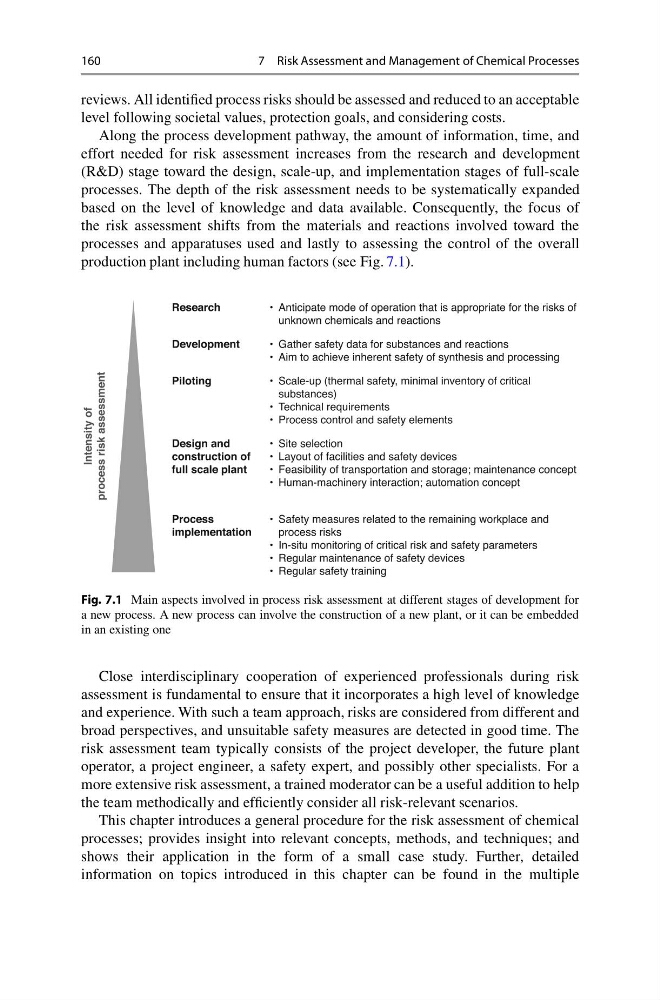
Along the process development pathway, the amount of information, time, and
effort needed for risk assessment increases from the research and development
(R&D) stage toward the design, scale-up, and implementation stages of full-scale
processes. The depth of the risk assessment needs to be systematically expanded
based on the level of knowledge and data available. Consequently, the focus of
the risk assessment shifts from the materials and reactions involved toward the
processes and apparatuses used and lastly to assessing the control of the overall
production plant including human factors (see Fig. 7.1).
Fig. 7.1 Main aspects involved in process risk assessment at different stages of development for
a new process. A new process can involve the construction of a new plant, or it can be embedded
in an existing one
Close interdisciplinary cooperation of experienced professionals during risk
assessment is fundamental to ensure that it incorporates a high level of knowledge
and experience. With such a team approach, risks are considered from different and
broad perspectives, and unsuitable safety measures are detected in good time. The
risk assessment team typically consists of the project developer, the future plant
operator, a project engineer, a safety expert, and possibly other specialists. For a
more extensive risk assessment, a trained moderator can be a useful addition to help
the team methodically and efficiently consider all risk-relevant scenarios.
This chapter introduces a general procedure for the risk assessment of chemical
processes; provides insight into relevant concepts, methods, and techniques; and
shows their application in the form of a small case study. Further, detailed
information on topics introduced in this chapter can be found in the multiple
7 Risk Assessment and Management of Chemical Processes
reviews. All identified process risks should be assessed and reduced to an acceptable
level following societal values, protection goals, and considering costs.
Along the process development pathway, the amount of information, time, and
effort needed for risk assessment increases from the research and development
(R&D) stage toward the design, scale-up, and implementation stages of full-scale
processes. The depth of the risk assessment needs to be systematically expanded
based on the level of knowledge and data available. Consequently, the focus of
the risk assessment shifts from the materials and reactions involved toward the
processes and apparatuses used and lastly to assessing the control of the overall
production plant including human factors (see Fig. 7.1).
Fig. 7.1 Main aspects involved in process risk assessment at different stages of development for
a new process. A new process can involve the construction of a new plant, or it can be embedded
in an existing one
Close interdisciplinary cooperation of experienced professionals during risk
assessment is fundamental to ensure that it incorporates a high level of knowledge
and experience. With such a team approach, risks are considered from different and
broad perspectives, and unsuitable safety measures are detected in good time. The
risk assessment team typically consists of the project developer, the future plant
operator, a project engineer, a safety expert, and possibly other specialists. For a
more extensive risk assessment, a trained moderator can be a useful addition to help
the team methodically and efficiently consider all risk-relevant scenarios.
This chapter introduces a general procedure for the risk assessment of chemical
processes; provides insight into relevant concepts, methods, and techniques; and
shows their application in the form of a small case study. Further, detailed
information on topics introduced in this chapter can be found in the multiple